RankRizz

Rotational Motion — JEE Advanced Previous Year Questions

Every Rotational Motion question JEE Advanced has set from 2007–2026, grouped by the idea it tests rather than the order of the syllabus. 64 questions across 5 distinct ideas. Free to read, answer key on every one.

Questions

64

Distinct ideas

5

Share of marks

9.1%

Difficulty

HARD

The ideas inside Rotational Motion

A chapter is not one subject — it is a handful of procedures the examiner reuses. These are the ones Rotational Motion questions actually test.

01Moment of inertia of standard bodies and composite systemsset 6×
02Parallel and perpendicular axis theoremsNot set in Advanced
03Torque and the rotational form of Newton's second lawset 1×
04Fixed-axis rotation: kinematics, rotational energy and pulleysNot set in Advanced
05Equilibrium of rigid bodies and topplingset 9×
06Angular momentum of particles and rigid bodiesset 16×
07Conservation of angular momentumNot set in Advanced
08Rolling without slipping: kinematics and energyNot set in Advanced
09Rolling with friction, slipping and impulsive forcesset 32×
10Collisions involving rigid bodiesNot set in Advanced

Rotational Motion weightage, year by year

The share of each year’s Physics questions that came from Rotational Motion, counted from the 19 papers we hold for the last 10 years, and paper by paper inside a year.

Falling: 7.0% of Physics questions in 2024–2026, down from 10.3% in 2017–2023. Its heaviest year was 2018, at 22.2%. Not asked at all in 2025.

20265 / 3414.7%PAPER 1 18.8%PAPER 2 11.1%
20250 / 320.0%PAPER 1 0.0%PAPER 2 0.0%
20242 / 345.9%PAPER 1 11.8%PAPER 2 0.0%
20234 / 3411.8%PAPER 1 11.8%PAPER 2 11.8%
20223 / 368.3%PAPER 1 11.1%PAPER 2 5.6%
20214 / 3810.5%PAPER 1 15.8%PAPER 2 5.3%
20203 / 368.3%PAPER 1 11.1%PAPER 2 5.6%
20191 / 362.8%PAPER 1 0.0%PAPER 2 5.6%
20184 / 1822.2%1 PAPER
20175 / 3613.9%PAPER 1 0.0%PAPER 2 27.8%

“QS” is Rotational Motion questions out of all Physics questions that year. A year with more sittings asks more questions, which is why the share, not the count, is the number to compare.

Rotational Motion: quick answers

How many Rotational Motion questions has JEE Advanced asked?

64 questions from 2007–2026. Over the last 20 papers, Rotational Motion carried about 9.1% of Physics marks.

Which Rotational Motion topics come up most?

Rolling with friction, slipping and impulsive forces (32 questions), Angular momentum of particles and rigid bodies (16 questions), Equilibrium of rigid bodies and toppling (9 questions). Start with these, they are what the examiner keeps coming back to.

Is Rotational Motion important for JEE Advanced?

Falling: 7.0% of Physics questions in 2024–2026, down from 10.3% in 2017–2023. Its heaviest year was 2018, at 22.2%. Not asked at all in 2025. It has carried about 9.1% of Physics marks in recent papers, rated hard on our difficulty scale. The year-by-year table above shows how that has moved.

Do these Rotational Motion PYQs have answers and solutions?

Yes. Every question shows its official answer key, and a worked solution opens on the question’s own page wherever we have one. Reading and checking answers is free, no sign-up needed.

What’s the fastest way to revise Rotational Motion?

Do one past question per idea first: Rotational Motion has 5 distinct ideas, listed above. Then practise the topics you get wrong, or build a timed test from this chapter.

Every Rotational Motion question

1–20 OF 64 · NEWEST FIRST

JEE ADVANCED 2026 · PAPER 1Rolling with friction, slipping and impulsive forcesTRANSCRIBED

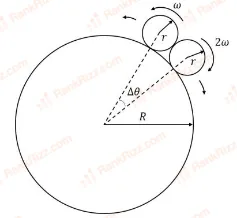
Consider a large disk of radius RR and two smaller disks, each of radius r=R/50r=R/50, lying on its circumference, as shown in the figure. The smaller disks are initially in contact with each other, with an angular separation Δθ\Delta\theta between their centers. They are made to roll without slipping in opposite directions, with constant angular velocities ω\omega and 2ω2\omega while the large disk is held stationary. The time τ\tau at which the smaller disks are again in contact is:

[Use sin⁡(Δθ)=Δθ\sin(\Delta\theta)=\Delta\theta and ignore gravity.]

Figure for JEE Advanced 2026 Physics question on Rolling with friction, slipping and impulsive forces
  1. A

    τ=51×(2π−451)/ω\tau=51\times\left(2\pi-\dfrac{4}{51}\right)/\omega

  2. B

    τ=51×(2π−251)/3ω\tau=51\times\left(2\pi-\dfrac{2}{51}\right)/3\omega

  3. C

    τ=51×(2π−451)/3ω\tau=51\times\left(2\pi-\dfrac{4}{51}\right)/3\omega

  4. D

    τ=51×(2π−251)/ω\tau=51\times\left(2\pi-\dfrac{2}{51}\right)/\omega

JEE ADVANCED 2026 · PAPER 1Rolling with friction, slipping and impulsive forcesTRANSCRIBED

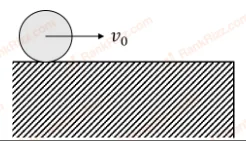
A solid cylinder of radius RR rolls without slipping with a center of mass speed v0=gR3v_0=\sqrt{\dfrac{gR}{3}} on a horizontal surface with a vertical edge, as shown in the figure. Here, gg is the acceleration due to the gravity. At the moment when the cylinder loses contact with the surface due to rotation around the corner, the speed of its center of mass is:

Figure for JEE Advanced 2026 Physics question on Rolling with friction, slipping and impulsive forces
  1. A

    00

  2. B

    5gR7\sqrt{\dfrac{5gR}{7}}

  3. C

    gR15\sqrt{\dfrac{gR}{15}}

  4. D

    3gR7\sqrt{\dfrac{3gR}{7}}

JEE ADVANCED 2026 · PAPER 1Moment of inertia of standard bodies and composite systemsTRANSCRIBED

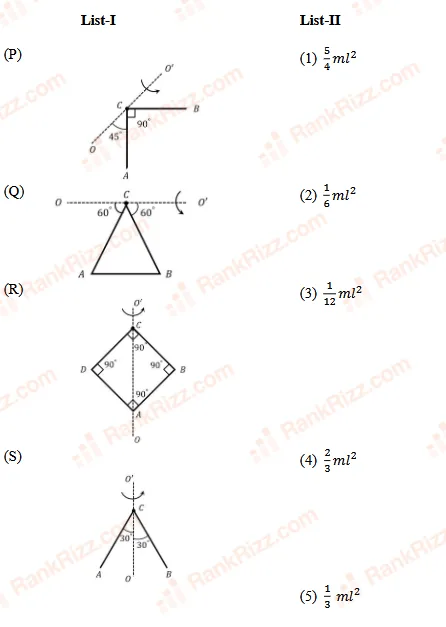
List-I shows four planar structures made of uniform solid rods each of mass mm and length ll. In the List-II the possible moment of inertia of these structures about an axis OCO′OCO', which lies in the plane of the structures, are given. Choose the option that describes the correct match between the entries in List-I to those in List-II.

Figure for JEE Advanced 2026 Physics question on Moment of inertia of standard bodies and composite systems
  1. A

    (P)→\to(5), (Q)→\to(1), (R)→\to(4), (S)→\to(2)

  2. B

    (P)→\to(1), (Q)→\to(3), (R)→\to(4), (S)→\to(2)

  3. C

    (P)→\to(5), (Q)→\to(3), (R)→\to(2), (S)→\to(1)

  4. D

    (P)→\to(5), (Q)→\to(4), (R)→\to(2), (S)→\to(1)

JEE ADVANCED 2026 · PAPER 2Rolling with friction, slipping and impulsive forcesTRANSCRIBED

Question Stem for Question Nos. 17 and 18

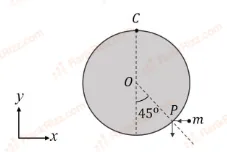
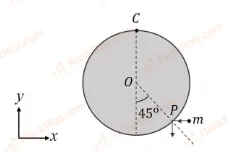
A uniform circular disk of radius 0.2 m0.2\,\mathrm{m} and mass 1 kg1\,\mathrm{kg} is pivoted at its top point CC such that it can rotate freely around CC in the XYXY plane, as shown in the figure. Initially, when the disk is at rest, a particle of mass 20 g20\,\mathrm{g}, travelling along negative xx direction in the XYXY plane with speed 100 ms−1100\,\mathrm{ms^{-1}}, hits the circumference of the disk at a point PP. After collision the particle moves along negative yy direction at a speed of 90 ms−190\,\mathrm{ms^{-1}}.

[Given: the acceleration due to gravity (g)=−10j^ ms−2(g)=-10\hat{j}\,\mathrm{ms^{-2}}]

Figure for JEE Advanced 2026 Physics question on Rolling with friction, slipping and impulsive forces

After the collision the disk starts to rotate around point CC in the XYXY plane. The maximum change in the height (in m) of its center OO is:

JEE ADVANCED 2026 · PAPER 2Angular momentum of particles and rigid bodiesTRANSCRIBED

Question Stem for Question Nos. 17 and 18

A uniform circular disk of radius 0.2 m0.2\,\mathrm{m} and mass 1 kg1\,\mathrm{kg} is pivoted at its top point CC such that it can rotate freely around CC in the XYXY plane, as shown in the figure. Initially, when the disk is at rest, a particle of mass 20 g20\,\mathrm{g}, travelling along negative xx direction in the XYXY plane with speed 100 ms−1100\,\mathrm{ms^{-1}}, hits the circumference of the disk at a point PP. After collision the particle moves along negative yy direction at a speed of 90 ms−190\,\mathrm{ms^{-1}}.

[Given: the acceleration due to gravity (g)=−10j^ ms−2(g)=-10\hat{j}\,\mathrm{ms^{-2}}]

Figure for JEE Advanced 2026 Physics question on Angular momentum of particles and rigid bodies

Amount of energy loss (in J) in the collision is:

JEE ADVANCED 2024 · PAPER 1Angular momentum of particles and rigid bodiesTRANSCRIBED

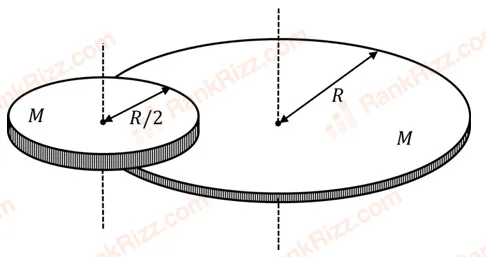
A disc of mass MM and radius RR is free to rotate about its vertical axis as shown in the figure. A battery operated motor of negligible mass is fixed to this disc at a point on its circumference. Another disc of the same mass MM and radius R/2R/2 is fixed to the motor's thin shaft. Initially, both the discs are at rest. The motor is switched on so that the smaller disc rotates at a uniform angular speed ω\omega. If the angular speed at which the large disc rotates is ω/n\omega/n, then the value of nn is ______.

Figure for JEE Advanced 2024 Physics question on Angular momentum of particles and rigid bodies
JEE ADVANCED 2024 · PAPER 1Angular momentum of particles and rigid bodiesTRANSCRIBED

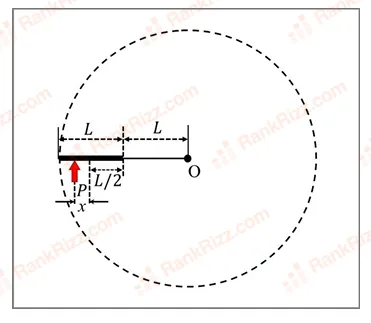
A thin uniform rod of length LL and certain mass is kept on a frictionless horizontal table with a massless string of length LL fixed to one end (top view is shown in the figure). The other end of the string is pivoted to a point OO. If a horizontal impulse PP is imparted to the rod at a distance x=L/nx = L/n from the mid-point of the rod (see figure), then the rod and string revolve together around the point OO, with the rod remaining aligned with the string. In such a case, the value of nn is ______.

Figure for JEE Advanced 2024 Physics question on Angular momentum of particles and rigid bodies
JEE ADVANCED 2023 · PAPER 1Moment of inertia of standard bodies and composite systemsTRANSCRIBED

A bar of mass M=1.00M = 1.00 kg and length L=0.20L = 0.20 m is lying on a horizontal frictionless surface. One end of the bar is pivoted at a point about which it is free to rotate. A small mass m=0.10m = 0.10 kg is moving on the same horizontal surface with 5.00 m s−1^{-1} speed on a path perpendicular to the bar. It hits the bar at a distance L/2L/2 from the pivoted end and returns back on the same path with speed v. After this elastic collision, the bar rotates with an angular velocity ω\omega. Which of the following statement is correct?

  1. A

    ω=6.98\omega = 6.98 rad s−1^{-1} and v = 4.30 m s−1^{-1}

  2. B

    ω=3.75\omega = 3.75 rad s−1^{-1} and v = 4.30 m s−1^{-1}

  3. C

    ω=3.75\omega = 3.75 rad s−1^{-1} and v = 10.0 m s−1^{-1}

  4. D

    ω=6.80\omega = 6.80 rad s−1^{-1} and v = 4.10 m s−1^{-1}

JEE ADVANCED 2023 · PAPER 2Rolling with friction, slipping and impulsive forcesTRANSCRIBED

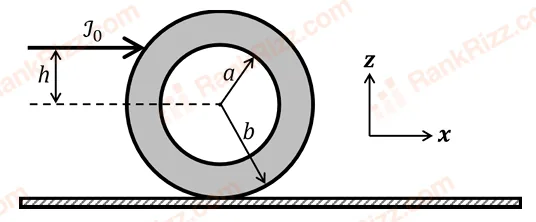
An annular disk of mass MM, inner radius aa and outer radius bb is placed on a horizontal surface with coefficient of friction μ\mu, as shown in the figure. At some time, an impulse J0x^J_0 \hat{x} is applied at a height h above the center of the disk. If h=hmh = h_m then the disk rolls without slipping along the x-axis. Which of the following statement(s) is(are) correct?

Figure for JEE Advanced 2023 Physics question on Rolling with friction, slipping and impulsive forces
  1. A

    For μ≠0\mu \neq 0 and a→0a \to 0, hm=b/2h_m = b/2

  2. B

    For μ≠0\mu \neq 0 and a→ba \to b, hm=bh_m = b

  3. C

    For h=hmh = h_m, the initial angular velocity does not depend on the inner radius aa.

  4. D

    For μ=0\mu = 0 and h=0h = 0, the wheel always slides without rolling.

JEE ADVANCED 2023 · PAPER 2Rolling with friction, slipping and impulsive forcesTRANSCRIBED

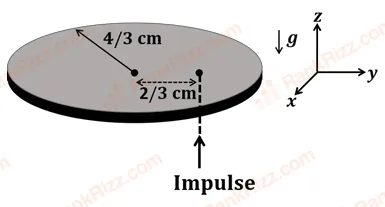
A thin circular coin of mass 5 gm and radius 4/3 cm is initially in a horizontal xyxy-plane. The coin is tossed vertically up (+z direction) by applying an impulse of π2×10⁻²\sqrt{\frac{\pi}{2}} \times 10^{-2} N-s at a distance 2/3 cm from its center. The coin spins about its diameter and moves along the +z direction. By the time the coin reaches back to its initial position, it completes nn rotations. The value of nn is ____.

[Given: The acceleration due to gravity g=10g = 10 ms−2^{-2}]

Figure for JEE Advanced 2023 Physics question on Rolling with friction, slipping and impulsive forces
JEE ADVANCED 2023 · PAPER 1Torque and the rotational form of Newton's second lawTRANSCRIBED

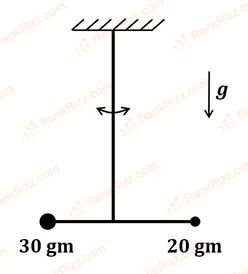
Two point-like objects of masses 20 gm and 30 gm are fixed at the two ends of a rigid massless rod of length 10 cm. This system is suspended vertically from a rigid ceiling using a thin wire attached to its center of mass, as shown in the figure. The resulting torsional pendulum undergoes small oscillations. The torsional constant of the wire is 1.2×10−81.2 \times 10^{-8} N m rad−1^{-1}. The angular frequency of the oscillations in n×10−3n \times 10^{-3} rad s−1^{-1}. The value of nn is ______.

Figure for JEE Advanced 2023 Physics question on Torque and the rotational form of Newton's second law
JEE ADVANCED 2022 · PAPER 1Rolling with friction, slipping and impulsive forcesTRANSCRIBED

At time t=0t = 0, a disk of radius 1 m starts to roll without slipping on a horizontal plane with an angular acceleration of α=23\alpha = \frac{2}{3} rad s−2^{-2}. A small stone is stuck to the disk. At t=0t = 0, it is at the contact point of the disk and the plane. Later, at time t=πt = \sqrt{\pi} s, the stone detaches itself and flies off tangentially from the disk. The maximum height (in m) reached by the stone measured from the plane is 12+x10\frac{1}{2} + \frac{x}{10}. The value of xx is ______. [Take g=10g = 10 m s−2^{-2}.]

JEE ADVANCED 2022 · PAPER 1Rolling with friction, slipping and impulsive forcesTRANSCRIBED

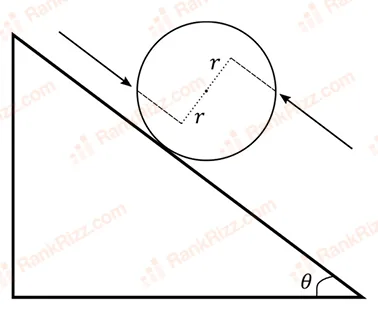
A solid sphere of mass 1 kg and radius 1 m rolls without slipping on a fixed inclined plane with an angle of inclination θ=30∘\theta = 30^\circ from the horizontal. Two forces of magnitude 1 N each, parallel to the incline, act on the sphere, both at distance r=0.5r = 0.5 m from the center of the sphere, as shown in the figure. The acceleration of the sphere down the plane is ______ ms−2^{-2}. (Take g=10g = 10 m s−2^{-2}.)

Figure for JEE Advanced 2022 Physics question on Rolling with friction, slipping and impulsive forces
JEE ADVANCED 2022 · PAPER 2Rolling with friction, slipping and impulsive forcesTRANSCRIBED

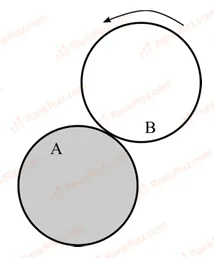
A flat surface of a thin uniform disk A of radius R is glued to a horizontal table. Another thin uniform disk B of mass M and with the same radius R rolls without slipping on the circumference of A, as shown in the figure. A flat surface of B also lies on the plane of the table. The center of mass of B has fixed angular speed ω\omega about the vertical axis passing through the center of A. The angular momentum of B is nMωR2nM\omega R^2 with respect to the center of A. Which of the following is the value of nn?

Figure for JEE Advanced 2022 Physics question on Rolling with friction, slipping and impulsive forces
  1. A

    2

  2. B

    5

  3. C

    72\dfrac{7}{2}

  4. D

    92\dfrac{9}{2}

JEE ADVANCED 2021 · PAPER 2Equilibrium of rigid bodies and topplingTRANSCRIBED

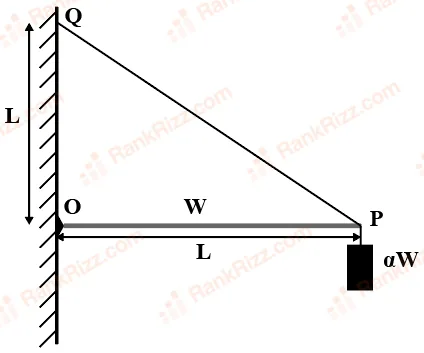
One end of a horizontal uniform beam of weight 𝑊 and length 𝐿 is hinged on a vertical wall at point O and its other end is supported by a light inextensible rope. The other end of the rope is fixed at point Q, at a height 𝐿 above the hinge at point O. A block of weight αW\alpha W is attached at the point P of the beam, as shown in the figure (not to scale). The rope can sustain a maximum tension of (222\sqrt{2})W. Which of the following statement(s) is(are) correct?

Figure for JEE Advanced 2021 Physics question on Equilibrium of rigid bodies and toppling
  1. A

    The vertical component of reaction force at O does not depend on α\alpha

  2. B

    The horizontal component of reaction force at O is equal to 𝑊 for α=0.5\alpha = 0.5

  3. C

    The tension in the rope is 2𝑊 for α=0.5\alpha = 0.5

  4. D

    The rope breaks if α>1.5\alpha > 1.5

JEE ADVANCED 2021 · PAPER 1Rolling with friction, slipping and impulsive forcesTRANSCRIBED

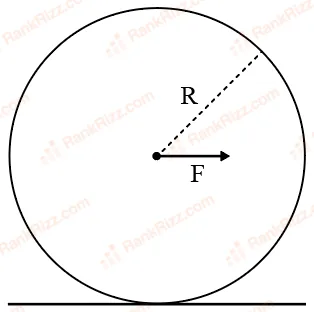
A horizontal force 𝐹 is applied at the center of mass of a cylindrical object of mass 𝑚 and radius 𝑅, perpendicular to its axis as shown in the figure. The coefficient of friction between the object and the ground is μ\mu. The center of mass of the object has an acceleration 𝑎. The acceleration due to gravity is 𝑔. Given that the object rolls without slipping, which of the following statement(s) is(are) correct?

Figure for JEE Advanced 2021 Physics question on Rolling with friction, slipping and impulsive forces
  1. A

    For the same F, the value of 𝑎 does not depend on whether the cylinder is solid or hollow

  2. B

    For a solid cylinder,the maximum possible value of 𝑎 is 2μg2 \mu g

  3. C

    The magnitude of the frictional force on the object due to the ground is always μmg\mu mg

  4. D

    For a thin-walled hollow cylinder, a=F2ma = \frac{F}{2m}

JEE ADVANCED 2021 · PAPER 1Angular momentum of particles and rigid bodiesTRANSCRIBED

A particle of mass M = 0.2 kg is initially at rest in the xy-plane at a point (x = −l, y = −h), where l = 10 m and h = 1 m. The particle is accelerated at time t = 0 with a constant acceleration 𝑎 = 10 m/s2^2 along the positive x-direction. Its angular momentum and torque with respect to the origin, in SI units, are represented by L→\overrightarrow{L} and τ→\overrightarrow{\tau}, respectively. i^,j^\hat{i}, \hat{j} and k^\hat{k} are unit vectors along the positive x, y and z-directions, respectively. If k^=i^×j^\hat{k} = \hat{i} \times \hat{j} then which of the following statement(s) is(are) correct?

  1. A

    The particle arrives at the point (x = l, y = −h) at time t = 2 s

  2. B

    τ^=2k^\hat{\tau} = 2 \hat{k} when the particle passes through the point (x = l, y = −h)

  3. C

    L^=4k^\hat{L} = 4 \hat{k} when the particle passes through the point (x = l, y = −h)

  4. D

    τ^=k^\hat{\tau} = \hat{k} when the particle passes through the point (x = 0, y = −h)

JEE ADVANCED 2021 · PAPER 1Angular momentum of particles and rigid bodiesTRANSCRIBED

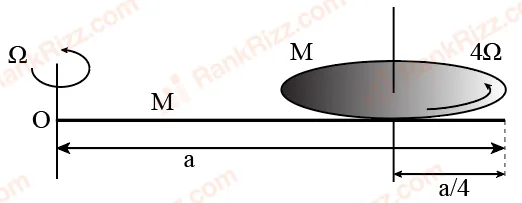
A thin rod of mass M and length 𝑎 is free to rotate in horizontal plane about a fixed vertical axis passing through point O. A thin circular disc of mass M and of radius 𝑎/4 is pivoted on this rod with its center at a distance 𝑎/4 from the free end so that it can rotate freely about its vertical axis, as shown in the figure. Assume that both the rod and the disc have uniform density and they remain horizontal during the motion. An outside stationary observer finds the rod rotating with an angular velocity Ω and the disc rotating about its vertical axis with angular velocity 4Ω. The total angular momentum of the system about the point O is (Ma2Ω48)n\left(\frac{M a^2 Ω}{48}\right)n.
The value of n is .........

Figure for JEE Advanced 2021 Physics question on Angular momentum of particles and rigid bodies
JEE ADVANCED 2020 · PAPER 1Equilibrium of rigid bodies and topplingTRANSCRIBED

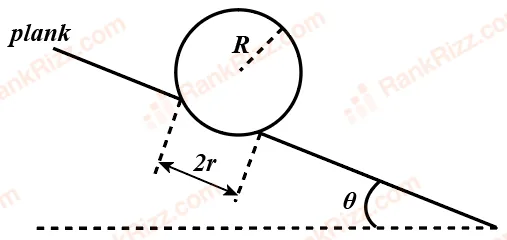
A football of radius R is kept on a hole of radius r (𝑟 < 𝑅) made on a plank kept horizontally. One end of the plank is now lifted so that it gets tilted making an angle 𝜃 from the horizontal as shown in the figure below. The maximum value of θ\theta so that the football does not start rolling down the plank satisfies (figure is schematic and not drawn to scale)

Figure for JEE Advanced 2020 Physics question on Equilibrium of rigid bodies and toppling
  1. A

    sin⁡θ=rR\sin \theta = \frac{r}{R}

  2. B

    tan⁡θ=rR\tan \theta = \frac{r}{R}

  3. C

    sin⁡θ=r2R\sin \theta = \frac{r}{2R}

  4. D

    cos⁡θ=r2R\cos \theta = \frac{r}{2R}

JEE ADVANCED 2020 · PAPER 1Rolling with friction, slipping and impulsive forcesTRANSCRIBED

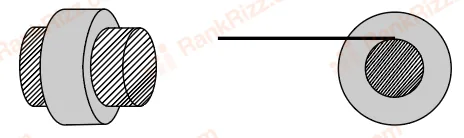
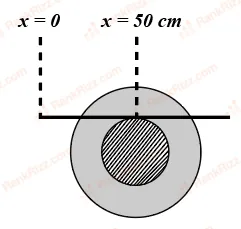
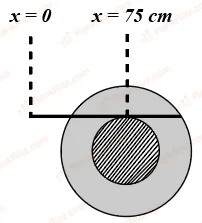
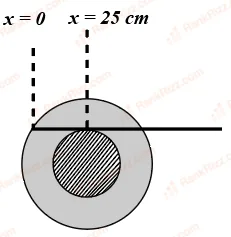
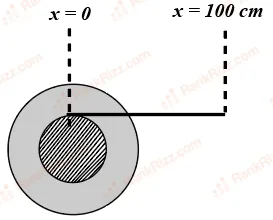
A small roller of diameter 20 cm has an axle of diameter 10 cm (see figure below on the left). It is on a horizontal floor and a meter scale is positioned horizontally on its axle with one edge of the scale on top of the axle (see figure on the right). The scale is now pushed slowly on the axle so that it moves without slipping on the axle, and the roller starts rolling without slipping. After the roller has moved 50 cm, the position of the scale will look like (figures are schematic and not drawn to scale)

Figure for JEE Advanced 2020 Physics question on Rolling with friction, slipping and impulsive forces
  1. A
    Figure for JEE Advanced 2020 Physics question on Rolling with friction, slipping and impulsive forces
  2. B
    Figure for JEE Advanced 2020 Physics question on Rolling with friction, slipping and impulsive forces
  3. C
    Figure for JEE Advanced 2020 Physics question on Rolling with friction, slipping and impulsive forces
  4. D
    Figure for JEE Advanced 2020 Physics question on Rolling with friction, slipping and impulsive forces