RankRizz

Thermodynamics — JEE Advanced Previous Year Questions

Every Thermodynamics question JEE Advanced has set from 2007–2026, grouped by the idea it tests rather than the order of the syllabus. 42 questions across 3 distinct ideas. Free to read, answer key on every one.

Questions

42

Distinct ideas

3

Share of marks

8%

Difficulty

HARD

The ideas inside Thermodynamics

A chapter is not one subject — it is a handful of procedures the examiner reuses. These are the ones Thermodynamics questions actually test.

01Zeroth and first law of thermodynamicsset 5×
02Work done in thermodynamic processes and P-V diagramsNot set in Advanced
03Isothermal and adiabatic processesNot set in Advanced
04Isobaric, isochoric and polytropic processesNot set in Advanced
05Multi-step processes and gas-piston-spring systemsset 34×
06Second law, heat engines, refrigerators and reversibilityNot set in Advanced
07Carnot engine and Carnot cycleset 3×

Thermodynamics weightage, year by year

The share of each year’s Physics questions that came from Thermodynamics, counted from the 19 papers we hold for the last 10 years, and paper by paper inside a year.

Rising: 10.0% of Physics questions in 2024–2026, up from 7.3% in 2017–2023. Its heaviest year was 2025, at 12.5%.

20264 / 3411.8%PAPER 1 18.8%PAPER 2 5.6%
20254 / 3212.5%PAPER 1 6.3%PAPER 2 18.8%
20242 / 345.9%PAPER 1 5.9%PAPER 2 5.9%
20233 / 348.8%PAPER 1 5.9%PAPER 2 11.8%
20222 / 365.6%PAPER 1 5.6%PAPER 2 5.6%
20212 / 385.3%PAPER 1 5.3%PAPER 2 5.3%
20202 / 365.6%PAPER 1 5.6%PAPER 2 5.6%
20194 / 3611.1%PAPER 1 5.6%PAPER 2 16.7%
20181 / 185.6%1 PAPER
20173 / 368.3%PAPER 1 16.7%PAPER 2 0.0%

“QS” is Thermodynamics questions out of all Physics questions that year. A year with more sittings asks more questions, which is why the share, not the count, is the number to compare.

Thermodynamics: quick answers

How many Thermodynamics questions has JEE Advanced asked?

42 questions from 2007–2026. Over the last 20 papers, Thermodynamics carried about 8% of Physics marks.

Which Thermodynamics topics come up most?

Multi-step processes and gas-piston-spring systems (34 questions), Zeroth and first law of thermodynamics (5 questions), Carnot engine and Carnot cycle (3 questions). Start with these, they are what the examiner keeps coming back to.

Is Thermodynamics important for JEE Advanced?

Rising: 10.0% of Physics questions in 2024–2026, up from 7.3% in 2017–2023. Its heaviest year was 2025, at 12.5%. It has carried about 8% of Physics marks in recent papers, rated hard on our difficulty scale. The year-by-year table above shows how that has moved.

Do these Thermodynamics PYQs have answers and solutions?

Yes. Every question shows its official answer key, and a worked solution opens on the question’s own page wherever we have one. Reading and checking answers is free, no sign-up needed.

What’s the fastest way to revise Thermodynamics?

Do one past question per idea first: Thermodynamics has 3 distinct ideas, listed above. Then practise the topics you get wrong, or build a timed test from this chapter.

Every Thermodynamics question

1–20 OF 42 · NEWEST FIRST

JEE ADVANCED 2026 · PAPER 1Multi-step processes and gas-piston-spring systemsTRANSCRIBED

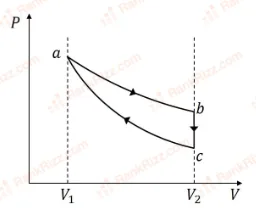
A quasi-static cycle of a monoatomic ideal gas contains an isothermal process (ab\boldsymbol{ab}), followed by an isochoric process (bc\boldsymbol{bc}) and an adiabatic process (ca\boldsymbol{ca}) as shown in the figure. The volumes of the gas are V1V_1 and V2V_2 at a\boldsymbol{a} and b\boldsymbol{b}, respectively. If the cycle has heat input QinQ_{\text{in}} and output QoutQ_{\text{out}}, then the efficiency of the cycle is defined as η=Qin−QoutQin\eta=\dfrac{Q_{\text{in}}-Q_{\text{out}}}{Q_{\text{in}}}. The correct statement(s) is(are):

[Given: ln⁡2≈0.7\ln 2\approx 0.7]

Figure for JEE Advanced 2026 Physics question on Multi-step processes and gas-piston-spring systems
  1. A

    If V2/V1=8V_2/V_1=8, the heat released in the process bc\boldsymbol{bc} is smaller than the heat absorbed in the process ab\boldsymbol{ab}.

  2. B

    For a given value of V2/V1V_2/V_1, η\eta does not depend on the temperature of the isothermal process.

  3. C

    If V2/V1=8V_2/V_1=8, then the temperature of the gas at a\boldsymbol{a} is 4 times the temperature of the gas at c\boldsymbol{c}.

  4. D

    If V2/V1=8V_2/V_1=8, then the pressure of the gas at a\boldsymbol{a} is 4 times the pressure of the gas at b\boldsymbol{b}.

JEE ADVANCED 2026 · PAPER 2Multi-step processes and gas-piston-spring systemsTRANSCRIBED

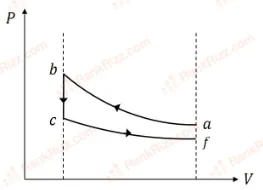
Ten moles of an ideal monatomic gas, initially in state a\boldsymbol{a} at atmospheric pressure and temperature Ta=27∘CT_a=27^\circ\mathrm{C}, is enclosed in a metal cylinder of volume V0V_0 fitted with a frictionless piston. The gas is suddenly compressed to state b\boldsymbol{b} with volume V0/3V_0/3. Now, keeping the piston stationary, the cylinder is submerged in a water bath of temperature 11∘C11^\circ\mathrm{C} until the gas reaches the temperature of the water bath, which is denoted as state c\boldsymbol{c}. Finally, while still in the water bath, the piston is brought slowly to its initial position, which is denoted as state f\boldsymbol{f}. If RR is universal gas constant, then the correct option(s) is/are:

[Given: 91/3=2.089^{1/3}=2.08]

  1. A

    The schematic P-V diagram of the processes described above is:

    Figure for JEE Advanced 2026 Physics question on Multi-step processes and gas-piston-spring systems
  2. B

    The change in internal energy in going from state a\boldsymbol{a} to b\boldsymbol{b} is 4860 R4860\,R.

  3. C

    The net change in the internal energy in the whole process is −240 R-240\,R.

  4. D

    The pressure and temperature of the state b\boldsymbol{b} are 2.082.08 times the atmospheric pressure and 624 K624\,\mathrm{K}, respectively.

JEE ADVANCED 2026 · PAPER 1Carnot engine and Carnot cycleTRANSCRIBED

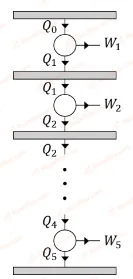
As shown in the figure, five Carnot engines, each with efficiency η\eta and same number of cycles per unit time, are operating between six heat reservoirs. The amount of heat released per cycle by one engine is completely absorbed by the next engine. Consider Q0Q_0 to be the amount of heat absorbed per cycle by the first engine and WW as the amount of total work done by all the engines per cycle, then the net efficiency of the system is found to be ηnet=WQ0=211243\eta_{\text{net}}=\dfrac{W}{Q_0}=\dfrac{211}{243}. The value of η\eta is:

Figure for JEE Advanced 2026 Physics question on Carnot engine and Carnot cycle
JEE ADVANCED 2026 · PAPER 1Multi-step processes and gas-piston-spring systemsTRANSCRIBED

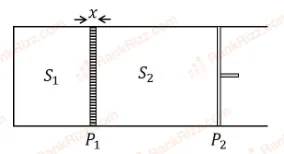
As shown in the figure, an insulated container is fitted with a thermally conducting but immovable partition (P1P_1) and a freely movable but thermally insulated piston (P2P_2). The partition P1P_1 with thermal conductivity KK, cross sectional area AA and width xx divides the container into two sections, S1S_1 and S2S_2, each containing one mole of a monoatomic gas. The piston P2P_2 moves freely such that the gas in S2S_2 is always at the atmospheric pressure. Initially, the difference between the temperatures of S1S_1 and S2S_2 is ΔT0\Delta T_0. The time it takes for the temperature difference to become ΔT02\dfrac{\Delta T_0}{2} is nxR/KAnxR/KA, where RR is the universal gas constant. The value of nn is:

[ Given: ln⁡2≈0.7\ln 2\approx 0.7 ]

Figure for JEE Advanced 2026 Physics question on Multi-step processes and gas-piston-spring systems
JEE ADVANCED 2025 · PAPER 2Carnot engine and Carnot cycleTRANSCRIBED

The efficiency of a Carnot engine operating with a hot reservoir kept at a temperature of 1000 K is 0.4. It extracts 150 J of heat per cycle from the hot reservoir. The work extracted from this engine is being fully used to run a heat pump which has a coefficient of performance 10. The hot reservoir of the heat pump is at a temperature of 300 K. Which of the following statements is/are correct:

  1. A

    Work extracted from the Carnot engine in one cycle is 60 J.

  2. B

    Temperature of the cold reservoir of the Carnot engine is 600 K.

  3. C

    Temperature of the cold reservoir of the heat pump is 270 K.

  4. D

    Heat supplied to the hot reservoir of the heat pump in one cycle is 540 J.

JEE ADVANCED 2025 · PAPER 1Multi-step processes and gas-piston-spring systemsTRANSCRIBED

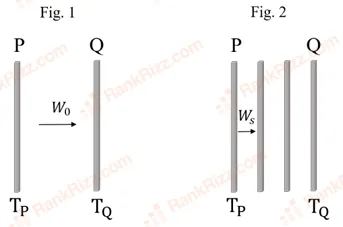
Two identical plates P and Q, radiating as perfect black bodies, are kept in vacuum at constant absolute temperatures TPT_P and TQT_Q, respectively, with TQ<TPT_Q < T_P, as shown in Fig. 1. The radiated power transferred per unit area from P to Q is W0W_0. Subsequently, two more plates, identical to P and Q, are introduced between P and Q, as shown in Fig. 2. Assume that heat transfer takes place only between adjacent plates. If the power transferred per unit area in the direction from P to Q (Fig. 2) in the steady state is WSW_S, then the ratio W0WS\frac{W_0}{W_S} is ________.

Figure for JEE Advanced 2025 Physics question on Multi-step processes and gas-piston-spring systems
JEE ADVANCED 2025 · PAPER 2Multi-step processes and gas-piston-spring systemsTRANSCRIBED

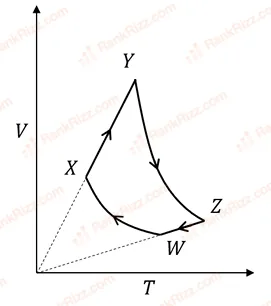
An ideal monatomic gas of nn moles is taken through a cycle WXYZWWXYZW consisting of consecutive adiabatic and isobaric quasi-static processes, as shown in the schematic VV-TT diagram. The volume of the gas at WW, XX and YY points are, 64 cm3^3, 125 cm3^3 and 250 cm3^3, respectively. If the absolute temperature of the gas TWT_W at the point WW is such that nRTW=1nRT_W = 1 J (RR is the universal gas constant), then the amount of heat absorbed (in J) by the gas along the path XYXY is ______.

Figure for JEE Advanced 2025 Physics question on Multi-step processes and gas-piston-spring systems
JEE ADVANCED 2025 · PAPER 2Zeroth and first law of thermodynamicsTRANSCRIBED

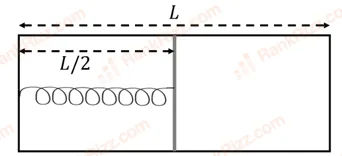
The left and right compartments of a thermally isolated container of length LL are separated by a thermally conducting, movable piston of area AA. The left and right compartments are filled with 32\frac{3}{2} and 1 moles of an ideal gas, respectively. In the left compartment the piston is attached to a spring with spring constant kk and natural length 2L5\frac{2L}{5}. In thermodynamic equilibrium, the piston is at a distance L2\frac{L}{2} from the left and right edges of the container as shown in the figure. Under the above conditions, if the pressure in the right compartment is P=kLAαP = \frac{kL}{A} \alpha, then the value of α\alpha is ______.

Figure for JEE Advanced 2025 Physics question on Zeroth and first law of thermodynamics
JEE ADVANCED 2024 · PAPER 2Multi-step processes and gas-piston-spring systemsTRANSCRIBED

A spherical soap bubble inside an air chamber at pressure P0=105P_0 = 10^5 Pa has a certain radius so that the excess pressure inside the bubble is ΔP=144\Delta P = 144 Pa. Now, the chamber pressure is reduced to 8P0/278P_0/27 so that the bubble radius and its excess pressure change. In this process, all the temperatures remain unchanged. Assume air to be an ideal gas and the excess pressure ΔP\Delta P in both the cases to be much smaller than the chamber pressure. The new excess pressure ΔP\Delta P in Pa is ________.

JEE ADVANCED 2024 · PAPER 1Multi-step processes and gas-piston-spring systemsTRANSCRIBED

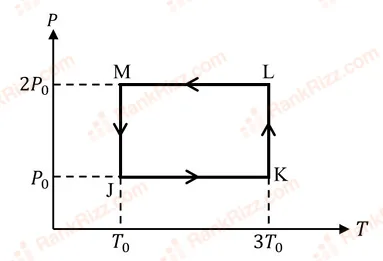
One mole of a monatomic ideal gas undergoes the cyclic process J →\to K →\to L →\to M →\to J, as shown in the P-T diagram.

Figure for JEE Advanced 2024 Physics question on Multi-step processes and gas-piston-spring systems

Match the quantities mentioned in List-I with their values in List-II and choose the correct option.

[RR is the gas constant.]

List-IList-II
(P)Work done in the complete cyclic process(1)RT0−4RT0ln⁡2RT_0 - 4RT_0 \ln 2
(Q)Change in the internal energy of the gas in the process JK(2)00
(R)Heat given to the gas in the process KL(3)3RT03RT_0
(S)Change in the internal energy of the gas in the process MJ(4)−2RT0ln⁡2-2RT_0 \ln 2
(5)−3RT0ln⁡2-3RT_0 \ln 2
  1. A

    P →\to 1; Q →\to 3; R →\to 5; S →\to 4

  2. B

    P →\to 4; Q →\to 3; R →\to 5; S →\to 2

  3. C

    P →\to 4; Q →\to 1; R →\to 2; S →\to 2

  4. D

    P →\to 2; Q →\to 5; R →\to 3; S →\to 4

JEE ADVANCED 2023 · PAPER 1Zeroth and first law of thermodynamicsTRANSCRIBED

A closed container contains a homogeneous mixture of two moles of an ideal monatomic gas (γ=5/3\gamma = 5/3) and one mole of an ideal diatomic gas (γ=7/5\gamma = 7/5). Here, γ\gamma is the ratio of the specific heats at constant pressure and constant volume of an ideal gas. The gas mixture does a work of 66 Joule when heated at constant pressure. The change in its internal energy is ______ Joule.

JEE ADVANCED 2023 · PAPER 2Multi-step processes and gas-piston-spring systemsTRANSCRIBED

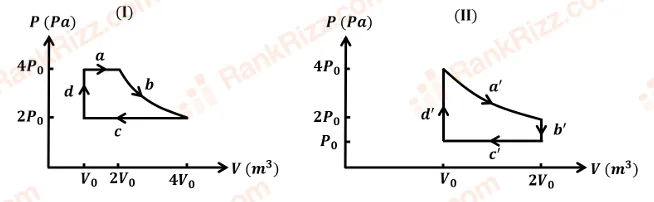
One mole of an ideal gas undergoes two different cyclic processes I and II, as shown in the PP-VV diagrams below. In cycle I, processes a, b, c and d are isobaric, isothermal, isobaric and isochoric, respectively. In cycle II, processes a', b', c' and d' are isothermal, isochoric, isobaric and isochoric, respectively. The total work done during cycle I is WIW_I and that during cycle II is WIIW_{II}. The ratio WI/WIIW_I/W_{II} is ____.

Figure for JEE Advanced 2023 Physics question on Multi-step processes and gas-piston-spring systems
JEE ADVANCED 2023 · PAPER 2Multi-step processes and gas-piston-spring systemsTRANSCRIBED

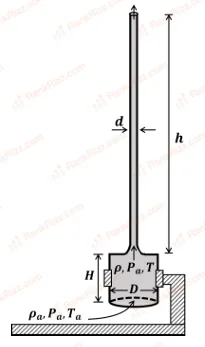
When the chimney is closed using a cap at the top, a pressure difference ΔP\Delta P develops between the top and the bottom surfaces of the cap. If the changes in the temperature and density of the hot air, due to the stoppage of air flow, are negligible then the value of ΔP\Delta P is ____ Nm−2^{-2}.

Figure for JEE Advanced 2023 Physics question on Multi-step processes and gas-piston-spring systems
JEE ADVANCED 2022 · PAPER 2Multi-step processes and gas-piston-spring systemsTRANSCRIBED

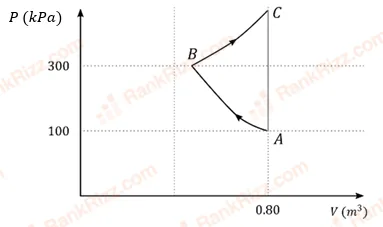
In the given P-V diagram, a monoatomic gas (γ=53)\left(\gamma = \dfrac{5}{3}\right) is first compressed adiabatically from state A to state B. Then it expands isothermally from state B to state C. [Given: (13)0.6=0.5\left(\dfrac{1}{3}\right)^{0.6} = 0.5, ln 2 ≃\simeq 0.7].

Figure for JEE Advanced 2022 Physics question on Multi-step processes and gas-piston-spring systems

Which of the following statement(s) is(are) incorrect?

  1. A

    The magnitude of the total work done in the process A →\to B →\to C is 144 kJ.

  2. B

    The magnitude of the work done in the process B →\to C is 84 kJ.

  3. C

    The magnitude of the work done in the process A →\to B is 60 kJ.

  4. D

    The magnitude of the work done in the process C →\to A is zero.

JEE ADVANCED 2022 · PAPER 1Multi-step processes and gas-piston-spring systemsTRANSCRIBED

List I describes thermodynamic processes in four different systems. List II gives the magnitudes (either exactly or as a close approximation) of possible changes in the internal energy of the system due to the process.

List-IList-II
(I) 10−310^{-3} kg of water at 100°C is converted to steam at the same temperature, at a pressure of 10510^5 Pa. The volume of the system changes from 10−610^{-6} m3^3 to 10−310^{-3} m3^3 in the process. Latent heat of water = 2250 kJ/kg.(P) 2 kJ
(II) 0.2 moles of a rigid diatomic ideal gas with volume VV at temperature 500 K undergoes an isobaric expansion to volume 3V. Assume R=8.0R = 8.0 J mol−1^{-1} K−1^{-1}.(Q) 7 kJ
(III) One mole of a monatomic ideal gas is compressed adiabatically from volume V=13V = \frac{1}{3} m3^3 and pressure 2 kPa to volume V8\frac{V}{8}.(R) 4 kJ
(IV) Three moles of a diatomic ideal gas whose molecules can vibrate, is given 9 kJ of heat and undergoes isobaric expansion.(S) 5 kJ
(T) 3 kJ

Which one of the following options is correct?

  1. A

    I →\to T, II →\to R, III →\to S, IV →\to Q

  2. B

    I →\to S, II →\to P, III →\to T, IV →\to P

  3. C

    I →\to P, II →\to R, III →\to T, IV →\to Q

  4. D

    I →\to Q, II →\to R, III →\to S, IV →\to T

JEE ADVANCED 2021 · PAPER 1Multi-step processes and gas-piston-spring systemsTRANSCRIBED

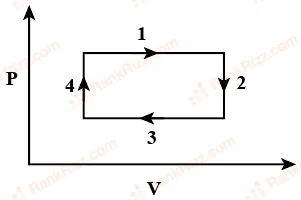
An ideal gas undergoes a four step cycle as shown in the 𝑃−𝑉 diagram below. During this cycle, heat is absorbed by the gas in

Figure for JEE Advanced 2021 Physics question on Multi-step processes and gas-piston-spring systems
  1. A

    steps 1 and 2

  2. B

    steps 1 and 3

  3. C

    steps 1 and 4

  4. D

    steps 2 and 4

JEE ADVANCED 2021 · PAPER 2Multi-step processes and gas-piston-spring systemsTRANSCRIBED

The value of TRTo\frac{T_R}{T_o} is

  1. A

    2\sqrt{2}

  2. B

    3\sqrt{3}

  3. C

    2

  4. D

    3

JEE ADVANCED 2020 · PAPER 2Multi-step processes and gas-piston-spring systemsTRANSCRIBED

A spherical bubble inside water has radius 𝑅. Take the pressure inside the bubble and the water pressure to be p0p_0. The bubble now gets compressed radially in an adiabatic manner so that its radius becomes (𝑅 − 𝑎). For a≪Ra \ll R the magnitude of the work done in the process is given by (4πp0Ra2)X2(4 \pi p_0 R a^2)X^2, where 𝑋 is a constant and γ=CpCV=4130\gamma = \frac{C_p}{C_V} = \frac{41}{30}. The value of X is ____________.

JEE ADVANCED 2020 · PAPER 1Multi-step processes and gas-piston-spring systemsTRANSCRIBED

Consider one mole of helium gas enclosed in a container at initial pressure p1p_{1} and volume v[1]v_[1]. It expands isothermally to volume 4𝑉14𝑉_{1}. After this, the gas expands adiabatically and its volume becomes 32𝑉132𝑉_{1}. The work done by the gas during isothermal and adiabatic expansion processes are 𝑊𝑖𝑠𝑜𝑊_{𝑖𝑠𝑜} and 𝑊𝑎𝑑𝑖𝑎𝑊_{𝑎𝑑𝑖𝑎}, respectively. If the ratio 𝑊𝑖𝑠𝑜𝑊𝑎𝑑𝑖𝑎\frac{𝑊_{𝑖𝑠𝑜}}{𝑊_{𝑎𝑑𝑖𝑎}} 𝑓 In2, then 𝑓 is ________.

JEE ADVANCED 2019 · PAPER 2Multi-step processes and gas-piston-spring systemsTRANSCRIBED

A mixture of ideal gas containing 5 moles of monatomic gas and 1 mole of rigid diatomic gas is initially at pressure P0P_0, volume V0V_0, and temperature T0T_0. If the gas mixture is adiabatically compressed to a volume V04\frac{V_0}{4}, then the correct statement(s)is/are,
(Given 21.2=2.3;23.2=9.2;2^{1.2} = 2.3; 2^{3.2} = 9.2; R is gas constant)

  1. A

    The work |W| done during the process is 13RT013RT_0

  2. B

    The average kinetic energy of the gas mixture after compression is in between 18RT018RT_0 and 19RT019RT_0

  3. C

    The final pressure of the gas mixture after compressionis in between 9P09P_0 and 10P010P_0

  4. D

    Adiabatic constant of the gas mixture is 1.6