RankRizz

Rotational Motion — JEE Advanced Previous Year Questions

Every Rotational Motion question JEE Advanced has set from 2007–2026, grouped by the idea it tests rather than the order of the syllabus. 64 questions across 5 distinct ideas. Free to read, answer key on every one.

Questions

64

Distinct ideas

5

Share of marks

9.1%

Difficulty

HARD

The ideas inside Rotational Motion

A chapter is not one subject — it is a handful of procedures the examiner reuses. These are the ones Rotational Motion questions actually test.

01Moment of inertia of standard bodies and composite systemsset 6×
02Parallel and perpendicular axis theoremsNot set in Advanced
03Torque and the rotational form of Newton's second lawset 1×
04Fixed-axis rotation: kinematics, rotational energy and pulleysNot set in Advanced
05Equilibrium of rigid bodies and topplingset 9×
06Angular momentum of particles and rigid bodiesset 16×
07Conservation of angular momentumNot set in Advanced
08Rolling without slipping: kinematics and energyNot set in Advanced
09Rolling with friction, slipping and impulsive forcesset 32×
10Collisions involving rigid bodiesNot set in Advanced

Every Rotational Motion question

41–60 OF 64 · NEWEST FIRST

JEE ADVANCED 2013 · PAPER 1Angular momentum of particles and rigid bodiesTRANSCRIBED

A uniform circular disc of mass 50 kg and radius 0.4 m is rotating with an angular velocity of 10 rad s−1s^{-1} aboutits own axis, which is vertical. Two uniform circular rings, each of mass 6.25 kg and radius 0.2 m, are gently placed symmetrically on the disc in such a manner that they are touching each other along the axis of the disc and are horizontal. Assume that the friction is large enough such that the rings are at rest relative to the disc and the system rotates about the original axis. The new angular velocity (in rad s−1s^{-1}) of the system is

JEE ADVANCED 2012 · PAPER 1Angular momentum of particles and rigid bodiesTRANSCRIBED

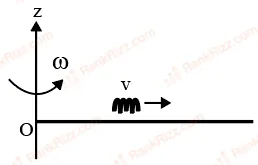
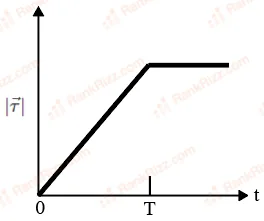
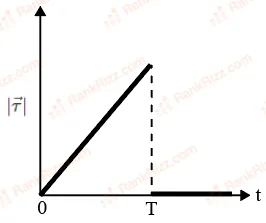
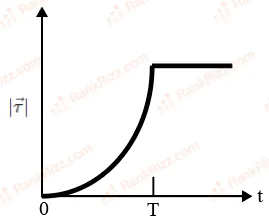
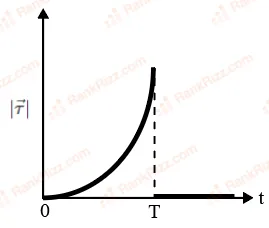
Athin uniform rod, pivoted at O,is rotating in the horizontal plane with constant angular speed ω\omega, as shownin the figure. At time t = 0, a small insect starts from O and moves with constant speedv with respect to the rod towardsthe other end. It reaches the end of the rod at t = T and stops. The angular speed of the system remains ω\omega throughout. The magnitude of the torque (∣τ→∣)(\mid \overrightarrow{\tau} \mid) on the system about O, as a function of time is best represented by which plot ?

Figure for JEE Advanced 2012 Physics question on Angular momentum of particles and rigid bodies
  1. A
    Figure for JEE Advanced 2012 Physics question on Angular momentum of particles and rigid bodies
  2. B
    Figure for JEE Advanced 2012 Physics question on Angular momentum of particles and rigid bodies
  3. C
    Figure for JEE Advanced 2012 Physics question on Angular momentum of particles and rigid bodies
  4. D
    Figure for JEE Advanced 2012 Physics question on Angular momentum of particles and rigid bodies
JEE ADVANCED 2012 · PAPER 2Rolling with friction, slipping and impulsive forcesTRANSCRIBED

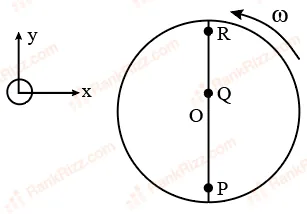
Consider a disc rotating in the horizontal plane with a constant angular speed ω\omega about its centre O. The disc has a shaded region on one side of the diameter and an unshaded region on the other side as shown in the figure. When the disc is in the orientation as shown, two pebbles P and Q are simultaneously projected at an angle towards R. The velocity of projection is in the y-z plane and is same for both pebbles with respect to the disc. Assume that (i) they land back on the disc before the disc completed 18\frac{1}{8} rotation. (ii) their range is less than half disc radius, and (iii) ω\omega remains constant throughout . Then

Figure for JEE Advanced 2012 Physics question on Rolling with friction, slipping and impulsive forces
  1. A

    P lands in the shaded region and Q in the unshaded region

  2. B

    P lands in the unshaded region and Q in the shaded region

  3. C

    Both P and Q land in the unshaded region

  4. D

    Both P and Q land in the shaded region

JEE ADVANCED 2012 · PAPER 1Angular momentum of particles and rigid bodiesTRANSCRIBED

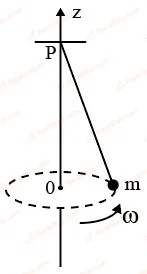
A small mass m is attached to a massless string whose other end is fixed at P as shown in the figure. The mass is undergoing circular motion in the x-y plane with centre at O and constant angular speed ω\omega If the angular momentum of the system, calculated about O and P are denoted by LO→\overrightarrow{L_O} and LP→\overrightarrow{L_P} respectively, then

Figure for JEE Advanced 2012 Physics question on Angular momentum of particles and rigid bodies
  1. A

    LO→\overrightarrow{L_O} and LP→\overrightarrow{L_P} do not vary with time

  2. B

    LO→\overrightarrow{L_O} varies with time while LP→\overrightarrow{L_P} remains constant.

  3. C

    LO→\overrightarrow{L_O} remains constant while LP→\overrightarrow{L_P} varies with time.

  4. D

    LO→\overrightarrow{L_O} and LP→\overrightarrow{L_P} both vary with time.

JEE ADVANCED 2012 · PAPER 2Rolling with friction, slipping and impulsive forcesTRANSCRIBED

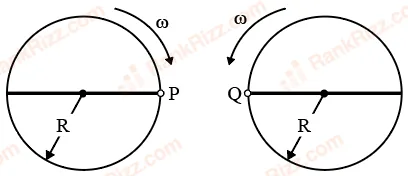
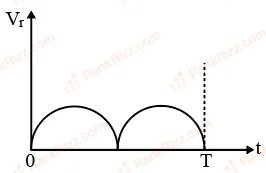
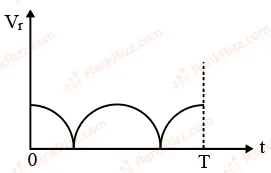
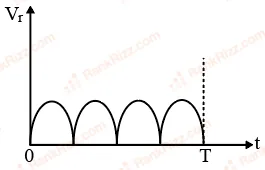
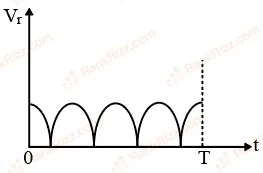
Two identical discs of same radius R are rotating about their axes in opposite directions with the same constant angular speed ω\omega. The disc are in the same horizontal plane. At time t = 0 , the points P and Q are facing each other as shown in the figure. The relative speed between the two points P and Q is vrv_r. as function of times best represented by

Figure for JEE Advanced 2012 Physics question on Rolling with friction, slipping and impulsive forces
  1. A
    Figure for JEE Advanced 2012 Physics question on Rolling with friction, slipping and impulsive forces
  2. B
    Figure for JEE Advanced 2012 Physics question on Rolling with friction, slipping and impulsive forces
  3. C
    Figure for JEE Advanced 2012 Physics question on Rolling with friction, slipping and impulsive forces
  4. D
    Figure for JEE Advanced 2012 Physics question on Rolling with friction, slipping and impulsive forces
JEE ADVANCED 2012 · PAPER 2Rolling with friction, slipping and impulsive forcesTRANSCRIBED

Which of the following statement regarding the angular speed about the istantaneous axis (passing through the centre of mass) is correct?

  1. A

    It is 2ω\sqrt{2} \omega for both the cases

  2. B

    It is ω\omega for case (a); and w2\frac{w}{\sqrt{2}} for case (b).

  3. C

    It is ω\omega for case (a); and 2ω\sqrt{2} \omega for case (b).

  4. D

    It is ω\omega for both the cases

JEE ADVANCED 2012 · PAPER 2Rolling with friction, slipping and impulsive forcesTRANSCRIBED

Which of the following statements about the instantaneous axis (passing through the centre of mass) is correct?

  1. A

    It is vertical for both the cases (a) and (b).

  2. B

    It is verticle for case (a); and is at 45∘45^\circ to the x-z plane and lies in the plane of the disc for case (b)

  3. C

    It is horizontal ofr case (a); and is at 45∘45^\circ to the x - z plane and is normal to the plane of the disc for case (b).

  4. D

    It is vertical of case (a); and is at 45∘45^\circ to the x - z plane and is normal to the plane of the disc for case (b).

JEE ADVANCED 2012 · PAPER 2Rolling with friction, slipping and impulsive forcesTRANSCRIBED

Two solid cylinders P andQ of same mass and same radius start rolling down a fixed inclined plane form the same height at the same time. Cylinder P has most of its mass concentrated near its surface, while Q has most of its mass concentrated near the axis. Which statement (s) is (are) correct?

  1. A

    Both cylinders P and Q reach the ground at the same time

  2. B

    Cylinder P has larger linear acceleration than cylinder Q.

  3. C

    Both cylinder Q reaches the ground with same translational kinetic energy.

  4. D

    Cylinder Q reaches the ground with larger angular speed.

JEE ADVANCED 2012 · PAPER 1Moment of inertia of standard bodies and composite systemsTRANSCRIBED

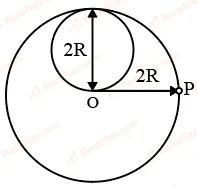
A lamina is made by removing a small disc of diameter 2R from a bigger disc of uniform mass density and radius 2R, as shown in the figure. The moment of inertia of this lamina about axes passing through O and is IOI_O and IPI_P, respectively. Both these axes are perpendicular to the plane of the lamina. The ratio IPIO\frac{I_P}{I_O} to the nearest integer is

Figure for JEE Advanced 2012 Physics question on Moment of inertia of standard bodies and composite systems
JEE ADVANCED 2012 · PAPER 2Rolling with friction, slipping and impulsive forcesTRANSCRIBED

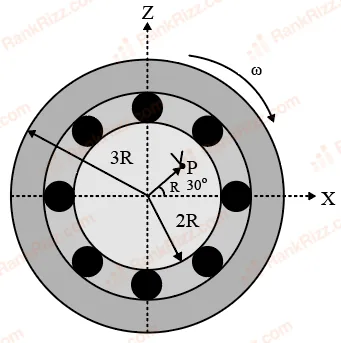
The figure shows a system consisting of (i) a ring of outer radius 3R rolling clockwise without slipping on a horizontal surface with angular speed ω\omega and (ii) an inner disc of radius 2R rotating anti-clockwisewith angular speed ω2\frac{\omega}{2}. The ring and disc are separated b frictionaless ball bearings. The system is in the x-z plane. The
point P on the inner disc is at distance R from the origin, where OP makes an angle of 30∘30^\circ with the horizontal. Then with respect to the horizontal surface,

Figure for JEE Advanced 2012 Physics question on Rolling with friction, slipping and impulsive forces
  1. A

    the point O has linear velocity 3Rωi^3R \omega \hat{i}.

  2. B

    the point P has a linear velocity 114Rωi^+34Rωk^\frac{11}{4}R \omega \hat{i} + \frac{\sqrt{3}}{4} R \omega \hat{k}

  3. C

    the point P has a linear velocity 134Rωi^−34Rωk^\frac{13}{4}R \omega \hat{i} - \frac{\sqrt{3}}{4} R \omega \hat{k}

  4. D

    the point P has a linear velocity (3−134)Rωi^+14Rωk^\left(3 - \frac{\sqrt{13}}{4}\right)R \omega \hat{i} + \frac{1}{4} R \omega \hat{k}

JEE ADVANCED 2011 · PAPER 1Equilibrium of rigid bodies and topplingTRANSCRIBED

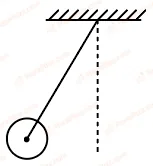
A metal rod of length 'L' and mass 'm' is pivoted at one end. A thin disk of mass 'M' and radius 'R' (< L) is attached at its centre to the free end of the rod. Consider two ways the disc is attached :(case A) The disc is not free to rotate about its center and (case B) the disc is free to rotate about its center. The rod-disc system performs SHM in vertical plane after being released from the same displaced position. Which of the following statement(s) is (are) true ?

Figure for JEE Advanced 2011 Physics question on Equilibrium of rigid bodies and toppling
  1. A

    Restoring torque in case A = Restoring torque in case B

  2. B

    Restoring torque in case A < Restoring torque in case B

  3. C

    Angular frequency for case A > Angular frequency for case B

  4. D

    Angular frequency for case A < Angular frequency for case B

JEE ADVANCED 2011 · PAPER 2Angular momentum of particles and rigid bodiesTRANSCRIBED

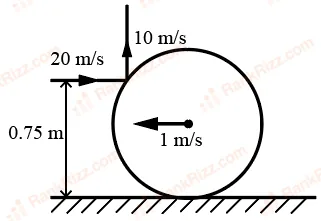
A thin ring of mass 2 kg and radius 0.5 m is rolling without slipping on a horizontal plane with velocity 1 m/s. A small ball of mass 0.1 kg, moving with velocity 20 m/s in the opposite direction, hits the ring at a height of 0.75 m and goes vertically up with velocity 10 m/s. Immediately after the collision

Figure for JEE Advanced 2011 Physics question on Angular momentum of particles and rigid bodies
  1. A

    the ring has pure rotation aboutits stationary CM.

  2. B

    the ring comes to a complete stop.

  3. C

    friction between the ring and the ground is to the left.

  4. D

    there is no friction between the ring and the ground.

JEE ADVANCED 2011 · PAPER 1Rolling with friction, slipping and impulsive forcesTRANSCRIBED

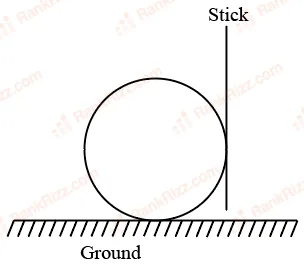
A boy is pushing a ring of mass 2 kg and radius 0.5 m with a stick as shown in the figure. The stick applies a force of 2 N on the ring and rolls it without slipping with an acceleration of 0.3 m/s2m/s^2. The coefficient of friction between the ground and the ring is large enough that rolling always occurs and the coefficient of friction between the stick and the ring is (P/10). The value of P is.

Figure for JEE Advanced 2011 Physics question on Rolling with friction, slipping and impulsive forces
JEE ADVANCED 2011 · PAPER 1Moment of inertia of standard bodies and composite systemsTRANSCRIBED

Four solid spheres each of diameter 5\sqrt{5} cm and mass 0.5 kg are placed with their centers at the corners of a square of side 4 cm. The momentum of inertia of the system about the diagonal of the square is N×10−4kg−m2N \times 10^{-4} kg -m^2, then N is.

JEE ADVANCED 2009 · PAPER 2Rolling with friction, slipping and impulsive forcesTRANSCRIBED

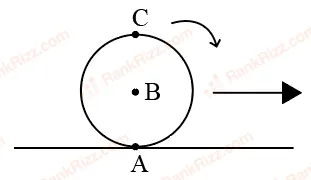
A sphere is rolling without slipping on a fixed horizontal plane surface. In the figure, A is the point of contact, B is the centre of the sphere and C is its topmost point. Then,

Figure for JEE Advanced 2009 Physics question on Rolling with friction, slipping and impulsive forces
  1. A

    V→C−V→A=2(V→B−V→C)\overrightarrow{V}_C - \overrightarrow{V}_A = 2\left(\overrightarrow{V}_B - \overrightarrow{V}_C\right)

  2. B

    V→C−V→B=V→B−V→A\overrightarrow{V}_C - \overrightarrow{V}_B = \overrightarrow{V}_B - \overrightarrow{V}_A

  3. C

    ∣V→C−V→A∣=2∣V→B−V→C∣\mid \overrightarrow{V}_C - \overrightarrow{V}_A \mid = 2\mid \overrightarrow{V}_B - \overrightarrow{V}_C \mid

  4. D

    ∣V→C−V→A∣=4∣V→B∣\mid \overrightarrow{V}_C - \overrightarrow{V}_A \mid = 4\mid \overrightarrow{V}_B \mid

JEE ADVANCED 2009 · PAPER 1Angular momentum of particles and rigid bodiesTRANSCRIBED

If the resultant of all the external forces acting on a system of particles is zero, then from an inertial frame, one can surely say that

  1. A

    linear momentum of the system does not change in time

  2. B

    kinetic energy of the system does not change in time

  3. C

    angular momentum of the system does not change in time

  4. D

    potential energy of the system does not change in time

JEE ADVANCED 2008 · PAPER 1Rolling with friction, slipping and impulsive forcesTRANSCRIBED

STATEMENT-1
Twocylinders, one hollow (metal) and the other solid (wood) with the same mass and identical dimensions are simultaneously allowed to roll without slipping down an inclined plane from the sameheight. The hollow cylinder will reach the bottom of the inclined plane first.
and
STATEMENT-2
By the principle of conservation of energy, the total kinetic energies of both the cylinders are identical when they reach the bottom of the incline.

  1. A

    STATEMENT-1 is True, STATEMENT-2 is True; STATEMENT-2 is a correct explanation for STATEMENT-1

  2. B

    STATEMENT-1 is True, STATEMENT-2 is True; STATEMENT-2 is NOT a correct explanation for STATEMENT-1

  3. C

    STATEMENT-1 is True, STATEMENT-2 is False

  4. D

    STATEMENT-1 is False, STATEMENT-2 is True

JEE ADVANCED 2008 · PAPER 2Rolling with friction, slipping and impulsive forcesTRANSCRIBED

The net external force acting on the disk whenits centre of mass is at displacement x with respect to its equilibrium position is

  1. A

    -kx

  2. B

    -2kx

  3. C

    −2kx3-\frac{2kx}{3}

  4. D

    −4kx3-\frac{4kx}{3}

JEE ADVANCED 2008 · PAPER 2Rolling with friction, slipping and impulsive forcesTRANSCRIBED

The centre of mass of the disk undergoes simple harmonic motion with angular frequency ω\omega equal to

  1. A

    kM\sqrt{\frac{k}{M}}

  2. B

    2kM\sqrt{\frac{2k}{M}}

  3. C

    2k3M\sqrt{\frac{2k}{3M}}

  4. D

    4k3M\sqrt{\frac{4k}{3M}}

JEE ADVANCED 2008 · PAPER 2Rolling with friction, slipping and impulsive forcesTRANSCRIBED

The maximum value of V0V_0 for which the disk will roll without slipping is

  1. A

    μgMk\mu g \sqrt{\frac{M}{k}}

  2. B

    μgM2k\mu g \sqrt{\frac{M}{2k}}

  3. C

    μg3Mk\mu g \sqrt{\frac{3M}{k}}

  4. D

    μg5M2k\mu g \sqrt{\frac{5M}{2k}}