RankRizz

Centre of Mass, Momentum & Collisions — JEE Advanced Previous Year Questions

Every Centre of Mass, Momentum & Collisions question JEE Advanced has set from 2007–2025, grouped by the idea it tests rather than the order of the syllabus. 12 questions across 4 distinct ideas. Free to read, answer key on every one.

Questions

12

Distinct ideas

4

Share of marks

0.9%

Difficulty

HARD

The ideas inside Centre of Mass, Momentum & Collisions

A chapter is not one subject — it is a handful of procedures the examiner reuses. These are the ones Centre of Mass, Momentum & Collisions questions actually test.

01Centre of mass of a system of particlesNot set in Advanced
02Centre of mass of continuous bodies and cavitiesset 1×
03Motion of centre of mass, momentum conservation and explosionsset 8×
04Impulse and impulse-momentum theoremset 2×
05Head-on collisions and coefficient of restitutionset 1×
06Oblique collisions in two dimensionsNot set in Advanced
07Variable mass systems and rocketsNot set in Advanced
08Two-body systems connected by springsNot set in Advanced

Centre of Mass, Momentum & Collisions weightage, year by year

The share of each year’s Physics questions that came from Centre of Mass, Momentum & Collisions, counted from the 19 papers we hold for the last 10 years, and paper by paper inside a year.

Steady: 1.0% of Physics questions in 2024–2026 against 0.9% in 2017–2023, and between 0.0% and 3.1% in every year shown. Not asked at all in 2018, 2019, 2020, 2021, 2022, 2024, 2026.

20260 / 340.0%PAPER 1 0.0%PAPER 2 0.0%
20251 / 323.1%PAPER 1 6.3%PAPER 2 0.0%
20240 / 340.0%PAPER 1 0.0%PAPER 2 0.0%
20231 / 342.9%PAPER 1 5.9%PAPER 2 0.0%
20220 / 360.0%PAPER 1 0.0%PAPER 2 0.0%
20210 / 380.0%PAPER 1 0.0%PAPER 2 0.0%
20200 / 360.0%PAPER 1 0.0%PAPER 2 0.0%
20190 / 360.0%PAPER 1 0.0%PAPER 2 0.0%
20180 / 180.0%1 PAPER
20171 / 362.8%PAPER 1 5.6%PAPER 2 0.0%

“QS” is Centre of Mass, Momentum & Collisions questions out of all Physics questions that year. A year with more sittings asks more questions, which is why the share, not the count, is the number to compare.

Centre of Mass, Momentum & Collisions: quick answers

How many Centre of Mass, Momentum & Collisions questions has JEE Advanced asked?

12 questions from 2007–2025. Over the last 20 papers, Centre of Mass, Momentum & Collisions carried about 0.9% of Physics marks.

Which Centre of Mass, Momentum & Collisions topics come up most?

Motion of centre of mass, momentum conservation and explosions (8 questions), Impulse and impulse-momentum theorem (2 questions), Centre of mass of continuous bodies and cavities (1 questions). Start with these, they are what the examiner keeps coming back to.

Is Centre of Mass, Momentum & Collisions important for JEE Advanced?

Steady: 1.0% of Physics questions in 2024–2026 against 0.9% in 2017–2023, and between 0.0% and 3.1% in every year shown. Not asked at all in 2018, 2019, 2020, 2021, 2022, 2024, 2026. It has carried about 0.9% of Physics marks in recent papers, rated hard on our difficulty scale. The year-by-year table above shows how that has moved.

Do these Centre of Mass, Momentum & Collisions PYQs have answers and solutions?

Yes. Every question shows its official answer key, and a worked solution opens on the question’s own page wherever we have one. Reading and checking answers is free, no sign-up needed.

What’s the fastest way to revise Centre of Mass, Momentum & Collisions?

Do one past question per idea first: Centre of Mass, Momentum & Collisions has 4 distinct ideas, listed above. Then practise the topics you get wrong, or build a timed test from this chapter.

Every Centre of Mass, Momentum & Collisions question

1–12 OF 12 · NEWEST FIRST

JEE ADVANCED 2025 · PAPER 1Motion of centre of mass, momentum conservation and explosionsTRANSCRIBED

In a scattering experiment, a particle of mass 2m2m collides with another particle of mass mm, which is initially at rest. Assuming the collision to be perfectly elastic, the maximum angular deviation θ\theta of the heavier particle, as shown in the figure, in radians is:
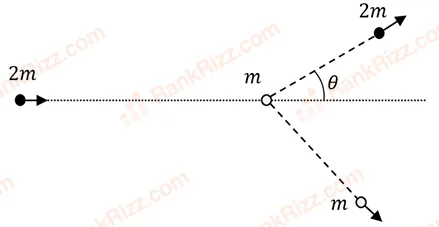
Figure for JEE Advanced 2025 Physics question on Motion of centre of mass, momentum conservation and explosions
  1. A

    π\pi

  2. B

    tan⁡−1(12)\tan^{-1}\left(\frac{1}{2}\right)

  3. C

    π3\frac{\pi}{3}

  4. D

    π6\frac{\pi}{6}

JEE ADVANCED 2023 · PAPER 1Head-on collisions and coefficient of restitutionTRANSCRIBED

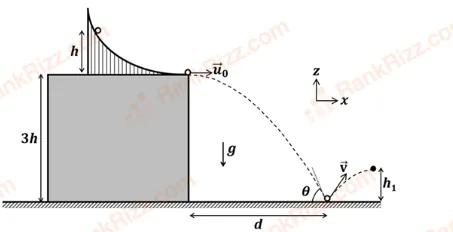
A slide with a frictionless curved surface, which becomes horizontal at its lower end, is fixed on the terrace of a building of height 3h3h from the ground, as shown in the figure. A spherical ball of mass m is released on the slide from rest at a height hh from the top of the terrace. The ball leaves the slide with a velocity u⃗0=u0x^\vec{u}_0 = u_0 \hat{x} and falls on the ground at a distance dd from the building making an angle θ\theta with the horizontal. It bounces off with a velocity v⃗\vec{v} and reaches a maximum height h1h_1. The acceleration due to gravity is gg and the coefficient of restitution of the ground is 1/31/\sqrt{3}. Which of the following statement(s) is(are) INCORRECT?

Figure for JEE Advanced 2023 Physics question on Head-on collisions and coefficient of restitution
  1. A

    u⃗0=2ghx^\vec{u}_0 = \sqrt{2gh}\hat{x}

  2. B

    v⃗=2gh(x^+z^)\vec{v} = \sqrt{2gh}(\hat{x} + \hat{z})

  3. C

    θ=30∘\theta = 30^\circ

  4. D

    d/h1=23d/h_1 = 2\sqrt{3}

JEE ADVANCED 2017 · PAPER 1Motion of centre of mass, momentum conservation and explosionsTRANSCRIBED

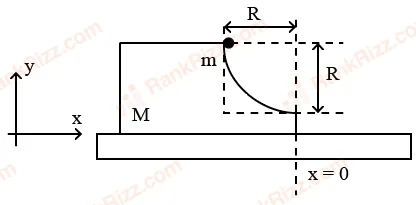
A block of mass M has a circular cut with a frictionless surface as shown. The block rests on the horizontal frictionless surface of a fixed table. Initially the right edge of the block is at x = 0, in a co-ordinate system fixed to the table. A point mass m is released from rest at the topmost point of the path as shown and it slides down. When the mass loses contact with the block, its position is x and the velocity is v. At that instant, which of the following options is/are correct?

Figure for JEE Advanced 2017 Physics question on Motion of centre of mass, momentum conservation and explosions
  1. A

    The position of the point mass m is: −2mRM+m-\sqrt{2} \frac{mR}{M + m}

  2. B

    The velocity of the point mass m is v=2gR1+mMv = \sqrt{\frac{2gR}{1 + \frac{m}{M}}}

  3. C

    The x component of displacement of the center of mass of the block M is: −mRM+m-\frac{mR}{M + m}

  4. D

    The velocity of the block M is: V=−mM2gRV = -\frac{m}{M}\sqrt{2gR}

JEE ADVANCED 2013 · PAPER 1Motion of centre of mass, momentum conservation and explosionsTRANSCRIBED

A particle of mass m is projected from the ground with an initial speed u0u_0, at an angle α\alpha with the horizontal. At the highest point of its trajectory, it makes a completely inelastic collision with another identical particle, which was thrown vertically upward from the ground with the same initial speed u0.u_0. The angle that the composite system makes with the horizontal immediately after the collision is

  1. A

    π4\frac{\pi}{4}

  2. B

    π4+α\frac{\pi}{4} + \alpha

  3. C

    π2−α\frac{\pi}{2} - \alpha

  4. D

    π2\frac{\pi}{2}

JEE ADVANCED 2011 · PAPER 2Impulse and impulse-momentum theoremTRANSCRIBED

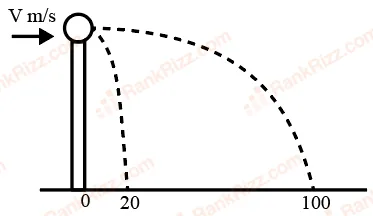
A ball of mass 0.2 kg rests on a vertical post of height 5 m. A bullet of mass 0.01 kg, traveling with a velocity V m/s in a horizontal direction, hits the centre of the ball. After the collision, the ball and bullet travel independently. The ball hits the ground at a distance of 20 m and the bullet at a distance of 100 m from the foot of the post. The initial velocity V of the bullet is

Figure for JEE Advanced 2011 Physics question on Impulse and impulse-momentum theorem
  1. A

    250 m/s

  2. B

    2502250\sqrt{2} m/s

  3. C

    400 m/s

  4. D

    500 m/s

JEE ADVANCED 2010 · PAPER 1Motion of centre of mass, momentum conservation and explosionsTRANSCRIBED

A point mass of 1 kg collides elastically with a stationary point mass of 5 kg. After their collision, the 1 kg mass reverses its direction and moves with a speed of 2 ms−1ms^{-1}.
Which of the following statement(s) is (are) correct for the system of these two masses ?

  1. A

    Total momentumof the system is 3 kg ms−1ms^{-1}

  2. B

    Momentum of 5 kg massaftercollision is 4 kg ms−1ms^{-1}

  3. C

    Kinetic energy of the centre of mass is 0.75 J

  4. D

    Total kinetic energy of the system is 4 J

JEE ADVANCED 2009 · PAPER 1Centre of mass of continuous bodies and cavitiesTRANSCRIBED

Look at the drawing given in the figure which has been drawn with ink of uniform linethickness. The mass of ink used to draw each of the two inner circles, and each of the two lines segments is m. The mass of the ink used to draw the outer circle is 6m. The coordinates of the centres of the different parts are : outer circle (0, 0), left inner circle (-a, a), right inner circle (a, a), vertical line (0, 0) and horizontal line (0, -a). The y-coordinate of the centre of mass of the ink in this drawing is-

Figure for JEE Advanced 2009 Physics question on Centre of mass of continuous bodies and cavities
  1. A

    a10\frac{a}{10}

  2. B

    a8\frac{a}{8}

  3. C

    a12\frac{a}{12}

  4. D

    a3\frac{a}{3}

JEE ADVANCED 2009 · PAPER 1Motion of centre of mass, momentum conservation and explosionsTRANSCRIBED

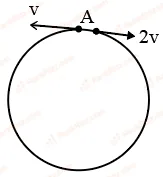
Two small particles of equal masses start moving in opposite directions from a point A in a horizontal circular orbit. Their tangential velocities are v and 2v, respectively, as shown in the figure. Between collisions, the particles move with constant speeds. After making how many collisions, other than that at A, these two particles will again reach the point A ?

Figure for JEE Advanced 2009 Physics question on Motion of centre of mass, momentum conservation and explosions
  1. A

    4

  2. B

    3

  3. C

    2

  4. D

    1

JEE ADVANCED 2009 · PAPER 2Motion of centre of mass, momentum conservation and explosionsTRANSCRIBED

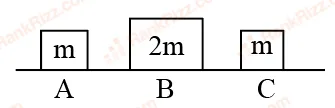
Three objects A. B and C are kept in a straight line on a frictionless horizontal surface. These have:masses m, 2m and m, respectively. The object A moves towards B with a speed 9 m/s and makes an elastic collision with it. Thereafter, B makes completely inelastic collision with C. All motions occur on the same straight line. Find the final speed (in m/s) of the object C.

Figure for JEE Advanced 2009 Physics question on Motion of centre of mass, momentum conservation and explosions
JEE ADVANCED 2008 · PAPER 1Impulse and impulse-momentum theoremTRANSCRIBED

Two balls, having linear momenta p→1=pi^\overrightarrow{p}_1 = p\hat{i} and p→1=−pi^\overrightarrow{p}_1 = -p\hat{i}, undergo a collision in free space. There is no external force acting on the balls. Let p→1′\overrightarrow{p}_1' and p→2′\overrightarrow{p}_2' be their final momenta. The following option(s) is(are) NOT ALLOWED for any non-zero value of p,a1,a2,b1,b2,c1p, a_1, a_2, b_1, b_2, c_1 and c2c_2.

  1. A

    p→1′=a1i^+b1j^+c1k^\overrightarrow{p}_1' = a_1\hat{i} + b_1\hat{j} + c_1\hat{k}
    p→2′=a2i^+b2j^\overrightarrow{p}_2' = a_2\hat{i} + b_2\hat{j}

  2. B

    p→1′=c1k^\overrightarrow{p}_1' = c_1\hat{k}
    p→2′=c2k^\overrightarrow{p}_2' = c_2\hat{k}

  3. C

    p→1′=a1i^+b1j^+c1k^\overrightarrow{p}_1' = a_1\hat{i} + b_1\hat{j} + c_1\hat{k}
    p→2′=a2i^+b2j^−c1k^\overrightarrow{p}_2' = a_2\hat{i} + b_2\hat{j} - c_1\hat{k}

  4. D

    p→1′=a1i^+b1j^\overrightarrow{p}_1' = a_1\hat{i} + b_1\hat{j}
    p→2′=a2i^+b1j^\overrightarrow{p}_2' = a_2\hat{i} + b_1\hat{j}

JEE ADVANCED 2008 · PAPER 1Motion of centre of mass, momentum conservation and explosionsTRANSCRIBED

If collision between the block and theincline is completely elastic, then the vertical (upward) component of the velocity of the block at point B, immediately after it strikes the second incline is

  1. A

    30\sqrt{30} m/s

  2. B

    15\sqrt{15} m/s

  3. C

    0

  4. D

    −15-\sqrt{15} m/s

JEE ADVANCED 2007 · PAPER 1Motion of centre of mass, momentum conservation and explosionsTRANSCRIBED

STATEMENT-1
In an elastic collision between two bodies, the relative speed of the bodies after collision is equal to the relative speed before the collision.
because
STATEMENT-2
In anelastic collision, the linear momentum of the system is conserved.

  1. A

    Statement-1 is True, Statement-2 is True; Statement-2 is a correct explanation for Statement-1

  2. B

    Statement-1 is True, Statement-2 is True; Statement-2 is NOT a correct explanation for Statement-1

  3. C

    Statement-1 is True, Statement-2 is False

  4. D

    Statement-1 is False, Statement-2 is True