RankRizz
JEE ADVANCED 2020 · PAPER 1+3 / −1MEDIUMTRANSCRIBED

JEE Advanced 2020 Physics question — Equilibrium of rigid bodies and toppling

A football of radius R is kept on a hole of radius r (𝑟 < 𝑅) made on a plank kept horizontally. One end of the plank is now lifted so that it gets tilted making an angle 𝜃 from the horizontal as shown in the figure below. The maximum value of θ\theta so that the football does not start rolling down the plank satisfies (figure is schematic and not drawn to scale)
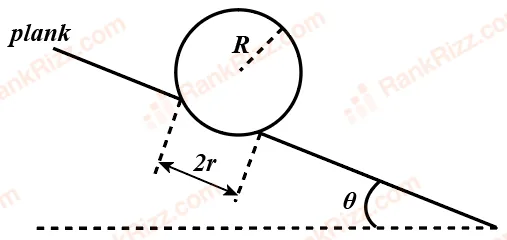
Figure for JEE Advanced 2020 Physics question on Equilibrium of rigid bodies and toppling
SOLUTION

Consider a vertical plane that contains the line of steepest descent of the tilted plank. In this plane the problem reduces to a two-dimensional geometry of a circle (the football, radius RR) resting on the two diametrically opposite edges of the hole (radius rr).

Before tilting, the centre OO of the ball is a distance h=R2−r2h = \sqrt{R^{2}-r^{2}} below the rim of the hole.
After the plank is tilted through an angle θ\theta about a horizontal axis (perpendicular to the plane we are considering), the two opposite edges of the hole acquire the coordinates

up-hill edge E1 (− rcos⁡θ,  + rsin⁡θ)E_1 \, (-\,r\cos\theta,\; +\,r\sin\theta)
down-hill edge E2 (+ rcos⁡θ,  − rsin⁡θ)E_2 \, (+\,r\cos\theta,\; -\,r\sin\theta)

Let the instantaneous coordinates of the sphere’s centre be O (x,  z)O\,(x,\;z) in the same plane (origin at the hole’s centre, zz measured vertically upward).
Because the sphere is in contact with both edges, the centre must satisfy

(x+rcos⁡θ)2+(z−rsin⁡θ)2=R2      −(1)\bigl(x + r\cos\theta\bigr)^{2} + \bigl(z - r\sin\theta\bigr)^{2} = R^{2} \;\;\;-(1)
(x−rcos⁡θ)2+(z+rsin⁡θ)2=R2      −(2)\bigl(x - r\cos\theta\bigr)^{2} + \bigl(z + r\sin\theta\bigr)^{2} = R^{2} \;\;\;-(2)

Subtracting (2)(2) from (1)(1) gives

xcos⁡θ−zsin⁡θ=0    ⟹    x=ztan⁡θ      −(3)x\cos\theta - z\sin\theta = 0 \;\;\Longrightarrow\;\; x = z\tan\theta \;\;\;-(3)

Adding (1)(1) and (2)(2) yields

x2+z2+r2=R2      −(4)x^{2} + z^{2} + r^{2} = R^{2} \;\;\;-(4)

Using (3)(3) in (4)(4):

z2tan⁡2θ+z2+r2=R2z^{2}\tan^{2}\theta + z^{2} + r^{2} = R^{2}
z2cos⁡2θ+r2=R2\frac{z^{2}}{\cos^{2}\theta} + r^{2} = R^{2}
z2=(R2−r2)cos⁡2θ      −(5)z^{2} = \bigl(R^{2}-r^{2}\bigr)\cos^{2}\theta \;\;\;-(5)

Therefore

x2=z2tan⁡2θ=(R2−r2)sin⁡2θ      −(6)x^{2} = z^{2}\tan^{2}\theta = \bigl(R^{2}-r^{2}\bigr)\sin^{2}\theta \;\;\;-(6)

The ball will be on the verge of rolling out when the vertical line through its centre just passes through the down-hill edge E2E_2. At this limiting case

x=rcos⁡θ      −(7)x = r\cos\theta \;\;\;-(7)

Substituting (6)(6) into (7)(7):

R2−r2  sin⁡θ=rcos⁡θ\sqrt{R^{2}-r^{2}}\;\sin\theta = r\cos\theta
tan⁡θ=rR2−r2      −(8)\tan\theta = \frac{r}{\sqrt{R^{2}-r^{2}}} \;\;\;-(8)

Using sin⁡θ=tan⁡θ1+tan⁡2θ\sin\theta = \dfrac{\tan\theta}{\sqrt{1+\tan^{2}\theta}} and simplifying with (8)(8):

sin⁡θ=rR2−r2  ⋅  R2−r2R=rR\sin\theta = \frac{r}{\sqrt{R^{2}-r^{2}}}\;\cdot\; \frac{\sqrt{R^{2}-r^{2}}}{R} = \frac{r}{R}

Hence the maximum tilt angle is determined by

sin⁡θ=rR\boxed{\sin\theta = \dfrac{r}{R}}

Option A which is: sin⁡θ=rR\sin \theta = \dfrac{r}{R}

Tagged Equilibrium of rigid bodies and toppling. Machine-assigned, so read it as a strong shortlist rather than a verdict.

SubjectPhysics
TopicEquilibrium of rigid bodies and toppling
TypeMultiple choice