JEE Advanced 2021 Physics question — Rolling with friction, slipping and impulsive forces
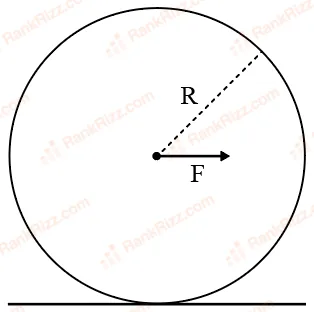
A horizontal force 𝐹 is applied at the center of mass of a cylindrical object of mass 𝑚 and radius 𝑅, perpendicular to its axis as shown in the figure. The coefficient of friction between the object and the ground is . The center of mass of the object has an acceleration 𝑎. The acceleration due to gravity is 𝑔. Given that the object rolls without slipping, which of the following statement(s) is(are) correct?
SOLUTION
The forces acting on the cylindrical object are
• the applied horizontal force at its centre of mass (to the right),
• the static frictional force at the point of contact with the ground (to the left, because it must oppose the relative motion that would otherwise occur),
• the weight (downward) and the normal reaction (upward).
Only and have horizontal components, so the vertical forces do not enter the following calculations.
1. Translational motion of the centre of mass
Using Newton’s second law along the horizontal direction,
where is the linear acceleration of the centre of mass.
2. Rotational motion about the centre of mass
The only horizontal force that produces a torque about the centre of mass is the frictional force (the line of action of passes through the centre, so it gives no torque).
If the cylinder rolls without slipping, the angular acceleration is related to by
Taking clockwise as positive, the torque equation is
The moment of inertia of a general cylinder can be written as
where
• for a solid cylinder,
• for a thin-walled hollow cylinder.
Substituting and using (2) in (3):
3. Eliminating the frictional force
Insert (4) in the translational equation (1):
Case 1: Solid cylinder ()
From (5), .
Case 2: Thin-walled hollow cylinder ()
From (5), .
4. Condition for rolling without slipping
Static friction must not exceed its limiting value:
With from (4), inequality (6) gives
Maximum acceleration for a solid cylinder
For a solid cylinder, , so (7) becomes
This is the highest acceleration possible while maintaining rolling without slipping; it is achieved when the static friction reaches its limiting value .
5. Verification of the given statements
Option A: “For the same , the value of does not depend on whether the cylinder is solid or hollow.”
Equation (5) shows , which does depend on . Therefore, Option A is incorrect.
Option B: “For a solid cylinder, the maximum possible value of is .”
Derived above: . Option B is correct.
Option C: “The magnitude of the frictional force on the object due to the ground is always .”
Actual friction is from (4), and only equals when the limiting condition is reached; otherwise it is smaller. Hence Option C is incorrect.
Option D: “For a thin-walled hollow cylinder, .”
Equation (5) gives for , but this holds only if rolling without slipping is possible, i.e. if . When is so large that would exceed this limit, slipping occurs and (5) no longer applies. Since the statement does not mention this restriction, it is not always true. Option D is therefore incorrect.
Conclusion
Only Option B is correct.
Final answer: Option B which is: For a solid cylinder, the maximum possible value of is .
Tagged Rolling with friction, slipping and impulsive forces. Machine-assigned, so read it as a strong shortlist rather than a verdict.