RankRizz

Electrostatics — JEE Advanced Previous Year Questions

Every Electrostatics question JEE Advanced has set from 2007–2026, grouped by the idea it tests rather than the order of the syllabus. 61 questions across 6 distinct ideas. Free to read, answer key on every one.

Questions

61

Distinct ideas

6

Share of marks

7.4%

Difficulty

HARD

The ideas inside Electrostatics

A chapter is not one subject — it is a handful of procedures the examiner reuses. These are the ones Electrostatics questions actually test.

01Electric charge and Coulomb's lawset 6×
02Electric field due to point charges and superpositionNot set in Advanced
03Electric field of continuous charge distributionsset 16×
04Motion and equilibrium of charged bodies in electric fieldsNot set in Advanced
05Electric flux and Gauss's lawset 21×
06Electric potential and potential energyset 1×
07Relation between field and potential, equipotential surfacesset 10×
08Electric dipole and dipole in external fieldset 7×
09Conductors, concentric shells and earthingNot set in Advanced

Electrostatics weightage, year by year

The share of each year’s Physics questions that came from Electrostatics, counted from the 19 papers we hold for the last 10 years, and paper by paper inside a year.

Rising: 10.0% of Physics questions in 2024–2026, up from 6.4% in 2017–2023. Its heaviest year was 2020, at 16.7%. Not asked at all in 2018, 2021.

20262 / 345.9%PAPER 1 0.0%PAPER 2 11.1%
20254 / 3212.5%PAPER 1 6.3%PAPER 2 18.8%
20244 / 3411.8%PAPER 1 5.9%PAPER 2 17.6%
20231 / 342.9%PAPER 1 0.0%PAPER 2 5.9%
20224 / 3611.1%PAPER 1 5.6%PAPER 2 16.7%
20210 / 380.0%PAPER 1 0.0%PAPER 2 0.0%
20206 / 3616.7%PAPER 1 16.7%PAPER 2 16.7%
20193 / 368.3%PAPER 1 11.1%PAPER 2 5.6%
20180 / 180.0%1 PAPER
20171 / 362.8%PAPER 1 0.0%PAPER 2 5.6%

“QS” is Electrostatics questions out of all Physics questions that year. A year with more sittings asks more questions, which is why the share, not the count, is the number to compare.

Electrostatics: quick answers

How many Electrostatics questions has JEE Advanced asked?

61 questions from 2007–2026. Over the last 20 papers, Electrostatics carried about 7.4% of Physics marks.

Which Electrostatics topics come up most?

Electric flux and Gauss's law (21 questions), Electric field of continuous charge distributions (16 questions), Relation between field and potential, equipotential surfaces (10 questions). Start with these, they are what the examiner keeps coming back to.

Is Electrostatics important for JEE Advanced?

Rising: 10.0% of Physics questions in 2024–2026, up from 6.4% in 2017–2023. Its heaviest year was 2020, at 16.7%. Not asked at all in 2018, 2021. It has carried about 7.4% of Physics marks in recent papers, rated hard on our difficulty scale. The year-by-year table above shows how that has moved.

Do these Electrostatics PYQs have answers and solutions?

Yes. Every question shows its official answer key, and a worked solution opens on the question’s own page wherever we have one. Reading and checking answers is free, no sign-up needed.

What’s the fastest way to revise Electrostatics?

Do one past question per idea first: Electrostatics has 6 distinct ideas, listed above. Then practise the topics you get wrong, or build a timed test from this chapter.

Every Electrostatics question

1–20 OF 61 · NEWEST FIRST

JEE ADVANCED 2026 · PAPER 2Electric potential and potential energyTRANSCRIBED

Two charges Q1=qQ_1=q and Q2=mqQ_2=mq are placed at the points P1(a,b)P_1(a,b) and P2(ma,mb)P_2(ma,mb), respectively, in the XYXY plane, where a,b≠0a,b\neq 0 and m≠0,1m\neq 0,1. If V1V_1 is the potential at a point in the XYXY plane due to charge Q1Q_1 and V2V_2 is the potential at that point due to charge Q2Q_2. Correct statement(s) for the points at which ∣V1∣=∣V2∣|V_1|=|V_2| is/are:

  1. A

    For m=−1m=-1, locus of these points is ax+by=0ax+by=0.

  2. B

    For m=2m=2, the locus of these points is a circle of radius 23a2+b2\dfrac{2}{3}\sqrt{a^2+b^2} centered at (23a,23b)\left(\dfrac{2}{3}a,\dfrac{2}{3}b\right).

  3. C

    For m=−2m=-2, the locus of these points is a circle of radius 2a2+b22\sqrt{a^2+b^2} centered at (2a,2b)(2a,2b).

  4. D

    For m=−3m=-3, locus of these points is 3bx+3ay=03bx+3ay=0.

JEE ADVANCED 2026 · PAPER 2Electric dipole and dipole in external fieldTRANSCRIBED

Consider an electric dipole comprising two charges +q+q and −q-q each with mass mm, separated by a fixed distance dd and initially at rest with its dipole moment pointing along i^\hat{i}. A uniform electric field Ej^E\hat{j} is turned on at time t=0t=0 and it is turned off at t=tft=t_f, when the dipole moment makes an angle θf\theta_f with i^\hat{i}. Neglecting any sources of energy loss, correct option(s) is/are:

  1. A

    The center of mass of the dipole is deflected towards j^\hat{j} in the presence of the field.

  2. B

    If the magnitude of the final angular velocity ωf=2qEmd\omega_f=\sqrt{\dfrac{2qE}{md}}, then θf=π6\theta_f=\dfrac{\pi}{6}.

  3. C

    If θf=π/3\theta_f=\pi/3, then the change in kinetic energy of the dipole is given by 23 qEd2\sqrt{3}\,qEd.

  4. D

    For θf=π/4\theta_f=\pi/4, the dipole rotates around its center of mass with a constant angular velocity after t>tft>t_f.

JEE ADVANCED 2025 · PAPER 2Electric flux and Gauss's lawTRANSCRIBED

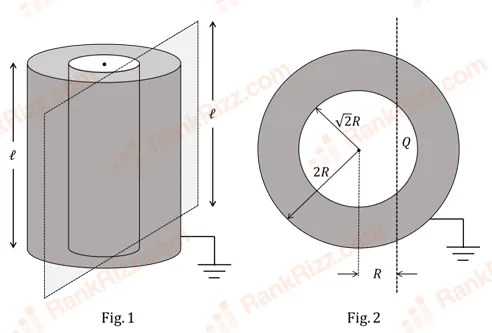
Two co-axial conducting cylinders of same length ℓ\ell with radii 2R\sqrt{2}R and 2R2R are kept, as shown in Fig. 1. The charge on the inner cylinder is QQ and the outer cylinder is grounded. The annular region between the cylinders is filled with a material of dielectric constant κ=5\kappa = 5. Consider an imaginary plane of the same length ℓ\ell at a distance RR from the common axis of the cylinders. This plane is parallel to the axis of the cylinders. The cross-sectional view of this arrangement is shown in Fig. 2. Ignoring edge effects, the flux of the electric field through the plane is (ϵ0\epsilon_0 is the permittivity of free space):

Figure for JEE Advanced 2025 Physics question on Electric flux and Gauss's law
  1. A

    Q30ϵ0\frac{Q}{30\epsilon_0}

  2. B

    Q15ϵ0\frac{Q}{15\epsilon_0}

  3. C

    Q60ϵ0\frac{Q}{60\epsilon_0}

  4. D

    Q120ϵ0\frac{Q}{120\epsilon_0}

JEE ADVANCED 2025 · PAPER 2Relation between field and potential, equipotential surfacesTRANSCRIBED

A positive point charge of 10−810^{-8} C is kept at a distance of 20 cm from the center of a neutral conducting sphere of radius 10 cm. The sphere is then grounded and the charge on the sphere is measured. The grounding is then removed and subsequently the point charge is moved a distance of 10 cm further away from the center of the sphere along the radial direction. Taking 14πϵ0=9×10⁹\frac{1}{4\pi\epsilon_0} = 9 \times 10^9 Nm2^2/C2^2 (where ϵ0\epsilon_0 is the permittivity of free space), which of the following statements is/are correct:

  1. A

    Before the grounding, the electrostatic potential of the sphere is 450 V.

  2. B

    Charge flowing from the sphere to the ground because of grounding is 5×10−95 \times 10^{-9} C.

  3. C

    After the grounding is removed, the charge on the sphere is −5×10⁻⁹-5 \times 10^{-9} C.

  4. D

    The final electrostatic potential of the sphere is 300 V.

JEE ADVANCED 2025 · PAPER 2Electric field of continuous charge distributionsTRANSCRIBED

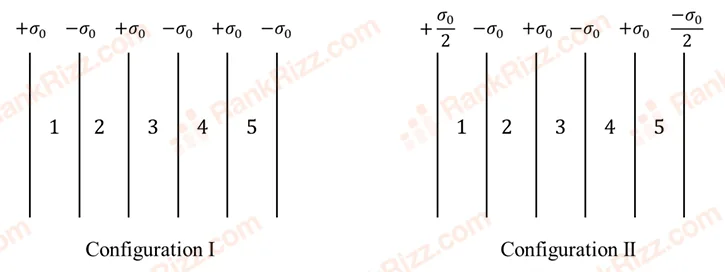
Six infinitely large and thin non-conducting sheets are fixed in configurations I and II. As shown in the figure, the sheets carry uniform surface charge densities which are indicated in terms of σ0\sigma_0. The separation between any two consecutive sheets is 1 μ1 \, \mum. The various regions between the sheets are denoted as 1, 2, 3, 4 and 5. If σ0=9 μ\sigma_0 = 9 \, \muC/m2^2, then which of the following statements is/are correct:

(Take permittivity of free space ϵ0=9×10⁻¹²\epsilon_0 = 9 \times 10^{-12} F/m)

Figure for JEE Advanced 2025 Physics question on Electric field of continuous charge distributions
  1. A

    In region 4 of the configuration I, the magnitude of the electric field is zero.

  2. B

    In region 3 of the configuration II, the magnitude of the electric field is σ0ϵ0\frac{\sigma_0}{\epsilon_0}.

  3. C

    Potential difference between the first and the last sheets of the configuration I is 5 V.

  4. D

    Potential difference between the first and the last sheets of the configuration II is zero.

JEE ADVANCED 2025 · PAPER 1Electric dipole and dipole in external fieldTRANSCRIBED

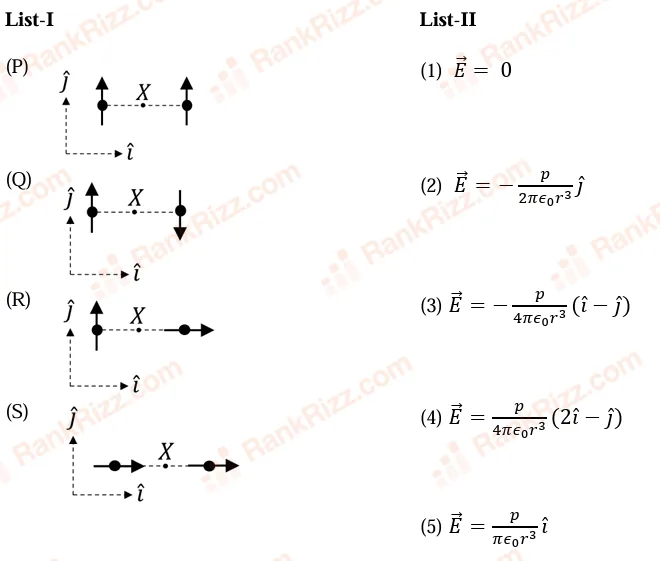
List-I shows four configurations, each consisting of a pair of ideal electric dipoles. Each dipole has a dipole moment of magnitude pp, oriented as marked by arrows in the figures. In all the configurations the dipoles are fixed such that they are at a distance 2r2r apart along the xx direction. The midpoint of the line joining the two dipoles is XX. The possible resultant electric fields E⃗\vec{E} at XX are given in List-II.

Choose the option that describes the correct match between the entries in List-I to those in List-II.

Figure for JEE Advanced 2025 Physics question on Electric dipole and dipole in external field
  1. A

    P→\to3, Q→\to1, R→\to2, S→\to4

  2. B

    P→\to4, Q→\to5, R→\to3, S→\to1

  3. C

    P→\to2, Q→\to1, R→\to4, S→\to5

  4. D

    P→\to2, Q→\to1, R→\to3, S→\to5

JEE ADVANCED 2024 · PAPER 1Electric charge and Coulomb's lawTRANSCRIBED

Two beads, each with charge qq and mass mm, are on a horizontal, frictionless, non-conducting, circular hoop of radius RR. One of the beads is glued to the hoop at some point, while the other one performs small oscillations about its equilibrium position along the hoop. The square of the angular frequency of the small oscillations is given by

[ε0\varepsilon_0 is the permittivity of free space.]

  1. A

    q24πε0R3m\frac{q^2}{4\pi\varepsilon_0 R^3 m}

  2. B

    q232πε0R3m\frac{q^2}{32\pi\varepsilon_0 R^3 m}

  3. C

    q28πε0R3m\frac{q^2}{8\pi\varepsilon_0 R^3 m}

  4. D

    q216πε0R3m\frac{q^2}{16\pi\varepsilon_0 R^3 m}

JEE ADVANCED 2024 · PAPER 2Electric dipole and dipole in external fieldTRANSCRIBED

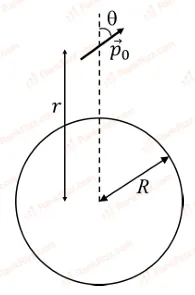
A small electric dipole p⃗0\vec{p}_0, having a moment of inertia II about its center, is kept at a distance rr from the center of a spherical shell of radius RR. The surface charge density σ\sigma is uniformly distributed on the spherical shell. The dipole is initially oriented at a small angle θ\theta as shown in the figure. While staying at a distance rr, the dipole is free to rotate about its center.

Figure for JEE Advanced 2024 Physics question on Electric dipole and dipole in external field

If released from rest, then which of the following statement(s) is (are) correct?

[ε0\varepsilon_0 is the permittivity of free space.]

  1. A

    The dipole will undergo small oscillations at any finite value of rr.

  2. B

    The dipole will undergo small oscillations at any finite value of r>Rr > R.

  3. C

    The dipole will undergo small oscillations with an angular frequency of 2σp0ε0I\sqrt{\dfrac{2\sigma p_0}{\varepsilon_0 I}} at r=2Rr = 2R

  4. D

    The dipole will undergo small oscillations with an angular frequency of σp0100ε0I\sqrt{\dfrac{\sigma p_0}{100 \varepsilon_0 I}} at r=10Rr = 10R

JEE ADVANCED 2024 · PAPER 2Electric flux and Gauss's lawTRANSCRIBED

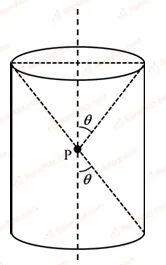
A charge is kept at the central point PP of a cylindrical region. The two edges subtend a half-angle θ\theta at PP, as shown in the figure. When θ=30∘\theta = 30^\circ, then the electric flux through the curved surface of the cylinder is Φ\Phi. If θ=60∘\theta = 60^\circ, then the electric flux through the curved surface becomes Φ/n\Phi / \sqrt{n}, where the value of nn is ________.

Figure for JEE Advanced 2024 Physics question on Electric flux and Gauss's law
JEE ADVANCED 2024 · PAPER 2Relation between field and potential, equipotential surfacesTRANSCRIBED

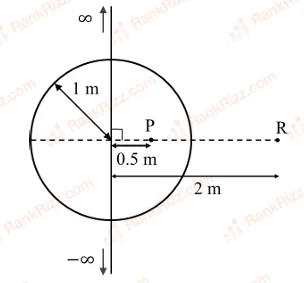
An infinitely long thin wire, having a uniform charge density per unit length of 5 nCm5\ \frac{nC}{m} , is passing through a spherical shell of radius 1 m1\ m, as shown in the figure. A 10 nC10\ nC charge is distributed uniformly over the spherical shell. If the configuration of the charges remains static, the magnitude of the potential difference between points PP and RR, in Volt, is ________.

[Given: In SI units 14πε0=9×10⁹\dfrac{1}{4\pi \varepsilon_0} = 9 \times 10^9, ln 2 = 0.7. Ignore the area pierced by the wire.]

Figure for JEE Advanced 2024 Physics question on Relation between field and potential, equipotential surfaces
JEE ADVANCED 2023 · PAPER 2Electric dipole and dipole in external fieldTRANSCRIBED

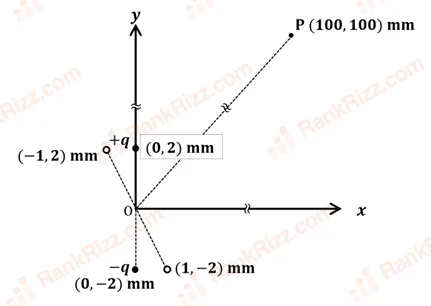
An electric dipole is formed by two charges +q+q and −q-q located in xy-plane at (0, 2) mm and (0, -2) mm, respectively, as shown in the figure. The electric potential at point P(100, 100) mm due to the dipole is V0V_0. The charges +q+q and −q-q are then moved to the points (-1, 2) mm and (1, -2) mm, respectively. What is the value of electric potential at P due to the new dipole?

Figure for JEE Advanced 2023 Physics question on Electric dipole and dipole in external field
  1. A

    V0/4V_0/4

  2. B

    V0/2V_0/2

  3. C

    V0/2V_0/\sqrt{2}

  4. D

    3V0/43V_0/4

JEE ADVANCED 2022 · PAPER 2Electric flux and Gauss's lawTRANSCRIBED

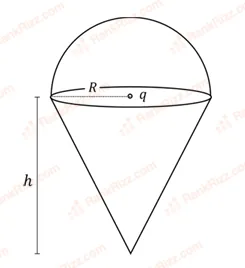
A charge qq is surrounded by a closed surface consisting of an inverted cone of height hh and base radius RR, and a hemisphere of radius RR as shown in the figure. The electric flux through the conical surface is nq6ϵ0\dfrac{nq}{6\epsilon_0} (in SI units). The value of nn is _______.

Figure for JEE Advanced 2022 Physics question on Electric flux and Gauss's law
JEE ADVANCED 2022 · PAPER 2Electric flux and Gauss's lawTRANSCRIBED

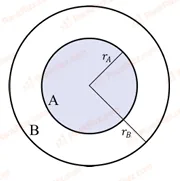
In the figure, the inner (shaded) region A represents a sphere of radius rA=1r_A = 1, within which the electrostatic charge density varies with the radial distance rr from the center as ρA=kr\rho_A = kr, where kk is positive. In the spherical shell B of outer radius rBr_B, the electrostatic charge density varies as ρB=2kr\rho_B = \dfrac{2k}{r}. Assume that dimensions are taken care of. All physical quantities are in their SI units.

Figure for JEE Advanced 2022 Physics question on Electric flux and Gauss's law

Which of the following statement(s) is(are) correct?

  1. A

    If rB=32r_B = \sqrt{\dfrac{3}{2}}, then the electric field is zero everywhere outside B.

  2. B

    If rB=32r_B = \dfrac{3}{2}, then the electric potential just outside B is kϵ0\dfrac{k}{\epsilon_0}.

  3. C

    If rB=2r_B = 2, then the total charge of the configuration is 15πk15\pi k.

  4. D

    If rB=52r_B = \dfrac{5}{2}, then the magnitude of the electric field just outside B is 13πkϵ0\dfrac{13\pi k}{\epsilon_0}.

JEE ADVANCED 2022 · PAPER 2Relation between field and potential, equipotential surfacesTRANSCRIBED

A disk of radius RR with uniform positive charge density σ\sigma is placed on the xyxy plane with its center at the origin. The Coulomb potential along the z-axis is

V(z)=σ2ϵ0(R2+z2−z)V(z) = \dfrac{\sigma}{2\epsilon_0}\left(\sqrt{R^2 + z^2} - z\right)

A particle of positive charge qq is placed initially at rest at a point on the z axis with z=z0z = z_0 and z0>0z_0 > 0. In addition to the Coulomb force, the particle experiences a vertical force F⃗=−ck^\vec{F} = -c\hat{k} with c>0c > 0. Let β=2cϵ0qσ\beta = \dfrac{2c\epsilon_0}{q\sigma}. Which of the following statement(s) is(are) correct?

  1. A

    For β=14\beta = \dfrac{1}{4} and z0=257Rz_0 = \dfrac{25}{7}R, the particle reaches the origin.

  2. B

    For β=14\beta = \dfrac{1}{4} and z0=37Rz_0 = \dfrac{3}{7}R, the particle reaches the origin.

  3. C

    For β=14\beta = \dfrac{1}{4} and z0=R3z_0 = \dfrac{R}{\sqrt{3}}, the particle returns back to z=z0z = z_0.

  4. D

    For β>1\beta > 1 and z0>0z_0 > 0, the particle always reaches the origin.

JEE ADVANCED 2022 · PAPER 1Electric flux and Gauss's lawTRANSCRIBED

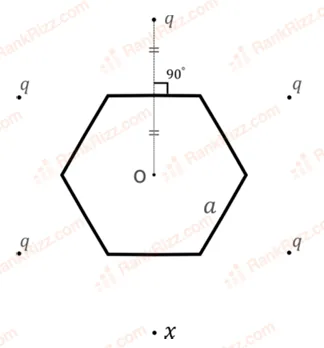
Six charges are placed around a regular hexagon of side length aa as shown in the figure. Five of them have charge qq, and the remaining one has charge xx. The perpendicular from each charge to the nearest hexagon side passes through the center O of the hexagon and is bisected by the side.

Figure for JEE Advanced 2022 Physics question on Electric flux and Gauss's law

Which of the following statement(s) is(are) correct in SI units?

  1. A

    When x=qx = q, the magnitude of the electric field at O is zero.

  2. B

    When x=−qx = -q, the magnitude of the electric field at O is q6πϵ0a2\frac{q}{6\pi \epsilon_0 a^2}.

  3. C

    When x=2qx = 2q, the potential at O is 7q43πϵ0a\frac{7q}{4\sqrt{3}\pi \epsilon_0 a}.

  4. D

    When x=−3qx = -3q, the potential at O is 3q43πϵ0a\frac{3q}{4\sqrt{3}\pi \epsilon_0 a}.

JEE ADVANCED 2020 · PAPER 2Electric field of continuous charge distributionsTRANSCRIBED

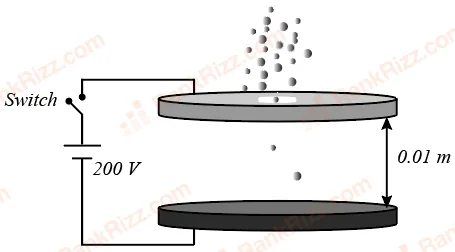
Two large circular discs separated by a distance of 0.01 m are connected to a battery via a switch as shown in the figure. Charged oil drops of density 900 kg m−3^{−3} are released through a tiny hole at the center of the top disc. Once some oil drops achieve terminal velocity, the switch is closed to apply a voltage of 200 V across the discs. As a result, an oil drop of radius 8×10−78 \times 10^{−7} m stops moving vertically and floats between the discs. The number of electrons present in this oil drop is ________. (neglect the buoyancy force, take acceleration due to gravity = 10 ms−2^{−2} and charge on an electron (e) = 1.6×10−191.6 \times 10^{-19} C)

Figure for JEE Advanced 2020 Physics question on Electric field of continuous charge distributions
JEE ADVANCED 2020 · PAPER 2Electric dipole and dipole in external fieldTRANSCRIBED

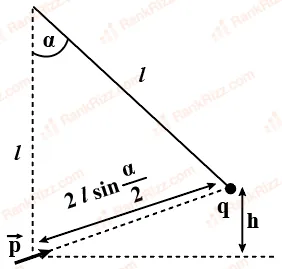
A point charge q of mass 𝑚 is suspended vertically by a string of length 𝑙. A point dipole of dipole moment p→\overrightarrow{p} is now brought towards q from infinity so that the charge moves away. The final equilibrium position of the system including the direction of the dipole, the angles and distances is shown in the figure below. If the work done in bringing the dipole to this position is N×(mgh)N \times (mgh), where g is the acceleration due to gravity, then the value of 𝑁 is _________ . (Note that for three coplanar forces keeping a point mass in equilibrium, Fsin⁡θ\frac{F}{\sin \theta} is the same for all forces, where 𝐹 is any one of the forces and θ\theta is the angle between the other two forces)

Figure for JEE Advanced 2020 Physics question on Electric dipole and dipole in external field
JEE ADVANCED 2020 · PAPER 1Electric field of continuous charge distributionsTRANSCRIBED

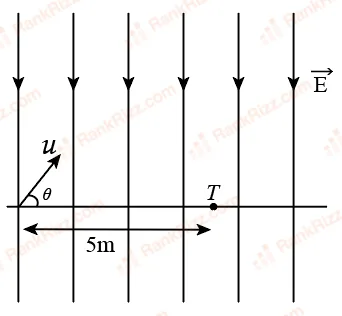
A uniform electric field, E→=−4003y^NC−1\overrightarrow{E} = −400\sqrt{3}\hat{y} NC^{−1} is applied in a region. A charged particle of mass m carrying positive charge q is projected in this region with an initial speed of 210×106ms−12\sqrt{10} \times 106 ms^{−1}. This particle is aimed to hit a target T, which is 5 m away from its entry point into the field as shown schematically in the figure. Take qm=1010Ckg−1\frac{q}{m} = 10^{10} Ckg^{−1}. Then

Figure for JEE Advanced 2020 Physics question on Electric field of continuous charge distributions
  1. A

    the particle will hit T if projected at an angle 45∘45^{\circ} from the horizontal

  2. B

    the particle will hit T if projected either at an angle 30∘30^{\circ} or 60∘60^{\circ} from the horizontal

  3. C

    time taken by the particle to hit T could be 56μs\sqrt{\frac{5}{6}} \mu s as well as 52μs\sqrt{\frac{5}{2}} \mu s

  4. D

    time taken by the particle to hit T is 53μs\sqrt{\frac{5}{3}} \mu s

JEE ADVANCED 2020 · PAPER 2Electric charge and Coulomb's lawTRANSCRIBED

Two identical non-conducting solid spheres of same mass and charge are suspended in air from a common point by two non-conducting, massless strings of same length. At equilibrium, the angle between the strings is α\alpha. The spheres are now immersed in a dielectric liquid of density 800 kg m−3^{−3} and dielectric constant 21. If the angle between the strings remains the same after the immersion, then

  1. A

    electric force between the spheres remains unchanged

  2. B

    electric force between the spheres reduces

  3. C

    mass density of the spheres is 840 kg m−3^{−3}

  4. D

    the tension in the strings holding the spheres remains unchanged

JEE ADVANCED 2020 · PAPER 1Electric dipole and dipole in external fieldTRANSCRIBED

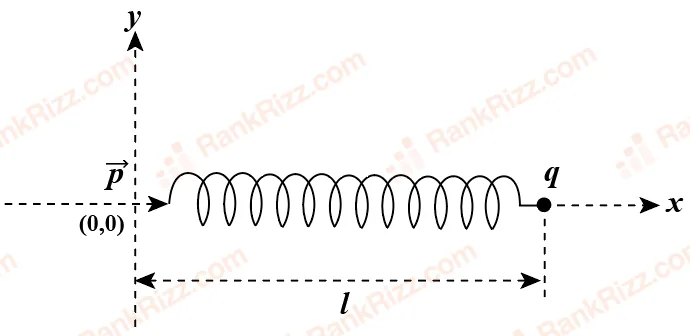
One end of a spring of negligible unstretched length and spring constant k is fixed at the origin (0,0). A point particle of mass m carrying a positive charge q is attached at its other end. The entire system is kept on a smooth horizontal surface. When a point dipole p→\overrightarrow{p} pointing towards the charge q is fixed at the origin, the spring gets stretched to a length l and attains a new equilibrium position (see figure below). If the point mass is now displaced slightly by △l<<l\triangle l << l from its equilibrium position and released, it is found to oscillate at frequency 1δkm\frac{1}{\delta}\sqrt{\frac{k}{m}}. The value of δ\delta is ______.

Figure for JEE Advanced 2020 Physics question on Electric dipole and dipole in external field