RankRizz

Thermal Properties of Matter — JEE Advanced Previous Year Questions

Every Thermal Properties of Matter question JEE Advanced has set from 2007–2024, grouped by the idea it tests rather than the order of the syllabus. 23 questions across 3 distinct ideas. Free to read, answer key on every one.

Questions

23

Distinct ideas

3

Share of marks

2.8%

Difficulty

EASY

The ideas inside Thermal Properties of Matter

A chapter is not one subject — it is a handful of procedures the examiner reuses. These are the ones Thermal Properties of Matter questions actually test.

01Temperature scales and thermal expansionset 3×
02Calorimetry and specific heat capacityset 7×
03Change of state and latent heatNot set in Advanced
04Heat conduction and thermal resistanceNot set in Advanced
05Thermal radiation: Stefan's law, Wien's law and Kirchhoff's lawset 13×
06Newton's law of coolingNot set in Advanced

Thermal Properties of Matter weightage, year by year

The share of each year’s Physics questions that came from Thermal Properties of Matter, counted from the 19 papers we hold for the last 10 years, and paper by paper inside a year.

Falling: 1.0% of Physics questions in 2024–2026, down from 3.4% in 2017–2023. Its heaviest year was 2018, at 5.6%. Not asked at all in 2022, 2025, 2026.

20260 / 340.0%PAPER 1 0.0%PAPER 2 0.0%
20250 / 320.0%PAPER 1 0.0%PAPER 2 0.0%
20241 / 342.9%PAPER 1 5.9%PAPER 2 0.0%
20231 / 342.9%PAPER 1 5.9%PAPER 2 0.0%
20220 / 360.0%PAPER 1 0.0%PAPER 2 0.0%
20211 / 382.6%PAPER 1 5.3%PAPER 2 0.0%
20202 / 365.6%PAPER 1 5.6%PAPER 2 5.6%
20192 / 365.6%PAPER 1 11.1%PAPER 2 0.0%
20181 / 185.6%1 PAPER
20171 / 362.8%PAPER 1 5.6%PAPER 2 0.0%

“QS” is Thermal Properties of Matter questions out of all Physics questions that year. A year with more sittings asks more questions, which is why the share, not the count, is the number to compare.

Thermal Properties of Matter: quick answers

How many Thermal Properties of Matter questions has JEE Advanced asked?

23 questions from 2007–2024. Over the last 20 papers, Thermal Properties of Matter carried about 2.8% of Physics marks.

Which Thermal Properties of Matter topics come up most?

Thermal radiation: Stefan's law, Wien's law and Kirchhoff's law (13 questions), Calorimetry and specific heat capacity (7 questions), Temperature scales and thermal expansion (3 questions). Start with these, they are what the examiner keeps coming back to.

Is Thermal Properties of Matter important for JEE Advanced?

Falling: 1.0% of Physics questions in 2024–2026, down from 3.4% in 2017–2023. Its heaviest year was 2018, at 5.6%. Not asked at all in 2022, 2025, 2026. It has carried about 2.8% of Physics marks in recent papers, rated easy on our difficulty scale. The year-by-year table above shows how that has moved.

Do these Thermal Properties of Matter PYQs have answers and solutions?

Yes. Every question shows its official answer key, and a worked solution opens on the question’s own page wherever we have one. Reading and checking answers is free, no sign-up needed.

What’s the fastest way to revise Thermal Properties of Matter?

Do one past question per idea first: Thermal Properties of Matter has 3 distinct ideas, listed above. Then practise the topics you get wrong, or build a timed test from this chapter.

Every Thermal Properties of Matter question

1–20 OF 23 · NEWEST FIRST

JEE ADVANCED 2024 · PAPER 1Calorimetry and specific heat capacityTRANSCRIBED

The specific heat capacity of a substance is temperature dependent and is given by the formula C=kTC = kT, where kk is a constant of suitable dimensions in SI units, and TT is the absolute temperature. If the heat required to raise the temperature of 1 kg of the substance from −73°-73°C to 27°27°C is nknk, the value of nn is ______.

[Given: 00 K =−273°= -273° C.]

JEE ADVANCED 2023 · PAPER 1Thermal radiation: Stefan's law, Wien's law and Kirchhoff's lawTRANSCRIBED

Match the temperature of a black body given in List-I with an appropriate statement in List-II, and choose the correct option.

[Given: Wien's constant as 2.9×10−32.9 \times 10^{-3} m-K and hce=1.24×10⁻⁶\frac{hc}{e} = 1.24 \times 10^{-6} V-m]

List-IList-II
(P)2000 K(1)The radiation at peak wavelength can lead to emission of photoelectrons from a metal of work function 4 eV
(Q)3000 K(2)The radiation at peak wavelength is visible to human eye.
(R)5000 K(3)The radiation at peak emission wavelength will result in the widest central maximum of a single slit diffraction.
(S)10000 K(4)The power emitted per unit area is 1/16 of that emitted by a blackbody at temperature 6000 K.
(5)The radiation at peak emission wavelength can be used to image human bones.
  1. A

    P →\to 3, Q →\to 5, R →\to 2, S →\to 3

  2. B

    P →\to 3, Q →\to 2, R →\to 4, S →\to 1

  3. C

    P →\to 3, Q →\to 4, R →\to 2, S →\to 1

  4. D

    P →\to 1, Q →\to 2, R →\to 5, S →\to 3

JEE ADVANCED 2021 · PAPER 1Thermal radiation: Stefan's law, Wien's law and Kirchhoff's lawTRANSCRIBED

A small object is placed at the center of a large evacuated hollow spherical container. Assume that the container is maintained at 0 K. At time 𝑡=0, the temperature of the object is 200 K. The temperature of the object becomes 100 K at t=t1t = t_1 and 50 K at t=t2t = t_2. Assume the object and the container to be ideal black bodies. The heat capacity of the object does not depend on temperature. The ratio (t2t1)\left(\frac{t_2}{t_1} \right) is ___.

JEE ADVANCED 2020 · PAPER 1Thermal radiation: Stefan's law, Wien's law and Kirchhoff's lawTRANSCRIBED

The filament of a light bulb has surface area 64mm264 mm^{2}. The filament can be considered as a black
body at temperature 2500 K emitting radiation like a point source when viewed from far. At night the light bulb is observed from a distance of 100 m. Assume the pupil of the eyes of the observer to be circular with radius 3 mm. Then
(Take Stefan-Boltzmann constant = 5.67×10⁻⁸Wm−2K−45.67 \times 10−8 Wm^{−2}K^{−4}, Wien’s displacement constant = 2.90×10⁻³m−K2.90 \times 10^{−3} m^{-K}, Planck’s constant = 6.63×10−346.63 \times 10^{−34}Js, speed of light in vacuum = 3.00×10⁸ms−13.00 \times 10^{8} ms^{−1})

  1. A

    power radiated by the filament is in the range 642 W to 645 W

  2. B

    radiated power entering into one eye of the observer is in the range 3.15×10⁻⁸Wto3.25×10−8W3.15 \times 10^{−8} W to 3.25 \times 10^{−8} W

  3. C

    the wavelength corresponding to the maximum intensity of light is 1160 nm

  4. D

    taking the average wavelength of emitted radiation to be 1740 nm, the total number of photons entering per second into one eye of the observer is in the range 2.75×10112.75 \times 10^{11} to 2.85×10112.85 \times 10^{11}

JEE ADVANCED 2020 · PAPER 2Thermal radiation: Stefan's law, Wien's law and Kirchhoff's lawTRANSCRIBED

A container with 1 kg of water in it is kept in sunlight, which causes the water to get warmer than the surroundings. The average energy per unit time per unit area received due to the sunlight is 700 Wm−2^{−2} and it is absorbed by the water over an effective area of 0.05 m2^2. Assuming that the heat loss from the water to the surroundings is governed by Newton’s law of cooling, the difference (in ∘C^\circ C) in the temperature of water and the surroundings after a long time will be _____________. (Ignore effect of the container, and take constant for Newton’s law of cooling = 0.001 s−1^{−1}, Heat capacity of water = 4200 J kg−1^{−1} K−1^{−1})

JEE ADVANCED 2019 · PAPER 1Calorimetry and specific heat capacityTRANSCRIBED

A current carrying wire heats a metal rod. The wire provides a constant power (P) to the rod. The metal rod is enclosed in an insulated container. It is observed that the temperature (T) inthe metal rod changes with time (t) as
T(t)=T0(1+βt14),T(t) = T_0 (1 + \beta t^{\frac{1}{4}}),
where β\beta is a constant with appropriate dimension while T0T_0 is a constant with dimension of temperature. The heat capacity of the metal is,

  1. A

    4P(T(t)−T0)3β4T04\frac{4P(T(t) - T_0)^3}{\beta^4 T_0^4}

  2. B

    4P(T(t)−T0)4β4T05\frac{4P(T(t) - T_0)^4}{\beta^4 T_0^5}

  3. C

    4P(T(t)−T0)2β4T03\frac{4P(T(t) - T_0)^2}{\beta^4 T_0^3}

  4. D

    4P(T(t)−T0)β4T02\frac{4P(T(t) - T_0)}{\beta^4 T_0^2}

JEE ADVANCED 2019 · PAPER 1Calorimetry and specific heat capacityTRANSCRIBED

A liquid at 30∘C30^\circ C is poured very slowly into a Calorimeter that is at temperature of 110∘C110^\circ C . The boiling temperature of the liquid is 80∘C80^\circ C . It is found that the first 5 gm of the liquid completely evaporates. After pouring another 80 gm of the liquid the equilibrium temperature is found to be 50∘C50^\circ C . The ratio of the Latent heat of the liquid to its specific heat will be ∘C^\circ C
[Neglect the heat exchange with surrounding]

JEE ADVANCED 2018 · PAPER 1Thermal radiation: Stefan's law, Wien's law and Kirchhoff's lawTRANSCRIBED

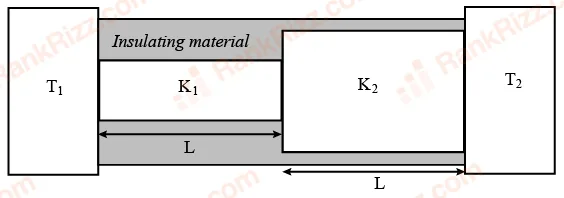
Two conducting cylinders of equal length but different radii are connected in series between two heat baths kept at temperatures 𝑇1=300𝐾and𝑇2𝑇_{1} = 300 𝐾 and 𝑇_{2} = 100 𝐾, as shown in the figure. The radius of the bigger cylinder is twice that of the smaller one and the thermal conductivities of the materials of the smaller and the larger cylinders are 𝐾1and𝐾2𝐾_{1} and 𝐾_{2} respectively. If the temperature at the junction of the two cylinders in the steady state is 200 𝐾, then 𝐾1𝐾2\frac{𝐾_{1}}{𝐾_{2}} =__________.

Figure for JEE Advanced 2018 Physics question on Thermal radiation: Stefan's law, Wien's law and Kirchhoff's law
JEE ADVANCED 2017 · PAPER 1Thermal radiation: Stefan's law, Wien's law and Kirchhoff's lawTRANSCRIBED

A human body has a surface area of approximately 1 m2m^2. The normal body temperature is 10 K above the surrounding room temperature T0T_0. Take the room temperature to be T0=300KT_0 = 300 K. For T0=300KT_0 = 300 K, the value of σT04=460Wm−2\sigma T_0^4 = 460 Wm^{-2} (where σ\sigma is the Stefan-Boltzmann constant). Which of the following options is/are correct?

  1. A

    The amount of energy radiated by the body in 1 second is close to 60 Joules

  2. B

    If the surrounding temperature reduces by a small amount △T0≪T0\triangle T_0 \ll T_0, then to maintain the same body temperature the same (living) human being needs to radiate △W=4σT03△T0\triangle W = 4 \sigma T_0^3 \triangle T_0 more energy per unit time

  3. C

    Reducing the exposed surface area of the body (e.g. by curling up) allows humans to maintain the same body temperature while reducing the energy lost by radiation

  4. D

    If the body temperature rises significantly then the peak in the spectrum of electromagnetic radiation emitted by the body would shift to longer wavelengths

JEE ADVANCED 2016 · PAPER 2Temperature scales and thermal expansionTRANSCRIBED

The ends Q and of two thin wires, PQ and RS, are soldered (joined) together. Initially each of the wires has a length of 1 m at 10∘C10^\circ C. Now the end P is maintained at 10∘C10^\circ C, while the end S is heated and maintained at 400∘C400^\circ C. The system is thermally insulated from its surroundings. If the thermal conductivity of wire PQ is twice that of the wire RS and the coefficient of linear thermal expansion of PQ is 1.2×10⁻⁵K−11.2 \times 10^{-5}K^{-1} the change in length of the wire PQ is

  1. A

    0.78 mm

  2. B

    0.90 mm

  3. C

    1.56 mm

  4. D

    2.34 mm

JEE ADVANCED 2016 · PAPER 1Thermal radiation: Stefan's law, Wien's law and Kirchhoff's lawTRANSCRIBED

A metal is heated in a furnace where a sensor is kept above the metal surface to read the power radiated (P) by the metal. The sensor hasa scale that displays log, (PP0)\left(\frac{P}{P_0}\right), where P0P_0 is a constant. When the metal surface is at a temperature of 487∘C487^\circ C, the sensor shows a value 1. Assume that the emissivity of the metallic surface remains constant. What is the value displayed by the sensor when the temperature of the metal surface is raised to 2767∘C2767^\circ C?

JEE ADVANCED 2015 · PAPER 1Thermal radiation: Stefan's law, Wien's law and Kirchhoff's lawTRANSCRIBED

Two spherical stars A and B emit blackbody radiation. The radius of A is 400 times that of B and A emits 10410^4 times the power emitted from B. The ratio (λAλB)\left(\frac{\lambda_A}{\lambda_B}\right) of their wavelengths λA\lambda_A and λB\lambda_B at which the peaks occurin their respective radiation curves is

JEE ADVANCED 2014 · PAPER 2Thermal radiation: Stefan's law, Wien's law and Kirchhoff's lawTRANSCRIBED

Parallel rays of light of intensity I=912Wm−2I = 912 Wm^{-2} are incident on a spherical black body kept in surroundings of temperature 300 K. Take Stefan-Boltzmann constant σ=5.7×10⁻⁸Wm−2K−4\sigma = 5.7 \times 10^{-8} Wm^{-2} K^{-4} and assume that the energy exchange with the surroundingsis only through radiation. The final steady state temperature of the black body is close to

  1. A

    330 K

  2. B

    660 K

  3. C

    990 K

  4. D

    1550 K

JEE ADVANCED 2013 · PAPER 2Calorimetry and specific heat capacityTRANSCRIBED

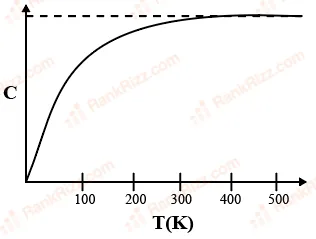
The figure below shows the variation of specific heat capacity (C) of a solid as a function of temperature (T). The temperature is increased continuously from 0 to 500 K at a constant rate. Ignoring any volume change, the following statement(s)is (are) correct to a reasonable approximation.

Figure for JEE Advanced 2013 Physics question on Calorimetry and specific heat capacity
  1. A

    the rate at which heat is absorbed in the range 0-100 K varies linearly with temperature T.

  2. B

    heat absorbed in increasing the temperature from 0-100 K is less than the heat required for increasing the temperature from 400-500 K.

  3. C

    there is no changein the rate of heat absorption in the range 400-500 K.

  4. D

    the rate of heat absorption increases in the range 200-300 K.

JEE ADVANCED 2013 · PAPER 1Thermal radiation: Stefan's law, Wien's law and Kirchhoff's lawTRANSCRIBED

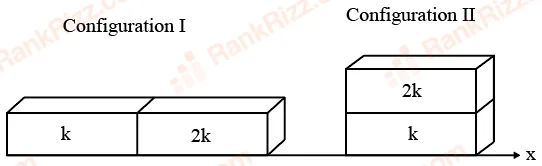
Two rectangular blocks, having identical dimensions, can be arranged either in configuration I or in configuration II as shown in the figure. One of the blocks has thermal conductivity K and the other 2K. The temperature difference between the ends along the x-axis is the same in both the configurations. It takes 9 s to transport a certain amount of heat from the hot end to the cold end in the configuration I. The time to transport the same amount of heat in the configuration II is

Figure for JEE Advanced 2013 Physics question on Thermal radiation: Stefan's law, Wien's law and Kirchhoff's law
  1. A

    2.0 s

  2. B

    3.0 s

  3. C

    4.5 s

  4. D

    6.0 s

JEE ADVANCED 2012 · PAPER 1Thermal radiation: Stefan's law, Wien's law and Kirchhoff's lawTRANSCRIBED

Three very large plates of same area are kept parallel and close to each other. They are considered as ideal black surfaces and have very high thermal conductivity. Thefirst and
third plates are maintained at temperatures 27 and 37 respectively. The temperature of the middle (i.e. second) plate under steady state condition is

  1. A

    (652)14T\left(\frac{65}{2}\right)^{\frac{1}{4}}T

  2. B

    (974)14T\left(\frac{97}{4}\right)^{\frac{1}{4}}T

  3. C

    (972)14T\left(\frac{97}{2}\right)^{\frac{1}{4}}T

  4. D

    (97)14T\left({97}\right)^{\frac{1}{4}}T

JEE ADVANCED 2012 · PAPER 2Calorimetry and specific heat capacityTRANSCRIBED

Two moles of ideal helium gas are in a rubber balloon at 30∘C30^\circ C .The balloon is fully expandable and can be assumed to require no energy in its expansion. The temperature of the gas in the balloon is slowly changed to 35∘C35^\circ C.The amount of heat required in raising the temperature is nearly (take R = 8.31 J/mol.K)

  1. A

    62 J

  2. B

    104 J

  3. C

    124 J

  4. D

    208 J

JEE ADVANCED 2011 · PAPER 1Thermal radiation: Stefan's law, Wien's law and Kirchhoff's lawTRANSCRIBED

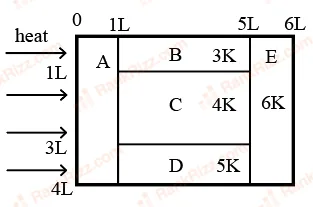
A composite book is made of slabs A, B, C, D and E of different thermal conductivities (given in terms of a constant K) and sizes (given in terms of length, L) as shown in the figure. All slabs are of same width. Heat 'Q' flow only from left to right through the blocks. Then in steady state-

Figure for JEE Advanced 2011 Physics question on Thermal radiation: Stefan's law, Wien's law and Kirchhoff's law
  1. A

    heat flow through A and E slabs are same

  2. B

    heat flow through slab E is maximum

  3. C

    temperature difference across slab E is smallest

  4. D

    heat flow through C = heat flow through B + heat flow through D

JEE ADVANCED 2011 · PAPER 1Temperature scales and thermal expansionTRANSCRIBED

Steel wire of length 'L' at 40∘C40^\circ C is suspended from the ceiling and then a mass 'm' is hung from its free end. The wire is cooled down from 40∘C40^\circ C to 30∘C30^\circ C to region its original length 'L'. The coefficient of linear thermal expansion of the steel is 10−5/∘C10^{-5}/^\circ C, Young's modulus of steel is 1011N/m210^{11} N/m^2 and radius of the wire is 1 mm. Assume that L >> diameter of the wire. Then the value of 'm' in kg is nearly.

JEE ADVANCED 2010 · PAPER 1Thermal radiation: Stefan's law, Wien's law and Kirchhoff's lawTRANSCRIBED

Two spherical bodies A (radius 6 cm) and B (radius 18 cm) are at temperatures T1T_1 and T2T_2, respectively. The maximum intensity in the emission spectrum of A is at 500 nm and in that of B is at 1500 nm. Considering themto be black bodies, what will be the ratio of the rate of total energy radiated by A to that of B ?