RankRizzStart free

Electrostatics — JEE Main Previous Year Questions

Every Electrostatics question JEE Main has set, grouped by the idea it tests rather than the order of the syllabus. 294 questions across 9 distinct ideas. Free to read, answer key on every one.

Questions

294

Distinct ideas

9

Share of marks

6%

Difficulty

MEDIUM

The ideas inside Electrostatics

A chapter is not one subject — it is a handful of procedures the examiner reuses. These are the ones Electrostatics questions actually test.

01Electric charge and Coulomb's lawset 42×
02Electric field due to point charges and superpositionset 25×
03Electric field of continuous charge distributionsset 42×
04Motion and equilibrium of charged bodies in electric fieldsset 7×
05Electric flux and Gauss's lawset 53×
06Electric potential and potential energyset 62×
07Relation between field and potential, equipotential surfacesset 13×
08Electric dipole and dipole in external fieldset 39×
09Conductors, concentric shells and earthingset 11×

Every Electrostatics question

1–20 OF 294 · NEWEST FIRST

JEE MAIN 2026 · 24 JAN S1Electric flux and Gauss's lawTRANSCRIBED

The electrostatic potential in a charged spherical region of radius r varies as , where a and b are constants. The total charge in the sphere of unit radius is . the value of is_____. (permittivity of vacuum is )

  1. A

    -9

  2. B

    -6

  3. C

    -12

  4. D

    -8

JEE MAIN 2026 · 21 JAN S2Relation between field and potential, equipotential surfacesTRANSCRIBED

Consider two identical metallic spheres of radius R each having charge Q and mass m. Their centers have an initial separation of 4R. Both the spheres are given an initial speed of u towards each other. The minimum value of u, so that they can just touch each other is :
(Take and assume > where G is the Gravitational constant)

  1. A

  2. B

  3. C

  4. D

JEE MAIN 2026 · 24 JAN S1Electric dipole and dipole in external fieldTRANSCRIBED

Three charges+ 2q, +3q and -4q are situated at (0, -3a), (2a, 0) and (-2a, 0) respectively in the x y plane. The resultant dipole moment about origin is ___ .

  1. A

  2. B

  3. C

  4. D

JEE MAIN 2026 · 22 JAN S1Electric potential and potential energyTRANSCRIBED

Electric field in a region is given by , where , and . If the electric potential at a point (10, 20) is 500 , then the electric potential at origin is____ .

  1. A

    2000

  2. B

    0

  3. C

    500

  4. D

    1000

JEE MAIN 2026 · 22 JAN S1Electric field due to point charges and superpositionTRANSCRIBED

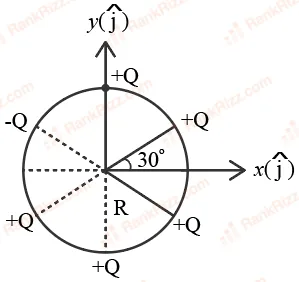
Six point charges are kept apart from each other on the circumference of a
circle of radius as shown in figure . The net electric field at the center of the circle is______.
( is permittivity of free space)

Screenshot_34
  1. A

  2. B

  3. C

  4. D

JEE MAIN 2026 · 22 JAN S2Electric potential and potential energyTRANSCRIBED

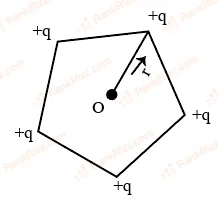
Five positive charges each having charge q are placed at the vertices of a pentagon as shown in the figure. The electric potential (V) and the electric field at the center O of the pentagon due to these five positive charges are:

34
  1. A

    and

  2. B

    and

  3. C

    and

  4. D

    V = 0 and

JEE MAIN 2026 · 24 JAN S1Electric potential and potential energyTRANSCRIBED

There are three co-centric conducting spherical shells A, B and C of radii a, b and c respectively (c > b > a) and they are charged with charge respectively. The potentials of the spheres A, Band C respectively, are :

  1. A

    , ,

  2. B

    ,

  3. C

  4. D

    , ,

JEE MAIN 2026 · 28 JAN S2Electric field of continuous charge distributionsTRANSCRIBED

Identify the correct statements :
A. Electrostatic field lines form closed loops .
B. The eleclric field lines point radially outward when charge is greater than zero.
C. The Gauss - Law is valid only for inverse - square force.
D. The workdone in moving a charged particle in a static eleclric field around a closed path is zero.
E. The motion of a particle under Coulomb's force must take place in a plane.
Choose the correct answer from the options given below:

  1. A

    A, C, E Only

  2. B

    A, B, D, E Only

  3. C

    B, C, D, E Only

  4. D

    A, B, C, D Only

JEE MAIN 2026 · 02 APR S1Relation between field and potential, equipotential surfacesTRANSCRIBED

Two charged conducting spheres S and S of radii 8 cm and 18 cm are connected to each other by a wire. After equilibrium is established, the ratio of electric fields on S and S spheres are E and E respectively. The value of is __________.

  1. A

  2. B

  3. C

  4. D

JEE MAIN 2026 · 23 JAN S1Electric flux and Gauss's lawTRANSCRIBED

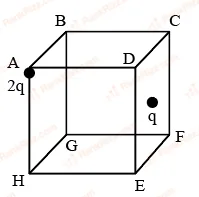
Two point charges 2q and q are placed at vertex A and centre of face CDEF of the cube as shown in figure. The electric flux passing through the cube is :

35
  1. A

  2. B

  3. C

  4. D

JEE MAIN 2026 · 23 JAN S2Electric potential and potential energyTRANSCRIBED

Two charges and  are placed at (-9,0,0)cm and (9,0,0)cm respectively in an external field , where Considering the potential at infinity is 0, the electrostatic energy of the configuration is ______J.

  1. A

    1.4

  2. B

    -90.7

  3. C

    49.3

  4. D

    24.3

JEE MAIN 2026 · 02 APR S1Electric dipole and dipole in external fieldTRANSCRIBED

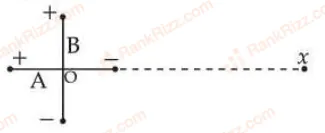
Two short electric dipoles A and B having dipole moment p and p respectively are placed with their axis mutually perpendicular as shown in the figure. The resultant electric field at a point x is making an angle of 60° with the line joining points O and x. The ratio of the dipole moments p/p is __________.

image
  1. A

  2. B

  3. C

  4. D

JEE MAIN 2026 · 04 APR S2Electric dipole and dipole in external fieldTRANSCRIBED

A rigid dipole undergoes a simple harmonic motion about its centre in the presence of an electric field . If another electric field is introduced to the system, what will be the percentage change in the frequency of the oscillation (approximate)?

  1. A

  2. B

  3. C

  4. D

JEE MAIN 2026 · 06 APR S2Relation between field and potential, equipotential surfacesTRANSCRIBED

The electric potential as a function of is given by V. The electric field at a point m is __________ V/m.

  1. A

  2. B

  3. C

  4. D

JEE MAIN 2026 · 04 APR S2Conductors, concentric shells and earthingTRANSCRIBED

Given below are two statements: one is labelled as Assertion A and the other is labelled as Reason R

Assertion A: In electrostatics, a conductor does not store any net charge inside.

Reason R: Inside the capacitor (with no dielectric medium), the free charge carriers, if placed between the plates of capacitor, experience force and drift.
Choose the correct answer from the options given below:

  1. A

    Both A and R are true, and R is the correct explanation of A

  2. B

    Both A and R are true, but R is NOT the correct explanation of A

  3. C

    A is true but R is false

  4. D

    A is false but R is true

JEE MAIN 2026 · 06 APR S1Electric field of continuous charge distributionsTRANSCRIBED

A thin half ring of radius 35 cm is uniformly charged with a total charge of coulomb. If the magnitude of the electric field at centre of the half ring is 100 V/m, then the value of is _______ nC.
C/Nm and

  1. A

    2.14

  2. B

    2.44

  3. C

    3.25

  4. D

    0.7

JEE MAIN 2026 · 21 JAN S1Relation between field and potential, equipotential surfacesTRANSCRIBED

A point charge of is placed at origin. The work done in moving a point charge from point A(4, 4, 2) m to B(2, 2, 1) m is _____J

  1. A

  2. B

  3. C

    0

  4. D

JEE MAIN 2026 · 08 APR S2Electric charge and Coulomb's lawTRANSCRIBED

Two point charges and are placed at points and respectively. Force on charge is __________ N.

  1. A

  2. B

  3. C

  4. D

JEE MAIN 2026 · 28 JAN S1Electric potential and potential energyTRANSCRIBED

Two point charges of 1 nC and 2 nC are placed at the two corners of equilateral triangle of side 3 cm. The work done in bringing a charge of3 nC from infinity to the third corner of the triangle is __

  1. A

    3.3

  2. B

    2.7

  3. C

    27

  4. D

    5.4

JEE MAIN 2026 · 22 JAN S2Electric potential and potential energyTRANSCRIBED

Three small identical drops of water having same charge on each coalesce to form a bigger drop. Then the ratio of the potentials on one initial drop and that on the resultant bigger drop is :

  1. A

  2. B

  3. C

  4. D