RankRizz

Waves — JEE Advanced Previous Year Questions

Every Waves question JEE Advanced has set from 2007–2026, grouped by the idea it tests rather than the order of the syllabus. 36 questions across 4 distinct ideas. Free to read, answer key on every one.

Questions

36

Distinct ideas

4

Share of marks

4.3%

Difficulty

MEDIUM

The ideas inside Waves

A chapter is not one subject — it is a handful of procedures the examiner reuses. These are the ones Waves questions actually test.

01Progressive waves: wave equation, phase and intensityset 7×
02Speed of waves on strings and of sound in mediaNot set in Advanced
03Superposition, interference and beatsset 12×
04Standing waves on strings and rodsset 1×
05Organ pipes and resonance columnsNot set in Advanced
06Doppler effect in soundset 16×

Waves weightage, year by year

The share of each year’s Physics questions that came from Waves, counted from the 19 papers we hold for the last 10 years, and paper by paper inside a year.

Rising: 5.0% of Physics questions in 2024–2026, up from 4.3% in 2017–2023. Its heaviest year was 2023, at 8.8%. Not asked at all in 2022.

20261 / 342.9%PAPER 1 6.3%PAPER 2 0.0%
20252 / 326.3%PAPER 1 6.3%PAPER 2 6.3%
20242 / 345.9%PAPER 1 11.8%PAPER 2 0.0%
20233 / 348.8%PAPER 1 0.0%PAPER 2 17.6%
20220 / 360.0%PAPER 1 0.0%PAPER 2 0.0%
20211 / 382.6%PAPER 1 0.0%PAPER 2 5.3%
20201 / 362.8%PAPER 1 5.6%PAPER 2 0.0%
20192 / 365.6%PAPER 1 5.6%PAPER 2 5.6%
20181 / 185.6%1 PAPER
20172 / 365.6%PAPER 1 11.1%PAPER 2 0.0%

“QS” is Waves questions out of all Physics questions that year. A year with more sittings asks more questions, which is why the share, not the count, is the number to compare.

Waves: quick answers

How many Waves questions has JEE Advanced asked?

36 questions from 2007–2026. Over the last 20 papers, Waves carried about 4.3% of Physics marks.

Which Waves topics come up most?

Doppler effect in sound (16 questions), Superposition, interference and beats (12 questions), Progressive waves: wave equation, phase and intensity (7 questions). Start with these, they are what the examiner keeps coming back to.

Is Waves important for JEE Advanced?

Rising: 5.0% of Physics questions in 2024–2026, up from 4.3% in 2017–2023. Its heaviest year was 2023, at 8.8%. Not asked at all in 2022. It has carried about 4.3% of Physics marks in recent papers, rated medium on our difficulty scale. The year-by-year table above shows how that has moved.

Do these Waves PYQs have answers and solutions?

Yes. Every question shows its official answer key, and a worked solution opens on the question’s own page wherever we have one. Reading and checking answers is free, no sign-up needed.

What’s the fastest way to revise Waves?

Do one past question per idea first: Waves has 4 distinct ideas, listed above. Then practise the topics you get wrong, or build a timed test from this chapter.

Every Waves question

1–20 OF 36 · NEWEST FIRST

JEE ADVANCED 2026 · PAPER 1Superposition, interference and beatsTRANSCRIBED

List-I shows four configurations made of straight and semi-circular narrow tubes containing air. A sound wave of wavelength λ=0.29 m\lambda=0.29\,\mathrm{m} enters these structures at the point SS and a sound detector is placed at DD. Between the points SS and DD, the sound travels only through the tubes. List-II contains the possible smallest values of ll (refer to the figures) for which the detector DD records maximum amplitude. Ignore effects of sharp corners. [Given cos⁡(15∘)=0.97\cos(15^\circ)=0.97]

Choose the option that best describes the match between the entries in List-I to those in List-II.
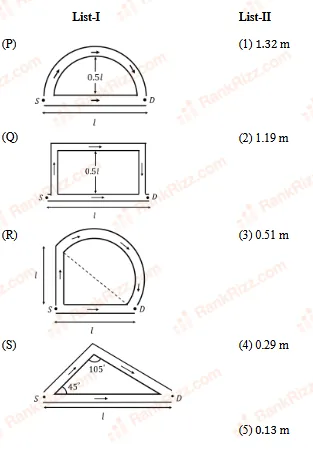
Figure for JEE Advanced 2026 Physics question on Superposition, interference and beats
  1. A

    (P)→\to(4), (Q)→\to(3), (R)→\to(5), (S)→\to(1)

  2. B

    (P)→\to(4), (Q)→\to(3), (R)→\to(1), (S)→\to(5)

  3. C

    (P)→\to(3), (Q)→\to(4), (R)→\to(1), (S)→\to(2)

  4. D

    (P)→\to(3), (Q)→\to(4), (R)→\to(5), (S)→\to(2)

JEE ADVANCED 2025 · PAPER 1Superposition, interference and beatsTRANSCRIBED

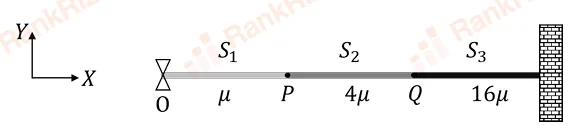
Consider a system of three connected strings, S1S_1, S2S_2 and S3S_3 with uniform linear mass densities μ\mu kg/m, 4μ4\mu kg/m and 16μ16\mu kg/m, respectively, as shown in the figure. S1S_1 and S2S_2 are connected at the point PP, whereas S2S_2 and S3S_3 are connected at the point QQ, and the other end of S3S_3 is connected to a wall. A wave generator O is connected to the free end of S1S_1. The wave from the generator is represented by y=y0cos⁡(ωt−kx)y = y_0 \cos(\omega t - kx) cm, where y0y_0, ω\omega and kk are constants of appropriate dimensions. Which of the following statements is/are correct:

Figure for JEE Advanced 2025 Physics question on Superposition, interference and beats
  1. A

    When the wave reflects from PP for the first time, the reflected wave is represented by y=α1y0cos⁡(ωt+kx+π)y = \alpha_1 y_0 \cos(\omega t + kx + \pi) cm, where α1\alpha_1 is a positive constant.

  2. B

    When the wave transmits through PP for the first time, the transmitted wave is represented by y=α2y0cos⁡(ωt−kx)y = \alpha_2 y_0 \cos(\omega t - kx) cm, where α2\alpha_2 is a positive constant.

  3. C

    When the wave reflects from QQ for the first time, the reflected wave is represented by y=α3y0cos⁡(ωt−kx+π)y = \alpha_3 y_0 \cos(\omega t - kx + \pi) cm, where α3\alpha_3 is a positive constant.

  4. D

    When the wave transmits through QQ for the first time, the transmitted wave is represented by y=α4y0cos⁡(ωt−4kx)y = \alpha_4 y_0 \cos(\omega t - 4kx) cm, where α4\alpha_4 is a positive constant.

JEE ADVANCED 2025 · PAPER 2Doppler effect in soundTRANSCRIBED

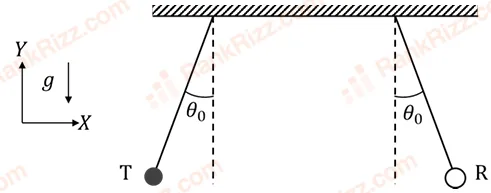
An audio transmitter (T) and a receiver (R) are hung vertically from two identical massless strings of length 8 m with their pivots well separated along the XX axis. They are pulled from the equilibrium position in opposite directions along the XX axis by a small angular amplitude θ0=cos⁡−1(0.9)\theta_0 = \cos^{-1}(0.9) and released simultaneously. If the natural frequency of the transmitter is 660 Hz and the speed of sound in air is 330 m/s, the maximum variation in the frequency (in Hz) as measured by the receiver is ______.

(Take the acceleration due to gravity g=10g = 10 m/s2^2)

Figure for JEE Advanced 2025 Physics question on Doppler effect in sound
JEE ADVANCED 2024 · PAPER 1Superposition, interference and beatsTRANSCRIBED

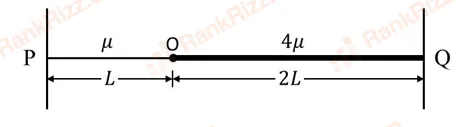
Two uniform strings of mass per unit length μ\mu and 4μ4\mu, and length LL and 2L2L, respectively, are joined at point OO, and tied at two fixed ends PP and QQ, as shown in the figure. The strings are under a uniform tension TT. If we define the frequency ν0=12LTμ\nu_0 = \frac{1}{2L}\sqrt{\frac{T}{\mu}}, which of the following statement(s) is(are) correct?

Figure for JEE Advanced 2024 Physics question on Superposition, interference and beats
  1. A

    With a node at OO, the minimum frequency of vibration of the composite string is ν0\nu_0

  2. B

    With an antinode at OO, the minimum frequency of vibration of the composite string is 2ν02\nu_0

  3. C

    When the composite string vibrates at the minimum frequency with a node at OO, it has 6 nodes, including the end nodes

  4. D

    No vibrational mode with an antinode at OO is possible for the composite string

JEE ADVANCED 2024 · PAPER 1Doppler effect in soundTRANSCRIBED

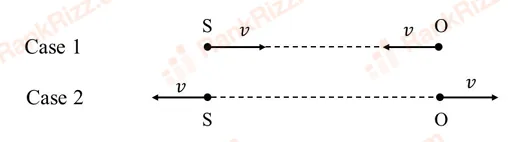
A source (SS) of sound has frequency 240 Hz. When the observer (OO) and the source move towards each other at a speed vv with respect to the ground (as shown in Case 1 in the figure), the observer measures the frequency of the sound to be 288 Hz. However, when the observer and the source move away from each other at the same speed vv with respect to the ground (as shown in Case 2 in the figure), the observer measures the frequency of sound to be nn Hz. The value of nn is ______.

Figure for JEE Advanced 2024 Physics question on Doppler effect in sound
JEE ADVANCED 2023 · PAPER 2Standing waves on strings and rodsTRANSCRIBED

A string of length 1 m and mass 2×10−52 \times 10^{-5} kg is under tension T. When the string vibrates, two successive harmonics are found to occur at frequencies 750 Hz and 1000 Hz. The value of tension T is ____ Newton.

JEE ADVANCED 2023 · PAPER 2Doppler effect in soundTRANSCRIBED

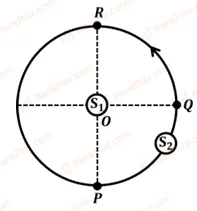
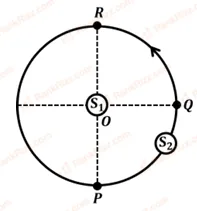
When only S2S_2 is emitting sound and it is QQ, the frequency of sound measured by the detector in Hz is ____.

Figure for JEE Advanced 2023 Physics question on Doppler effect in sound
JEE ADVANCED 2023 · PAPER 2Doppler effect in soundTRANSCRIBED

Consider both sources emitting sound. When S2S_2 is at R and S1S_1 approaches the detector with a speed 4 ms−1^{-1}, the beat frequency measured by the detector is ____ Hz.

Figure for JEE Advanced 2023 Physics question on Doppler effect in sound
JEE ADVANCED 2021 · PAPER 2Doppler effect in soundTRANSCRIBED

A source, approaching with speed 𝑢 towards the open end of a stationary pipe of length 𝐿, is emitting a sound of frequency fsf_s. The farther end of the pipe is closed. The speed of sound in air is v and f0f_0 is the fundamental frequency of the pipe. For which of the following combination(s) of u and fsf_s, will the sound reaching the pipe lead to a resonance?

  1. A

    u = 0.8v and fs=f0f_s = f_0

  2. B

    u = 0.8v and fs=2f0f_s = 2 f_0

  3. C

    u = 0.8v and fs=0.5f0f_s = 0.5 f_0

  4. D

    u = 0.8v and fs=1.5f0f_s = 1.5 f_0

JEE ADVANCED 2020 · PAPER 1Doppler effect in soundTRANSCRIBED

A stationary tuning fork is in resonance with an air column in a pipe. If the tuning fork is moved with a speed of 2ms−12 ms^{−1} in front of the open end of the pipe and parallel to it, the length of the pipe should be changed for the resonance to occur with the moving tuning fork. If the speed of sound in air is 320ms−1320 ms^{−1}, the smallest value of the percentage change required in the length of the pipe is
____________.

JEE ADVANCED 2019 · PAPER 1Doppler effect in soundTRANSCRIBED

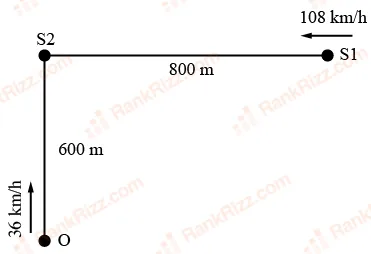
A tram S1, moving with a uniform velocity of 108 km/h, approaches another train S2 standing on a platform. An observer O moves with a uniform velocity of 36 km/h towards S2, as shown in figure. Both the trains are blowing whistles of same frequency 120 Hz. When O is 600 m away from S2 and distance between S1 and S2 is 800 m, the number of beats heard by O is __________.
[Speed of the sound = 330 m/s]

Figure for JEE Advanced 2019 Physics question on Doppler effect in sound
JEE ADVANCED 2019 · PAPER 2Superposition, interference and beatsTRANSCRIBED

The length of the strings 1, 2, 3 and 4 are kept fixed at L0,3L02,5L04L_0, \frac{3L_0}{2}, \frac{5L_0}{4} and 7L04\frac{7L_0}{4}, respectively. Strings 1, 2, 3, and 4 are vibrated at their 1st,3rd,5th1^{st}, 3^{rd}, 5^{th} and 14th14^{th} harmonics, respectively such that all the strings have same frequency. The correct match for the tension in the four strings in the units of T0T_0 will be,

  1. A

    I→P,II→R,III→T,IV→UI \rightarrow P, II \rightarrow R, III \rightarrow T, IV \rightarrow U

  2. B

    I→P,II→Q,III→T,IV→UI \rightarrow P, II \rightarrow Q, III \rightarrow T, IV \rightarrow U

  3. C

    I→P,II→Q,III→R,IV→TI \rightarrow P, II \rightarrow Q, III \rightarrow R, IV \rightarrow T

  4. D

    I→T,II→Q,III→R,IV→UI \rightarrow T, II \rightarrow Q, III \rightarrow R, IV \rightarrow U

JEE ADVANCED 2018 · PAPER 1Doppler effect in soundTRANSCRIBED

Two men are walking along a horizontal straight line in the same direction. The man in front walks at a speed 1.0 ms−1ms^{-1} and the man behind walks at a speed 2.0 ms−1ms^{-1} . A third man is standing at a height 12 𝑚 above the same horizontal line such that all three men are in a vertical plane. The two walking men are blowing identical whistles which emit a sound of frequency 1430 𝐻𝑧. The speed of sound in air is 330 ms−1ms^{-1} . At the instant, when the moving men are 10 𝑚 apart, the stationary man is equidistant from them. The frequency of beats in 𝐻𝑧, heard by the stationary man at this instant, is __________.

JEE ADVANCED 2017 · PAPER 1Progressive waves: wave equation, phase and intensityTRANSCRIBED

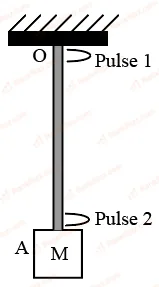
A block M hangs vertically at the bottom end of a uniform rope of constant mass per unit length. The top end of the rope is attached to a fixed rigid support at O. A transverse wave pulse (Pulse 1) of wavelength λ0\lambda_0 is produced at point O on the rope. The pulse takes time TOAT_{OA} to reach point A. If the wave pulse of wavelength λ0\lambda_0 is produced at point A (Pulse 2) without disturbing the position of M it takes time TOAT_{OA} to reach point O. Which of the following options is/are correct?

Figure for JEE Advanced 2017 Physics question on Progressive waves: wave equation, phase and intensity
  1. A

    The time TAO=TOAT_{AO} = T_{OA}

  2. B

    The velocities of the two pulses (Pulse 1 and Pulse 2) are the same at the midpoint of rope

  3. C

    The wavelength of Pulse 1 becomes longer when it reaches point A

  4. D

    The velocity of any pulse along the rope is independent of its frequency and wavelength

JEE ADVANCED 2017 · PAPER 1Doppler effect in soundTRANSCRIBED

A stationary source emits sound of frequency f0=492Hzf_0 = 492 Hz. The sound is reflected by a large car approaching the source with a speed of 2ms−12 ms^{-1}. The reflected signal is received by the source and superposed with the original. What will be the beat frequency of the resulting signal in Hz? (Given that the speed of sound in air is 330ms−1330 ms^{-1} and the car reflects the sound at the frequency it has received).

JEE ADVANCED 2016 · PAPER 1Doppler effect in soundTRANSCRIBED

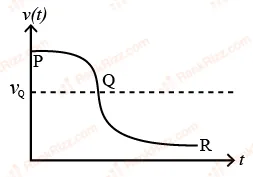
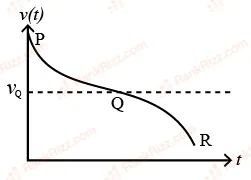
Two loudspeakers M and WN are located 20 m apart and emit sound at frequencies 118 Hz and 121 Hz, respectively. A caris initially at a point P , 1800 m away from the midpoint Q
of the line MN and moves towards @ constantly at 60 km/hr along the perpendicular bisector of MN. It crosses Q and eventually reaches a point R, 1800 m away from Q. Let v(t) represent the beat frequency measured by a person sitting in the car at time t. Let VP,VQV_P, V_Q and VRV_R be the beat frequencies measured at locations P, Q and R, respectively. The speed of sound in air is 330 ms−1^{-1} Which of the following statement(s) is(are) true regarding the sound heard bythe person?

  1. A

    VP+VR=2VQV_P + V_R = 2V_Q

  2. B

    The rate of change in beat frequency is maximum when thecar passes through Q

  3. C

    The plot below represents schematically the variation of beat frequency with time

    Figure for JEE Advanced 2016 Physics question on Doppler effect in sound
  4. D

    The plot below represents schematically the variation of beat frequency with time t

    Figure for JEE Advanced 2016 Physics question on Doppler effect in sound
JEE ADVANCED 2015 · PAPER 2Superposition, interference and beatsTRANSCRIBED

Four harmonic waves of equal frequencies and equalintensities I0I_0 have phase angles 0,π3,2π30, \frac{\pi}{3}, \frac{2\pi}{3} and π\pi. When they are superposed, the intensity of the resulting wave is nI0.nI_0. The value of n is

JEE ADVANCED 2014 · PAPER 1Progressive waves: wave equation, phase and intensityTRANSCRIBED

One end of a taut string of length 3m along the x axis is fixed at x = 0.The speed of the waves in the string is 100ms−1100 ms^{-1}. The other end of the string is vibrating in the y direction so that stationary waves are set up in the string. The possible waveform(s) of these stationary waves is(are)

  1. A

    y(t)=Asin⁡πx6cos⁡50πt3y(t) = A \sin \frac{\pi x}{6} \cos \frac{50 \pi t}{3}

  2. B

    y(t)=Asin⁡πx3cos⁡100πt3y(t) = A \sin \frac{\pi x}{3} \cos \frac{100 \pi t}{3}

  3. C

    y(t)=Asin⁡5πx6cos⁡250πt3y(t) = A \sin \frac{5 \pi x}{6} \cos \frac{250 \pi t}{3}

  4. D

    y(t)=Asin⁡5πx2cos⁡250πty(t) = A \sin \frac{5 \pi x}{2} \cos {250 \pi t}

JEE ADVANCED 2014 · PAPER 1Progressive waves: wave equation, phase and intensityTRANSCRIBED

A student is performing an experiment using a resonance column and a tuning fork of frequency 244s−1244s^{−1}. He is told that the air in the tube has been replaced by another gas (assume that the column remains filled with the gas). If the minimum height at which resonance occurs is (0.350±0.005)m,(0.350 \pm 0.005) m, the gas in the tube is
(Useful information: 167RT=640J12mole−12;140RT=590J12mole−12\sqrt {167 RT} = 640 J^{\frac{1}{2}} mole^{\frac{-1}{2}} ;\sqrt {140 RT} = 590 J^{\frac{1}{2}} mole^{\frac{-1}{2}}.The molar masses Min grams are given in the options. Take the values of 10M\sqrt{\frac{10}{M}} for each gas as given there.)

  1. A

    Neon (M=20,1020=710)\left(M = 20, \sqrt{\frac{10}{20}} = \frac{7}{10}\right)

  2. B

    Nitrogen (M=28,1028=35)\left(M = 28, \sqrt{\frac{10}{28}} = \frac{3}{5}\right)

  3. C

    Oxygen (M=32,1032=916)\left(M = 32, \sqrt{\frac{10}{32}} = \frac{9}{16}\right)

  4. D

    Argon (M=36,1036=1732)\left(M = 36, \sqrt{\frac{10}{36}} = \frac{17}{32}\right)

JEE ADVANCED 2013 · PAPER 2Doppler effect in soundTRANSCRIBED

Two vehicles, each moving with speed u on the samehorizontal straight road, are approaching each other. Wind blows along the road with velocity w. One of these vehicles blows a whistle of frequency f1f_1. An observerin the other vehicle hears the frequency of the whistle to be f2f_2. The speed of soundin still air is V. The correct statement(s) is (are)

  1. A

    If the wind blows from the observerto the source, f2>f1f_2 > f_1.

  2. B

    If the wind blows from the source to the observer, f2>f1f_2 > f_1.

  3. C

    If the wind blows from observerto the source, f2<f1f_2 < f_1.

  4. D

    If the wind blows from the source to the observer, f2<f1f_2 < f_1.