RankRizz

Current Electricity — JEE Advanced Previous Year Questions

Every Current Electricity question JEE Advanced has set from 2007–2026, grouped by the idea it tests rather than the order of the syllabus. 31 questions across 8 distinct ideas. Free to read, answer key on every one.

Questions

31

Distinct ideas

8

Share of marks

2.8%

Difficulty

MEDIUM

The ideas inside Current Electricity

A chapter is not one subject — it is a handful of procedures the examiner reuses. These are the ones Current Electricity questions actually test.

01Electric current, current density and drift velocityset 2×
02Ohm's law, resistance, resistivity and colour codeset 4×
03Combination of resistors and equivalent resistanceNot set in Advanced
04Cells: emf, internal resistance and combinationsNot set in Advanced
05Kirchhoff's laws and circuit analysisset 3×
06Wheatstone bridgeset 3×
07Meter bridgeset 5×
08Potentiometerset 1×
09Electric power and heating effect of currentset 9×
10Galvanometer conversion to ammeter and voltmeterset 4×

Current Electricity weightage, year by year

The share of each year’s Physics questions that came from Current Electricity, counted from the 19 papers we hold for the last 10 years, and paper by paper inside a year.

Falling: 2.0% of Physics questions in 2024–2026, down from 3.0% in 2017–2023. Its heaviest year was 2022, at 8.3%. Not asked at all in 2017, 2018, 2023, 2024, 2025.

20262 / 345.9%PAPER 1 0.0%PAPER 2 11.1%
20250 / 320.0%PAPER 1 0.0%PAPER 2 0.0%
20240 / 340.0%PAPER 1 0.0%PAPER 2 0.0%
20230 / 340.0%PAPER 1 0.0%PAPER 2 0.0%
20223 / 368.3%PAPER 1 5.6%PAPER 2 11.1%
20211 / 382.6%PAPER 1 0.0%PAPER 2 5.3%
20202 / 365.6%PAPER 1 5.6%PAPER 2 5.6%
20191 / 362.8%PAPER 1 5.6%PAPER 2 0.0%
20180 / 180.0%1 PAPER
20170 / 360.0%PAPER 1 0.0%PAPER 2 0.0%

“QS” is Current Electricity questions out of all Physics questions that year. A year with more sittings asks more questions, which is why the share, not the count, is the number to compare.

Current Electricity: quick answers

How many Current Electricity questions has JEE Advanced asked?

31 questions from 2007–2026. Over the last 20 papers, Current Electricity carried about 2.8% of Physics marks.

Which Current Electricity topics come up most?

Electric power and heating effect of current (9 questions), Meter bridge (5 questions), Ohm's law, resistance, resistivity and colour code (4 questions). Start with these, they are what the examiner keeps coming back to.

Is Current Electricity important for JEE Advanced?

Falling: 2.0% of Physics questions in 2024–2026, down from 3.0% in 2017–2023. Its heaviest year was 2022, at 8.3%. Not asked at all in 2017, 2018, 2023, 2024, 2025. It has carried about 2.8% of Physics marks in recent papers, rated medium on our difficulty scale. The year-by-year table above shows how that has moved.

Do these Current Electricity PYQs have answers and solutions?

Yes. Every question shows its official answer key, and a worked solution opens on the question’s own page wherever we have one. Reading and checking answers is free, no sign-up needed.

What’s the fastest way to revise Current Electricity?

Do one past question per idea first: Current Electricity has 8 distinct ideas, listed above. Then practise the topics you get wrong, or build a timed test from this chapter.

Every Current Electricity question

1–20 OF 31 · NEWEST FIRST

JEE ADVANCED 2026 · PAPER 2Electric current, current density and drift velocityTRANSCRIBED

A metal wire of cross-sectional area 0.5 mm20.5\,\mathrm{mm^2} and length 100 m100\,\mathrm{m} is connected across a battery of e.m.f. 2 V2\,\mathrm{V} and internal resistance 1 Ω1\,\Omega. The density, atomic mass and electrical conductivity of the metal are 6.35×10³ kg m−36.35\times 10^{3}\,\mathrm{kg\,m^{-3}}, 63.5 gm/mole63.5\,\mathrm{gm/mole} and 2×10⁸ mho m−12\times 10^{8}\,\mathrm{mho\,m^{-1}}, respectively. Assuming one conduction electron per atom of the metal, the drift velocity (in mm s−1\mathrm{mm\,s^{-1}}) of the electrons in the wire is:

[Take Avogadro's number as 6×10236\times 10^{23} and charge of the electron as 1.6×10⁻¹⁹ C1.6\times 10^{-19}\,\mathrm{C}.]

  1. A

    0.0520.052

  2. B

    0.1040.104

  3. C

    0.2080.208

  4. D

    0.1560.156

JEE ADVANCED 2026 · PAPER 2Galvanometer conversion to ammeter and voltmeterTRANSCRIBED

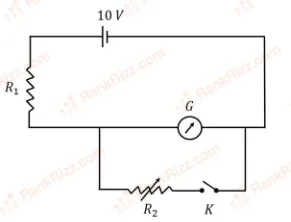
As shown in the figure, the resistance of a galvanometer GG can be found by the half-deflection method. Here the resistance R2R_2 is adjusted such that when the key KK is closed the deflection in the galvanometer becomes half of the value as compared to when KK is open. Half-deflection is obtained at R2=4 ΩR_2=4\,\Omega and thus the galvanometer resistance is found to be 6 Ω6\,\Omega. In this half-deflection condition the current (in mA) through the resistor R1R_1 is:

Figure for JEE Advanced 2026 Physics question on Galvanometer conversion to ammeter and voltmeter
JEE ADVANCED 2022 · PAPER 2PotentiometerTRANSCRIBED

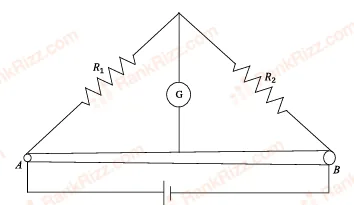
Two resistances R1=XR_1 = X Ω\Omega and R2=1R_2 = 1 Ω\Omega are connected to a wire AB of uniform resistivity, as shown in the figure. The radius of the wire varies linearly along its axis from 0.2 mm at A to 1 mm at B. A galvanometer (G) connected to the center of the wire, 50 cm from each end along its axis, shows zero deflection when A and B are connected to a battery. The value of X is _______.

Figure for JEE Advanced 2022 Physics question on Potentiometer
JEE ADVANCED 2022 · PAPER 2Electric power and heating effect of currentTRANSCRIBED

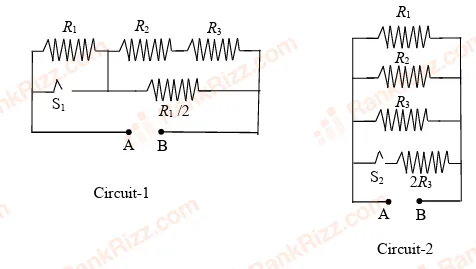
In Circuit-1 and Circuit-2 shown in the figures, R1=1R_1 = 1 Ω\Omega, R2=2R_2 = 2 Ω\Omega and R3=3R_3 = 3 Ω\Omega. P1P_1 and P2P_2 are the power dissipations in Circuit-1 and Circuit-2 when the switches S1S_1 and S2S_2 are in open conditions, respectively.

Q1Q_1 and Q2Q_2 are the power dissipations in Circuit-1 and Circuit-2 when the switches S1S_1 and S2S_2 are in closed conditions, respectively.

Figure for JEE Advanced 2022 Physics question on Electric power and heating effect of current

Which of the following statement(s) is(are) correct?

  1. A

    When a voltage source of 6 V is connected across A and B in both circuits, P1<P2P_1 < P_2.

  2. B

    When a constant current source of 2 Amp is connected across A and B in both circuits, P1>P2P_1 > P_2.

  3. C

    When a voltage source of 6 V is connected across A and B in Circuit-1, Q1>P1Q_1 > P_1.

  4. D

    When a constant current source of 2 Amp is connected across A and B in both circuits, Q2<Q1Q_2 < Q_1.

JEE ADVANCED 2022 · PAPER 1Kirchhoff's laws and circuit analysisTRANSCRIBED

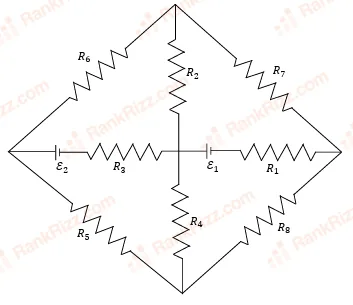
The figure shows a circuit having eight resistances of 1 Ω\Omega each, labelled R1R_1 to R8R_8, and two ideal batteries with voltages ε1=12\varepsilon_1 = 12 V and ε2=6\varepsilon_2 = 6 V.

Figure for JEE Advanced 2022 Physics question on Kirchhoff's laws and circuit analysis

Which of the following statement(s) is(are) correct?

  1. A

    The magnitude of current flowing through R1R_1 is 7.2 A.

  2. B

    The magnitude of current flowing through R2R_2 is 1.2 A.

  3. C

    The magnitude of current flowing through R3R_3 is 4.8 A.

  4. D

    The magnitude of current flowing through R5R_5 is 2.4 A.

JEE ADVANCED 2021 · PAPER 2Meter bridgeTRANSCRIBED

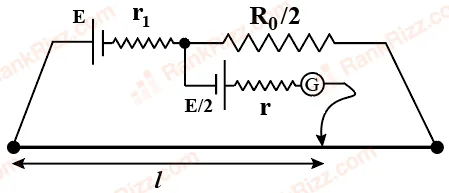
In order to measure the internal resistance r1r_1 of a cell of emf 𝐸, a meter bridge of wire resistance R0=50ΩR_0 = 50 Ω, a resistance R0/2R_0/2, another cell of emf E/2 (internal resistance 𝑟) and a galvanometer G are used in a circuit, as shown in the figure. If the null point is found at l = 72 cm, then the value of r_1 = ___ Ω.

Figure for JEE Advanced 2021 Physics question on Meter bridge
JEE ADVANCED 2020 · PAPER 1Electric current, current density and drift velocityTRANSCRIBED

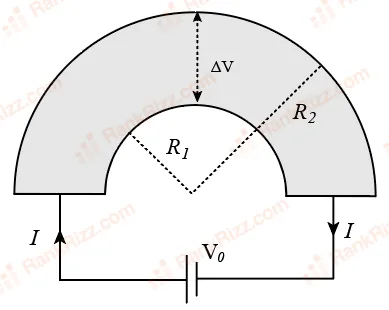
Shown in the figure is a semicircular metallic strip that has thickness t and resistivity ρ\rho. Its inner radius is R1R_{1} and outer radius is R2R_{2}. If a voltage V0V_{0} is applied between its two ends, a current I flows in it. In addition, it is observed that a transverse voltage △V\triangle V develops between its inner and outer surfaces due to purely kinetic effects of moving electrons (ignore any role of the magnetic field due to the current). Then (figure is schematic and not drawn to scale)

Figure for JEE Advanced 2020 Physics question on Electric current, current density and drift velocity
  1. A

    I=v0tπρI = \frac{v_{0}t}{\pi \rho} In (R2R1)\left(\frac{R_{2}}{R_{1}}\right)

  2. B

    the outer surface is at a higher voltage than the inner surface

  3. C

    the outer surface is at a lower voltage than the inner surface

  4. D

    △V∝I2\triangle V \propto I^{2}

JEE ADVANCED 2020 · PAPER 2Wheatstone bridgeTRANSCRIBED

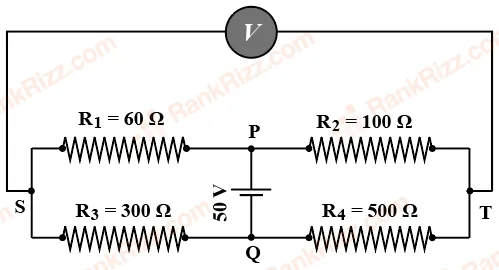
In the balanced condition, the values of the resistances of the four arms of a Wheatstone bridge are shown in the figure below. The resistance 𝑅3𝑅_3 has temperature coefficient 0.0004 ∘C−1^\circ C^{−1}. If the temperature of 𝑅3𝑅_3 is increased by 100 ∘C^\circ C, the voltage developed between 𝑆 and 𝑇 will be __________ volt.

Figure for JEE Advanced 2020 Physics question on Wheatstone bridge
JEE ADVANCED 2019 · PAPER 1Galvanometer conversion to ammeter and voltmeterTRANSCRIBED

Two identical moving coil galvanometers have 10Ω10 Ω resistance and full scale deflection at 2μA2 \mu A current. One of them is converted into a voltmeter of 100 m V full scale reading and the other into an Ammeter of 1mA full scale current using appropriate resistors. These are then used to measure the voltage and current in the Ohm’s law experiment with R=1000ΩR = 1000 Ω resistor by using an ideal cell. Which of the following statement(s) is/are correct?

  1. A

    The resistance of the Voltmeter will be 100kΩ100 kΩ

  2. B

    The resistance of the Ammeterwill be 0.02Ω0.02 Ω (round off to 2nd2^{nd} decimalplace)

  3. C

    The measured value of R willbe 978Ω<R<982Ω978 Ω < R < 982 Ω

  4. D

    If the ideal cell is replaced by a cell having internal resistance of 5Ω5 Ω then the measured value of R will be more than 1000Ω1000 Ω

JEE ADVANCED 2016 · PAPER 1Ohm's law, resistance, resistivity and colour codeTRANSCRIBED

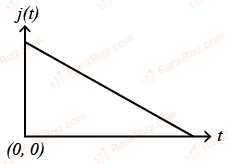
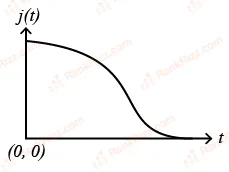
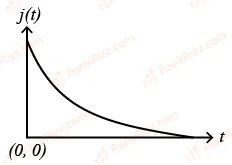
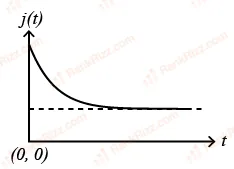
An infinite line charge of uniform electric charge density λ\lambda lies along the axis of an electrically conducting infinite cylindrical shell of radius R. At time t = 0, the space inside the cylinder is filled with a material of permittivity ε and electrical conductivity σ\sigma. The electrical conduction in the material follows Ohm’s law. Which one of the following graphs best describes the subsequent variation of the magnitude of current density j(t) at any point in the material?

  1. A
    Figure for JEE Advanced 2016 Physics question on Ohm's law, resistance, resistivity and colour code
  2. B
    Figure for JEE Advanced 2016 Physics question on Ohm's law, resistance, resistivity and colour code
  3. C
    Figure for JEE Advanced 2016 Physics question on Ohm's law, resistance, resistivity and colour code
  4. D
    Figure for JEE Advanced 2016 Physics question on Ohm's law, resistance, resistivity and colour code
JEE ADVANCED 2016 · PAPER 1Electric power and heating effect of currentTRANSCRIBED

An incandescent bulb has a thin filament of tungsten that is heated to high temperature by passing an electric current. The hot filament emits black-body radiation. The filament is observed to break up at randomlocations after a sufficiently long time of operation due to non-uniform evaporation of tungsten from the filament. If the bulb is powered at constant voltage, which of the following statement(s) is(are) true?

  1. A

    The temperature distribution overthe filament is uniform

  2. B

    The resistance over small sections of the filament decreases with time

  3. C

    The filament emits morelight at higher band of frequencies before it breaks up

  4. D

    The filament consumesless electrical power towards the end ofthe life of the bulb

JEE ADVANCED 2016 · PAPER 2Galvanometer conversion to ammeter and voltmeterTRANSCRIBED

Consider two identical galvanometers and two identical resistors with resistance R. If the internal resistance of the galvanometers Rc<R2R_c < \frac{R}{2}, which of the following statement(s) about any one of the galvanometers is(are) true?

  1. A

    The maximum voltage range is obtained when all the components are connected in series

  2. B

    The maximum voltage range is obtained when the two resistors and one galvanometer are connected in series, and the second galvanometer is connected in parallel to the first galvanometer

  3. C

    The maximum current range is obtained when all the components are connected in parallel

  4. D

    The maximum current rangeis obtained when the two galvanometers are connected in series and the combination is connected in parallel with both the resistors

JEE ADVANCED 2015 · PAPER 2Wheatstone bridgeTRANSCRIBED

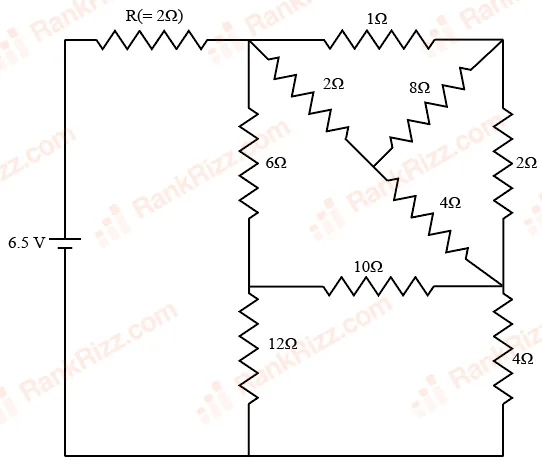
In the following circuit, the current through the resistor R(=2Ω)R (= 2Ω) is I Amperes. The value of I is

Figure for JEE Advanced 2015 Physics question on Wheatstone bridge
JEE ADVANCED 2015 · PAPER 1Ohm's law, resistance, resistivity and colour codeTRANSCRIBED

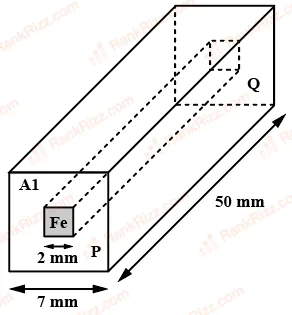
In an aluminum (Al) bar of square cross section, a square hole is drilled and is filled with iron (Fe) as shown in the figure. The electrical resistivities of Al and Fe are 2.7×10⁻⁸Ωm2.7 \times 10^{-8} Ω m and 1.0×10⁻⁷Ωm,1.0 \times 10^{-7} Ω m, respectively. The electrical resistance between the two faces P and Q of the composite bar is

Figure for JEE Advanced 2015 Physics question on Ohm's law, resistance, resistivity and colour code
  1. A

    247564μΩ\frac {2475}{64} \muΩ

  2. B

    187564μΩ\frac {1875}{64} \muΩ

  3. C

    187549μΩ\frac {1875}{49} \muΩ

  4. D

    2475132μΩ\frac {2475}{132} \muΩ

JEE ADVANCED 2014 · PAPER 2Meter bridgeTRANSCRIBED

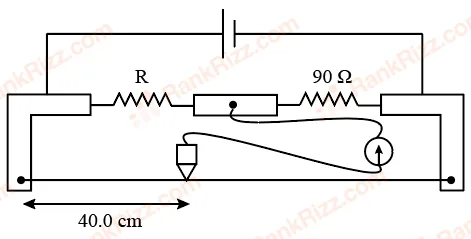
During an experiment with ametre bridge, the galvanometer shows a null point when the jockey is pressed at 40.0 cm using a standard resistance of 90Ω90 Ω,as shown in the figure. The least count of the scale used in the metre bridge is 1 mm. The unknown resistance is

Figure for JEE Advanced 2014 Physics question on Meter bridge
  1. A

    60±0.15Ω60 \pm 0.15Ω

  2. B

    135±0.56Ω135 \pm 0.56Ω

  3. C

    60±0.25Ω60 \pm 0.25Ω

  4. D

    135±0.23Ω135 \pm 0.23Ω

JEE ADVANCED 2014 · PAPER 1Electric power and heating effect of currentTRANSCRIBED

Heater of an electric kettle is made of a wire of length L and diameter d. It takes 4 minutes to raise the temperature of 0.5kg water by 40K. This heater is replaced by a new heater having two wires of the same material, each of length L and diameter 2d.The way these wires are connected is given in the options. How much time in minutes will it take to raise the temperature of the same amount of water by 40 K?

  1. A

    4 if wires are in parallel

  2. B

    2 if wires are in series

  3. C

    1 if wires are in series

  4. D

    0.5 if wires are in parallel

JEE ADVANCED 2014 · PAPER 1Wheatstone bridgeTRANSCRIBED

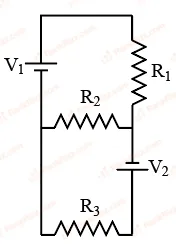
Two ideal batteries of  emfV1emfV_1 and V2V_2 and three resistances R1,R2R_1, R_2 and R3R_3 are connected as shown in the figure. The current in resistance R2R_2 would be zero if

Figure for JEE Advanced 2014 Physics question on Wheatstone bridge
  1. A

    V1=V2V_1 = V_2 and R1=R2=R3R_1 = R_2 = R_3

  2. B

    V1=V2V_1 = V_2 and R1=2R2=R3R_1 = 2R_2 = R_3

  3. C

    V1=2V2V_1 = 2V_2 and 2R1=2R2=R32R_1 = 2R_2 = R_3

  4. D

    2V1=V22V_1 = V_2 and 2R1=R2=R32R_1 = R_2 = R_3

JEE ADVANCED 2014 · PAPER 1Galvanometer conversion to ammeter and voltmeterTRANSCRIBED

A galvanometer gives full scale deflection with 0.006 A current. By connecting it to a 4990Ω4990 Ω resistance, it can be converted into a voltmeter of range 0 - 30 V. If connected to a 2n249Ω\frac{2n}{249}Ω resistance, it becomes an ammeter of range 0 - 1.5 A. The value of n is

JEE ADVANCED 2013 · PAPER 2Electric power and heating effect of currentTRANSCRIBED

If the direct transmission method with a cable of resistance 0.4Ωkm−10.4Ωkm^{-1} is used, the power dissipation (in %) during transmission is

  1. A

    20

  2. B

    30

  3. C

    40

  4. D

    50

JEE ADVANCED 2012 · PAPER 1Kirchhoff's laws and circuit analysisTRANSCRIBED

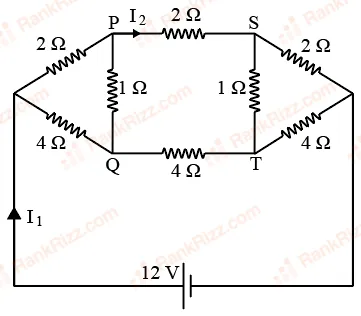
For the resistance network shown in the figure, choose the correct option(s)

Figure for JEE Advanced 2012 Physics question on Kirchhoff's laws and circuit analysis
  1. A

    The current through PQ is zero.

  2. B

    I1=3AI_1 = 3A

  3. C

    The potential at S is less than that at Q.

  4. D

    I2=2AI_2 = 2A