RankRizz

Wave Optics — JEE Advanced Previous Year Questions

Every Wave Optics question JEE Advanced has set from 2007–2026, grouped by the idea it tests rather than the order of the syllabus. 21 questions across 3 distinct ideas. Free to read, answer key on every one.

Questions

21

Distinct ideas

3

Share of marks

3.4%

Difficulty

MEDIUM

The ideas inside Wave Optics

A chapter is not one subject — it is a handful of procedures the examiner reuses. These are the ones Wave Optics questions actually test.

01Wavefronts and Huygens' principleset 1×
02Young's double slit experiment: fringe width and intensityset 17×
03YDSE with slabs, white light and modified setupsNot set in Advanced
04Single slit diffractionNot set in Advanced
05Resolving power of microscopes and telescopesNot set in Advanced
06Polarisation: Malus's law and Brewster's lawset 3×

Wave Optics weightage, year by year

The share of each year’s Physics questions that came from Wave Optics, counted from the 19 papers we hold for the last 10 years, and paper by paper inside a year.

Rising: 6.0% of Physics questions in 2024–2026, up from 2.1% in 2017–2023. Its heaviest year was 2024, at 8.8%. Not asked at all in 2018, 2021.

20262 / 345.9%PAPER 1 6.3%PAPER 2 5.6%
20251 / 323.1%PAPER 1 0.0%PAPER 2 6.3%
20243 / 348.8%PAPER 1 5.9%PAPER 2 11.8%
20231 / 342.9%PAPER 1 0.0%PAPER 2 5.9%
20221 / 362.8%PAPER 1 0.0%PAPER 2 5.6%
20210 / 380.0%PAPER 1 0.0%PAPER 2 0.0%
20201 / 362.8%PAPER 1 5.6%PAPER 2 0.0%
20191 / 362.8%PAPER 1 0.0%PAPER 2 5.6%
20180 / 180.0%1 PAPER
20171 / 362.8%PAPER 1 0.0%PAPER 2 5.6%

“QS” is Wave Optics questions out of all Physics questions that year. A year with more sittings asks more questions, which is why the share, not the count, is the number to compare.

Wave Optics: quick answers

How many Wave Optics questions has JEE Advanced asked?

21 questions from 2007–2026. Over the last 20 papers, Wave Optics carried about 3.4% of Physics marks.

Which Wave Optics topics come up most?

Young's double slit experiment: fringe width and intensity (17 questions), Polarisation: Malus's law and Brewster's law (3 questions), Wavefronts and Huygens' principle (1 questions). Start with these, they are what the examiner keeps coming back to.

Is Wave Optics important for JEE Advanced?

Rising: 6.0% of Physics questions in 2024–2026, up from 2.1% in 2017–2023. Its heaviest year was 2024, at 8.8%. Not asked at all in 2018, 2021. It has carried about 3.4% of Physics marks in recent papers, rated medium on our difficulty scale. The year-by-year table above shows how that has moved.

Do these Wave Optics PYQs have answers and solutions?

Yes. Every question shows its official answer key, and a worked solution opens on the question’s own page wherever we have one. Reading and checking answers is free, no sign-up needed.

What’s the fastest way to revise Wave Optics?

Do one past question per idea first: Wave Optics has 3 distinct ideas, listed above. Then practise the topics you get wrong, or build a timed test from this chapter.

Every Wave Optics question

1–20 OF 21 · NEWEST FIRST

JEE ADVANCED 2026 · PAPER 2Polarisation: Malus's law and Brewster's lawTRANSCRIBED

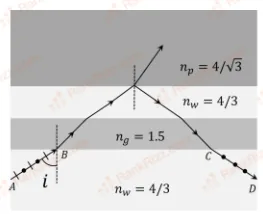
As shown in the figure, a ray ABAB of unpolarized light enters from water of refractive index nw=4/3n_w=4/3 into a medium of refractive index np=4/3n_p=4/\sqrt{3} after passing through a glass plate of refractive index ng=1.5n_g=1.5 and a layer of water. At a particular incident angle ii the reflected ray CDCD is polarized in the direction as shown in the figure. The value of ii (in degrees) is:

Figure for JEE Advanced 2026 Physics question on Polarisation: Malus's law and Brewster's law
JEE ADVANCED 2026 · PAPER 1Polarisation: Malus's law and Brewster's lawTRANSCRIBED

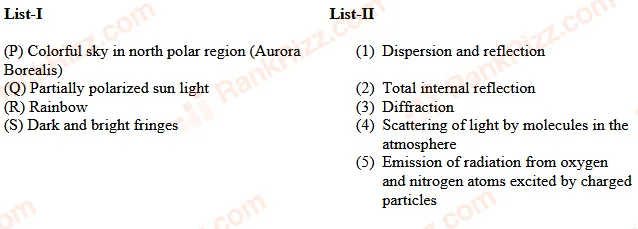
In the List-I, four optical effects are mentioned. The physical phenomena of light which are essential to describe these optical effects are given in List-II. Choose the option which describes the correct match between the entries in List-I to those in List-II.

Figure for JEE Advanced 2026 Physics question on Polarisation: Malus's law and Brewster's law
  1. A

    (P)→\to(5), (Q)→\to(4), (R)→\to(1), (S)→\to(3)

  2. B

    (P)→\to(4), (Q)→\to(2), (R)→\to(1), (S)→\to(3)

  3. C

    (P)→\to(4), (Q)→\to(1), (R)→\to(2), (S)→\to(3)

  4. D

    (P)→\to(5), (Q)→\to(4), (R)→\to(1), (S)→\to(2)

JEE ADVANCED 2025 · PAPER 2Young's double slit experiment: fringe width and intensityTRANSCRIBED

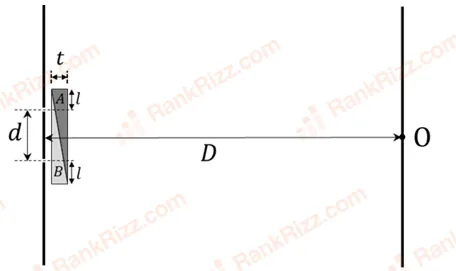
In a Young's double slit experiment, a combination of two glass wedges AA and BB, having refractive indices 1.7 and 1.5, respectively, are placed in front of the slits, as shown in the figure. The separation between the slits is d=2d = 2 mm and the shortest distance between the slits and the screen is D=2D = 2 m. Thickness of the combination of the wedges is t=12 μt = 12 \, \mum. The value of ll as shown in the figure is 1 mm. Neglect any refraction effect at the slanted interface of the wedges. Due to the combination of the wedges, the central maximum shifts (in mm) with respect to O by ______.

Figure for JEE Advanced 2025 Physics question on Young's double slit experiment: fringe width and intensity
JEE ADVANCED 2024 · PAPER 1Polarisation: Malus's law and Brewster's lawTRANSCRIBED

A point source SS emits unpolarized light uniformly in all directions. At two points AA and BB, the ratio r=IA/IBr = I_A/I_B of the intensities of light is 2. If a set of two polaroids having 45° angle between their pass-axes is placed just before point BB, then the new value of rr will be ______.

JEE ADVANCED 2024 · PAPER 2Young's double slit experiment: fringe width and intensityTRANSCRIBED

The 8th bright fringe above the point OO oscillates with time between two extreme positions. The separation between these two extreme positions, in micrometer (μ\mum), is ________.

JEE ADVANCED 2024 · PAPER 2Young's double slit experiment: fringe width and intensityTRANSCRIBED

The maximum speed in μ\mu m/s at which the 8th8^{th} bright fringe will move is ________.

JEE ADVANCED 2023 · PAPER 2Wavefronts and Huygens' principleTRANSCRIBED

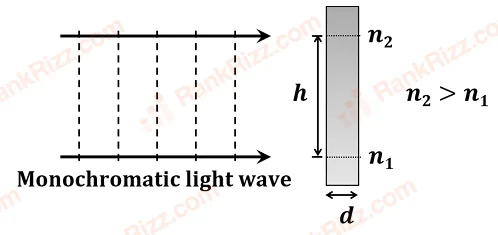
A monochromatic light wave is incident normally on a glass slab of thickness d, as shown in the figure. The refractive index of the slab increases linearly from n1n_1 to n2n_2 over the height h. Which of the following statement(s) is (are) true about the light wave emerging out of the slab?

Figure for JEE Advanced 2023 Physics question on Wavefronts and Huygens' principle
  1. A

    It will deflect up by an angle tan⁡−1[(n22−n12)d2h]\tan^{-1}\left[\frac{(n_2^2 - n_1^2)d}{2h}\right]

  2. B

    It will deflect up by an angle tan⁡−1[(n2−n1)dh]\tan^{-1}\left[\frac{(n_2 - n_1)d}{h}\right]

  3. C

    It will not deflect.

  4. D

    The deflection angle depends only on (n2−n1)(n_2 - n_1) and not on the individual values of n1n_1 and n2n_2.

JEE ADVANCED 2022 · PAPER 2Young's double slit experiment: fringe width and intensityTRANSCRIBED

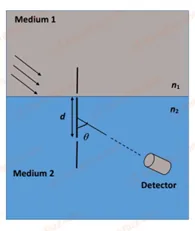
A double slit setup is shown in the figure. One of the slits is in medium 2 of refractive index n2n_2. The other slit is at the interface of this medium with another medium 1 of refractive index n1n_1 (≠n2\neq n_2). The line joining the slits is perpendicular to the interface and the distance between the slits is dd. The slit widths are much smaller than dd. A monochromatic parallel beam of light is incident on the slits from medium 1. A detector is placed in medium 2 at a large distance from the slits, and at an angle θ\theta from the line joining them, so that θ\theta equals the angle of refraction of the beam. Consider two approximately parallel rays from the slits received by the detector.

Figure for JEE Advanced 2022 Physics question on Young's double slit experiment: fringe width and intensity

Which of the following statement(s) is (are) correct?

  1. A

    The phase difference between the two rays is independent of dd.

  2. B

    The two rays interfere constructively at the detector.

  3. C

    The phase difference between the two rays depends on n1n_1 but is independent of n2n_2.

  4. D

    The phase difference between the two rays vanishes only for certain values of dd and the angle of incidence of the beam, with θ\theta being the corresponding angle of refraction.

JEE ADVANCED 2020 · PAPER 1Young's double slit experiment: fringe width and intensityTRANSCRIBED

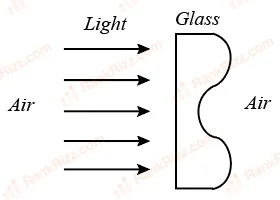
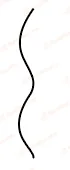
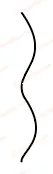
A parallel beam of light strikes a piece of transparent glass having cross section as shown in the figure below. Correct shape of the emergent wavefront will be (figures are schematic and not drawn to scale)

Figure for JEE Advanced 2020 Physics question on Young's double slit experiment: fringe width and intensity
  1. A
    Figure for JEE Advanced 2020 Physics question on Young's double slit experiment: fringe width and intensity
  2. B
    Figure for JEE Advanced 2020 Physics question on Young's double slit experiment: fringe width and intensity
  3. C
    Figure for JEE Advanced 2020 Physics question on Young's double slit experiment: fringe width and intensity
  4. D
    Figure for JEE Advanced 2020 Physics question on Young's double slit experiment: fringe width and intensity
JEE ADVANCED 2019 · PAPER 2Young's double slit experiment: fringe width and intensityTRANSCRIBED

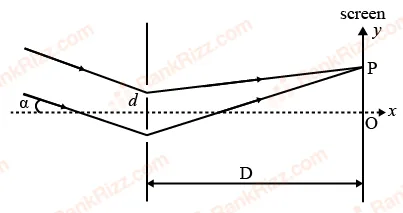
In a Young’s double slit experiment, the slit separation d is 0.3 mm and the screen distance D is 1 m. A parallel beam of light of wavelength 600 nm is incident on the slits at angle α\alpha as shown in figure. On the screen, the point O is equidistant from the slits and distance PO is 11.0 mm. Which of the following statement(s) is/are correct?

Figure for JEE Advanced 2019 Physics question on Young's double slit experiment: fringe width and intensity
  1. A

    For α=0.36π\alpha = \frac{0.36}{\pi} degree, there will be destructive interference at point O.

  2. B

    For α=0\alpha = 0 there will be constructive interference at P point P.

  3. C

    For α=0.36π\alpha = \frac{0.36}{\pi} degree, there will be destructive interference at P point P.

  4. D

    Fringe spacing depends on α\alpha.

JEE ADVANCED 2017 · PAPER 2Young's double slit experiment: fringe width and intensityTRANSCRIBED

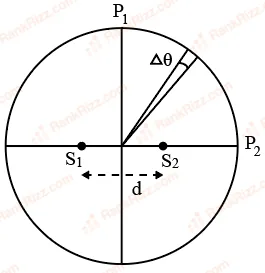
Two coherent monochromatic point sources S1S_{1} and S2S_{2} of wavelength λ=600\lambda=600 nm are placed symmetrically on either side of the center of the circle as shown. The sources are separated by a distance d=1.8d=1.8 mm. This arrangement produces interference fringes visible as alternate bright and dark spots on the circumference of the circle. The angular separation between two consecutive bright spots is △θ\triangle\theta. Which of the following options is/are correct?

Figure for JEE Advanced 2017 Physics question on Young's double slit experiment: fringe width and intensity
  1. A

    A dark spot will be formed at the point P2P_{2}

  2. B

    At P2P_{2} the order of the fringe will be maximum

  3. C

    The total number of fringes produced between P1P_{1} and P2P_{2} in the first quadrant is close to 3000

  4. D

    The angular separation between two consecutive bright spots decreases as we move from P1P_{1} to P2P_{2} along the first quadrant

JEE ADVANCED 2016 · PAPER 2Young's double slit experiment: fringe width and intensityTRANSCRIBED

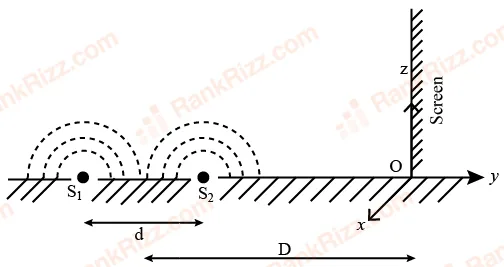
While conducting the Young’s double slit experiment, a student replaced the two slits with a large opaque plate in the x-y plane containing two small holes that act as two coherent point sources (S1,S2)(S_1, S_2) emitting light of wavelength 600 nm. The student mistakenly placed the screen parallel to the x-z plane (for z > 0) at a distance D = 3 m from the mid-point of S,S,, as shown schematically in the figure. The distance between the sources d = 0.6003 mm. The origin O is at the intersection of the screen and the line joining S1,S2S_1, S_2. Which of the following is(are) true of the intensity pattern on the screen?

Figure for JEE Advanced 2016 Physics question on Young's double slit experiment: fringe width and intensity
  1. A

    Straight bright and dark bands parallel to the x-axis

  2. B

    The region very close to the point O will be dark

  3. C

    Hyperbolic bright and dark bands with foci symmetrically placed about O in the x-direction

  4. D

    Semi circular bright and dark bands centered at point O

JEE ADVANCED 2015 · PAPER 1Young's double slit experiment: fringe width and intensityTRANSCRIBED

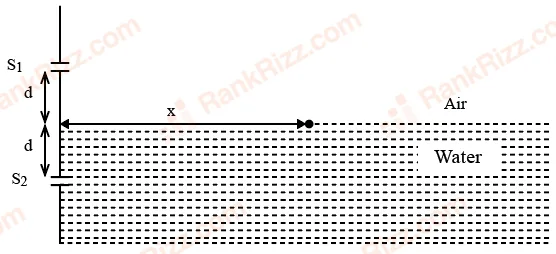
A Young’s double slit interference arrangement with slits S1S_1 and S2S_2 is immersed in water (refractive index = 43\frac{4}{3}) as shown in the figure. The positions of maxima on the surface of water are given by x2=p2m2λ2−d2x^2 = p^2m^2 \lambda^2 - d^2, where λ\lambda is the wave length of light in air (refractive index = 1), 2d is the separation between theslits and m is an integer. The valueofp is

Figure for JEE Advanced 2015 Physics question on Young's double slit experiment: fringe width and intensity
JEE ADVANCED 2014 · PAPER 1Young's double slit experiment: fringe width and intensityTRANSCRIBED

A light source, which emits two wavelengths λ1=400nm\lambda_1 = 400 nm and λ2=600nm\lambda_2 = 600 nm, is used in a Young’s double slit experiment. If recorded fringe widths for λ1\lambda_1 and λ2\lambda_2 are β1\beta_1 and β2\beta_2 number of fringes for them within a distance yon one side of the central maximum are m1m_1 and m2m_2, respectively, then

  1. A

    β2>β1\beta_2 > \beta_1

  2. B

    m1>m2m_1 > m_2

  3. C

    From the central maximum, 3rd3^{rd} maximum of λ2\lambda_2 overlaps with 5th5^{th} minimum of λ1\lambda_1

  4. D

    The angular separation of fringes for λ1\lambda_1 is greater than λ2\lambda_2

JEE ADVANCED 2013 · PAPER 1Young's double slit experiment: fringe width and intensityTRANSCRIBED

In the Young’s double slit experiment using a monochromatic light of wavelength λ\lambda, the path difference (in terms of an integer n) corresponding to any point having half the peak intensity is

  1. A

    (2n+1)λ2\left(2n + 1\right)\frac{\lambda}{2}

  2. B

    (2n+1)λ4\left(2n + 1\right)\frac{\lambda}{4}

  3. C

    (2n+1)λ8\left(2n + 1\right)\frac{\lambda}{8}

  4. D

    (2n+1)λ16\left(2n + 1\right)\frac{\lambda}{16}

JEE ADVANCED 2012 · PAPER 1Young's double slit experiment: fringe width and intensityTRANSCRIBED

Young's double slit experimentis carried out by using green, red and bluelight, one color at a time. The fringe widths recorded are βG,βR,βB\beta_G, \beta_R, \beta_B, respectively. Then,

  1. A

    βG>βB>βR\beta_G > \beta_B > \beta_R

  2. B

    βB>βG>βR\beta_B > \beta_G > \beta_R

  3. C

    βR>βB>βG\beta_R > \beta_B > \beta_G

  4. D

    βR>βG>βB\beta_R > \beta_G > \beta_B

JEE ADVANCED 2009 · PAPER 2Young's double slit experiment: fringe width and intensityTRANSCRIBED

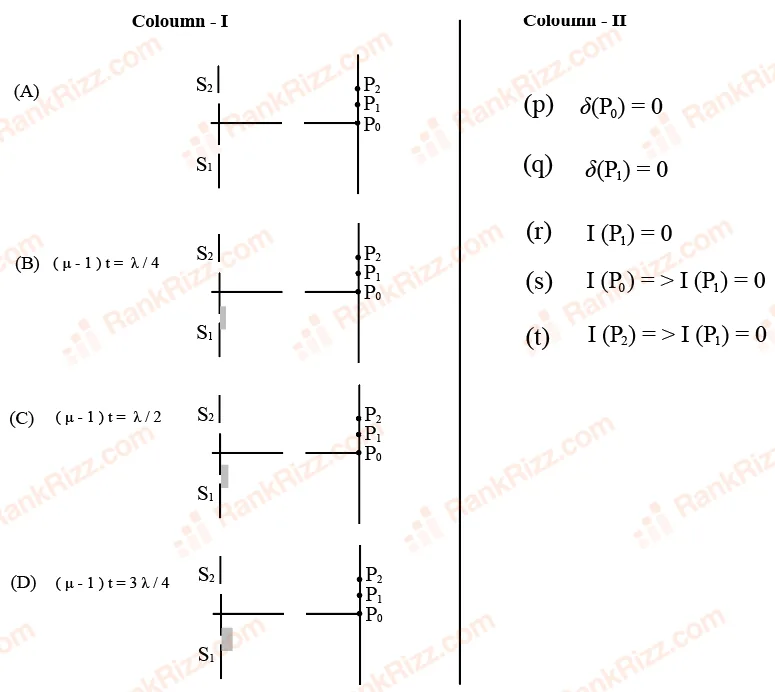
Column I shows four situations of standard Young’s double slit arrangement with the screen placed far away from the slits S1S_1 and S2S_2. In each of these cases S1P0=S2P0,S1P1−S2P1=λ4S_1P_0 = S_2P_0, S_1P_1 - S_2P_1 = \frac{\lambda}{4} and S1P2−S2P2=λ3S_1P_2 - S_2P_2 = \frac{\lambda}{3}, where λ\lambda is the wavelength of the light used. In the cases B, C and D, a transparent sheet of refractive index μ\mu and thickness t is pasted on slit S2S_2. The thicknesses of the sheets are different in different cases. The phase difference between thelight waves reaching a point P on the screen from the two slits is denoted by δ(P)\delta(P) and the intensity by I(P)I(P). Match each situation given in Column I with the statement(s) in Column II valid for that situation.

Figure for JEE Advanced 2009 Physics question on Young's double slit experiment: fringe width and intensity
JEE ADVANCED 2008 · PAPER 1Young's double slit experiment: fringe width and intensityTRANSCRIBED

In a Young’s double slit experiment, the separation between the two slits is d and the wavelength of the light is λ\lambda. The intensity of light falling on slit 1 is four times the
intensity of light falling on slit 2. Choose the correct choice(s).

  1. A

    If d=λd = \lambda, the screen will contain only one maximum

  2. B

    If λ<d<2λ\lambda < d < 2 \lambda, at least one more maximum (besides the central maximum) will be observed on the screen

  3. C

    If the intensity of light falling on slit 1 is reduced so that it becomes equal to that of slit 2, the intensities of the observed dark and bright fringes will increase

  4. D

    If the intensity of light falling on slit 2 is increased so that it becomes equal to that of slit 1, the intensities of the observed dark and bright fringes will increase

JEE ADVANCED 2007 · PAPER 2Young's double slit experiment: fringe width and intensityTRANSCRIBED

Light travels as a

  1. A

    parallel beam in each medium

  2. B

    convergent beam in each medium

  3. C

    divergent beam in each medium

  4. D

    divergent beam in one medium and convergent beam in the other medium

JEE ADVANCED 2007 · PAPER 2Young's double slit experiment: fringe width and intensityTRANSCRIBED

The phases of the light wave at c, d, e and f are ϕC,ϕd,ϕe\phi_C, \phi_d, \phi_e and ϕf\phi_f respectively. It is given that ϕc≠ϕf\phi_c \neq \phi_f.

  1. A

    ϕc\phi_c cannot be equal to ϕd\phi_d

  2. B

    ϕd\phi_d can be equal to ϕe\phi_e

  3. C

    (ϕd−ϕf)(\phi_d - \phi_f) is equal to (ϕc−ϕe)(\phi_c - \phi_e)

  4. D

    (ϕd−ϕc)(\phi_d - \phi_c) is not equal to (ϕf−ϕe)(\phi_f - \phi_e)