RankRizz

Gravitation — JEE Advanced Previous Year Questions

Every Gravitation question JEE Advanced has set from 2007–2026, grouped by the idea it tests rather than the order of the syllabus. 21 questions across 4 distinct ideas. Free to read, answer key on every one.

Questions

21

Distinct ideas

4

Share of marks

2.6%

Difficulty

MEDIUM

The ideas inside Gravitation

A chapter is not one subject — it is a handful of procedures the examiner reuses. These are the ones Gravitation questions actually test.

01Newton's law of gravitation and superpositionNot set in Advanced
02Acceleration due to gravity and its variationset 4×
03Gravitational field and potential of rings, shells and spheresNot set in Advanced
04Gravitational potential energy of systemsset 1×
05Escape speedset 8×
06Satellites: orbital speed, period, energy and geostationary orbitsNot set in Advanced
07Kepler's laws and planetary motionset 8×

Gravitation weightage, year by year

The share of each year’s Physics questions that came from Gravitation, counted from the 19 papers we hold for the last 10 years, and paper by paper inside a year.

Rising: 4.0% of Physics questions in 2024–2026, up from 2.1% in 2017–2023. Its heaviest year was 2025, at 6.3%. Not asked at all in 2018, 2020.

20261 / 342.9%PAPER 1 0.0%PAPER 2 5.6%
20252 / 326.3%PAPER 1 0.0%PAPER 2 12.5%
20241 / 342.9%PAPER 1 0.0%PAPER 2 5.9%
20231 / 342.9%PAPER 1 5.9%PAPER 2 0.0%
20221 / 362.8%PAPER 1 5.6%PAPER 2 0.0%
20211 / 382.6%PAPER 1 0.0%PAPER 2 5.3%
20200 / 360.0%PAPER 1 0.0%PAPER 2 0.0%
20191 / 362.8%PAPER 1 5.6%PAPER 2 0.0%
20180 / 180.0%1 PAPER
20171 / 362.8%PAPER 1 0.0%PAPER 2 5.6%

“QS” is Gravitation questions out of all Physics questions that year. A year with more sittings asks more questions, which is why the share, not the count, is the number to compare.

Gravitation: quick answers

How many Gravitation questions has JEE Advanced asked?

21 questions from 2007–2026. Over the last 20 papers, Gravitation carried about 2.6% of Physics marks.

Which Gravitation topics come up most?

Escape speed (8 questions), Kepler's laws and planetary motion (8 questions), Acceleration due to gravity and its variation (4 questions). Start with these, they are what the examiner keeps coming back to.

Is Gravitation important for JEE Advanced?

Rising: 4.0% of Physics questions in 2024–2026, up from 2.1% in 2017–2023. Its heaviest year was 2025, at 6.3%. Not asked at all in 2018, 2020. It has carried about 2.6% of Physics marks in recent papers, rated medium on our difficulty scale. The year-by-year table above shows how that has moved.

Do these Gravitation PYQs have answers and solutions?

Yes. Every question shows its official answer key, and a worked solution opens on the question’s own page wherever we have one. Reading and checking answers is free, no sign-up needed.

What’s the fastest way to revise Gravitation?

Do one past question per idea first: Gravitation has 4 distinct ideas, listed above. Then practise the topics you get wrong, or build a timed test from this chapter.

Every Gravitation question

1–20 OF 21 · NEWEST FIRST

JEE ADVANCED 2026 · PAPER 2Kepler's laws and planetary motionTRANSCRIBED

A particle of mass mm, and angular momentum ℓ\ell is moving in a circular orbit of radius r0r_0 under the influence of an attractive force F⃗(r)=−kr2r^\vec{F}(r)=-\dfrac{k}{r^2}\hat{r}. Keeping its angular momentum unchanged, the particle is displaced radially by a small distance δr≪r0\delta r\ll r_0, due to which its radial distance varies periodically. The corresponding time period is:

  1. A

    2πℓ3mk2\dfrac{2\pi\ell^3}{mk^2}

  2. B

    2πmk2\pi\sqrt{\dfrac{m}{k}}

  3. C

    2πℓ33mk2\dfrac{2\pi\ell^3}{3mk^2}

  4. D

    2πℓ35mk2\dfrac{2\pi\ell^3}{5mk^2}

JEE ADVANCED 2025 · PAPER 2Kepler's laws and planetary motionTRANSCRIBED

Consider a star of mass m2m_2 kg revolving in a circular orbit around another star of mass m1m_1 kg with m1≫m2m_1 \gg m_2. The heavier star slowly acquires mass from the lighter star at a constant rate of γ\gamma kg/s. In this transfer process, there is no other loss of mass. If the separation between the centers of the stars is rr, then its relative rate of change 1rdrdt\frac{1}{r}\frac{dr}{dt} (in s−1^{-1}) is given by:

  1. A

    −3γ2m2-\frac{3\gamma}{2m_2}

  2. B

    −2γm2-\frac{2\gamma}{m_2}

  3. C

    −2γm1-\frac{2\gamma}{m_1}

  4. D

    −3γ2m1-\frac{3\gamma}{2m_1}

JEE ADVANCED 2025 · PAPER 2Escape speedTRANSCRIBED

A geostationary satellite above the equator is orbiting around the earth at a fixed distance r1r_1 from the center of the earth. A second satellite is orbiting in the equatorial plane in the opposite direction to the earth's rotation, at a distance r2r_2 from the center of the earth, such that r1=1.21 r2r_1 = 1.21 \, r_2. The time period of the second satellite as measured from the geostationary satellite is 24p\frac{24}{p} hours. The value of pp is ______.

JEE ADVANCED 2024 · PAPER 2Escape speedTRANSCRIBED

A particle of mass mm is under the influence of the gravitational field of a body of mass MM (≫m\gg m). The particle is moving in a circular orbit of radius r0r_0 with time period T0T_0 around the mass MM. Then, the particle is subjected to an additional central force, corresponding to the potential energy Vc(r)=mα/r3V_c(r) = m\alpha / r^3, where α\alpha is a positive constant of suitable dimensions and rr is the distance from the center of the orbit. If the particle moves in the same circular orbit of radius r0r_0 in the combined gravitational potential due to MM and Vc(r)V_c(r), but with a new time period T1T_1, then (T12−T02)/T12(T_1^2 - T_0^2)/T_1^2 is given by

[GG is the gravitational constant.]

  1. A

    3αGMr02\dfrac{3\alpha}{GMr_0^2}

  2. B

    α2GMr02\dfrac{\alpha}{2GMr_0^2}

  3. C

    αGMr02\dfrac{\alpha}{GMr_0^2}

  4. D

    2αGMr02\dfrac{2\alpha}{GMr_0^2}

JEE ADVANCED 2023 · PAPER 1Acceleration due to gravity and its variationTRANSCRIBED

Two satellites P and Q are moving in different circular orbits around the Earth (radius RR). The heights of P and Q from the Earth surface are hPh_P and hQh_Q, respectively, where hP=R/3h_P = R/3. The accelerations of P and Q due to Earth's gravity are gPg_P and gQg_Q, respectively. If gP/gQ=36/25g_P/g_Q = 36/25, what is the value of hQh_Q?

  1. A

    3R/53R/5

  2. B

    R/6R/6

  3. C

    6R/56R/5

  4. D

    5R/65R/6

JEE ADVANCED 2022 · PAPER 1Escape speedTRANSCRIBED

Two spherical stars AA and BB have densities ρA\rho_A and ρB\rho_B, respectively. AA and BB have the same radius, and their masses MAM_A and MBM_B are related by MB=2MAM_B = 2M_A. Due to an interaction process, star AA loses some of its mass, so that its radius is halved, while its spherical shape is retained, and its density remains ρA\rho_A. The entire mass lost by AA is deposited as a thick spherical shell on BB with the density of the shell being ρA\rho_A. If vAv_A and vBv_B are the escape velocities from AA and BB after the interaction process, the ratio vBvA=10n151/3\frac{v_B}{v_A} = \sqrt{\frac{10n}{15^{1/3}}}. The value of nn is ______.

JEE ADVANCED 2021 · PAPER 2Kepler's laws and planetary motionTRANSCRIBED

The distance between two stars of masses 3MS3 M_S and 6MS6 M_S is 9𝑅. Here 𝑅 is the mean distance between the centers of the Earth and the Sun, and MSM_S is the mass of the Sun. The two stars orbit around their common center of mass in circular orbits with period 𝑛𝑇, where 𝑇 is the period of Earth’s revolution around the Sun.
The value of n is ___.

JEE ADVANCED 2019 · PAPER 1Kepler's laws and planetary motionTRANSCRIBED

Consider a spherical gaseous cloud of mass density ρ\rho(r) in free space where r is the radial distance from its center. The gaseous cloud is made ofparticles of equal mass m moving in circular orbits about the common center with the same kinetic energy K. The force acting on the particles is their mutual gravitational force. If ρ\rho(r) is constant in time, the particle numberdensity n(r) = ρ\rho(r)/m is
[G is universal gravitational constant]

  1. A

    K2πr2m2G\frac{K}{2 \pi r^2 m^2 G}

  2. B

    Kπr2m2G\frac{K}{\pi r^2 m^2 G}

  3. C

    3Kπr2m2G\frac{3K}{\pi r^2 m^2 G}

  4. D

    K6πr2m2G\frac{K}{6 \pi r^2 m^2 G}

JEE ADVANCED 2017 · PAPER 2Escape speedTRANSCRIBED

A rocket is launched normal to the surface of the Earth, away from the Sun, along the line joining the Sun and the Earth. The Sun is 3×1053\times10^{5} times heavier than the Earth and is at a distance 2.5×1042.5\times10^{4} times larger than the radius of the Earth. The escape velocity from Earth’s gravitational field is
νe=11.2kms−1\nu_{e}=11.2 kms^{-1}. The minimum initial velocity νs\nu_{s} required for the rocket to be able to leave the Sun-Earth system is closest to

(Ignore the rotation and revolution of the Earth and the presence of any other planet)

  1. A

    νs=22km s−1\nu_{s}=22 km\ s^{-1}

  2. B

    νs=42km s−1\nu_{s}=42 km\ s^{-1}

  3. C

    νs=62km s−1\nu_{s}=62 km\ s^{-1}

  4. D

    νs=72km s−1\nu_{s}=72 km\ s^{-1}

JEE ADVANCED 2015 · PAPER 2Kepler's laws and planetary motionTRANSCRIBED

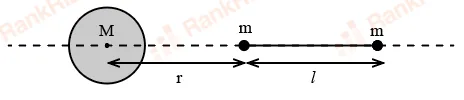
A large spherical mass M is fixed at one position and two identical point masses m are kept on a line passing through the centre of M (see figure). The point masses are connected by a rigid massless rod of length / and this assembly is free to move along the line connecting them. All three masses interact only through their mutual gravitational interaction. When the point mass nearer to M is at a distance r = 3l from M, the tension in the rod is zero for m=k(M288)m = k \left(\frac {M}{288}\right). The value of k is

Figure for JEE Advanced 2015 Physics question on Kepler's laws and planetary motion
JEE ADVANCED 2015 · PAPER 1Escape speedTRANSCRIBED

A bullet is fired vertically upwards with velocity v from the surface of a spherical planet. Whenit reaches its maximum height, its acceleration due to the planet’s gravity is 14th\frac{1}{4^{th}} of its value at the surface of the planet. If the escape velocity from the planet is vesc=vNv_{esc} = v\sqrt{N}, then the value of N is (ignore energy loss due to atmosphere)

JEE ADVANCED 2014 · PAPER 2Acceleration due to gravity and its variationTRANSCRIBED

A planet of radius R=110×R = \frac{1}{10} \times (radius of Earth) has the same mass density as Earth. Scientists dig a well of depth R5\frac{R}{5} on it and lower a wire of the same length and of linear mass density 10−3kgm−110^{-3} kgm{-1} into it. If the wire is not touching anywhere, the force applied at the top of the wire by a person holding it in place is (take the radius of Earth =6×10⁶m= 6 \times 10^6 m and the acceleration due to gravity on Earth is 10ms−210 ms^{-2})

  1. A

    96 N

  2. B

    108 N

  3. C

    120 N

  4. D

    150 N

JEE ADVANCED 2013 · PAPER 2Escape speedTRANSCRIBED

Two bodies, each of mass M, are kept fixed with a separation 2L. A particle of mass m is projected from the midpoint of the line joining their centres, perpendicular to the line. The gravitational constant is G. The correct statement(s) is (are)

  1. A

    The minimum initial velocity of the mass m to escape the gravitational field of the two bodiesis 4GML4 \sqrt{\frac{GM}{L}}

  2. B

    The minimum initial velocity of the mass m to escape the gravitational field of the two bodiesis 2GML2 \sqrt{\frac{GM}{L}}

  3. C

    The minimum initial velocity of the mass m to escape the gravitational field of the two bodiesis 2GML\sqrt{\frac{2GM}{L}}

  4. D

    The energy of the mass m remains constant.

JEE ADVANCED 2012 · PAPER 2Escape speedTRANSCRIBED

Two spherical planets P andQ have the same unfirom density ρ\rho, masses MPM_P and MQM_Q, an surface areas A and 4A, respectively. A spherical planet R also has unfirom density ρ\rho and its mass is (MP+MQ)(M_P + M_Q). The escape velocities from the planets P, Q and R, are VP,VQV_P, V_Q and VV respectively. Then

  1. A

    VQ>VR>VPV_Q > V_R > V_P

  2. B

    VR>VQ>VPV_R > V_Q > V_P

  3. C

    VRVP=3\frac{V_R}{V_P} = 3

  4. D

    VPVQ=12\frac{V_P}{V_Q} = \frac{1}{2}

JEE ADVANCED 2011 · PAPER 2Escape speedTRANSCRIBED

A satellite is moving with a constant speed ‘V’ in a circular orbit about the earth. An object of mass ‘m’ is ejected from the satellite such that it just escapes from the gravitational pull
of the earth. At the time of its ejection, the kinetic energy of the object is

  1. A

    12mV2\frac{1}{2} m V^2

  2. B

    mV2m V^2

  3. C

    32mV2\frac{3}{2} m V^2

  4. D

    2mV22m V^2

JEE ADVANCED 2010 · PAPER 1Gravitational potential energy of systemsTRANSCRIBED

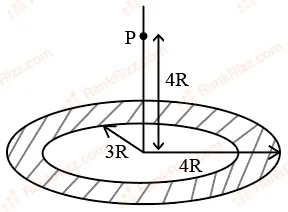
A thin uniform annular disc (see figure) of mass M has outer radius 4R and inner radius 3R. The work required to take a unit mass from point P on its axis to infinity is

Figure for JEE Advanced 2010 Physics question on Gravitational potential energy of systems
  1. A

    2GM7R(42−5)\frac{2GM}{7R}(4\sqrt{2} - 5)

  2. B

    −2GM7R(42−5)-\frac{2GM}{7R}(4\sqrt{2} - 5)

  3. C

    GM4R\frac{GM}{4R}

  4. D

    2GM5R(2−1)\frac{2GM}{5R}(\sqrt{2} - 1)

JEE ADVANCED 2010 · PAPER 1Kepler's laws and planetary motionTRANSCRIBED

A binarystar consists of two stars A (mass 2.2 MsM_s) and B (mass 11 MsM_s). where MsM_s is the mass of the sun. They are separated by distance d and are rotating about their centre of mass, which is stationary. The ratio of the total angular momentum of the binarystar to the angular momentumof star B about the centre of mass is

JEE ADVANCED 2010 · PAPER 1Acceleration due to gravity and its variationTRANSCRIBED

Gravitational acceleration on the surface of a planet is 611g\frac{\sqrt{6}}{11} g, where g is the gravitational acceleration on the surface of the earth. The average mass density of the planet is 23\frac{2}{3} times that of the earth. If the escape speed on the surface of the earth is taken to be 11 kms−1kms^{-1}, the escape speed on the surface of the planet in kms−1kms^{-1} will be

JEE ADVANCED 2008 · PAPER 1Kepler's laws and planetary motionTRANSCRIBED

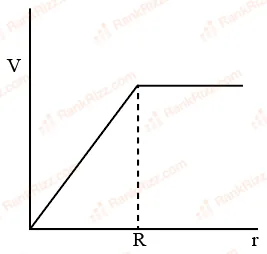
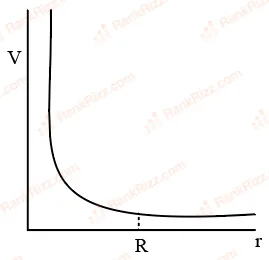
A spherically symmetric gravitational system of particles has a mass density ρ={ρ0forr≤R0forr>R\rho = \begin{cases}\rho_0 & for & r \leq R\\0 & for & r > R\end{cases} where ρ0\rho_0 is a constant. A test mass can undergo circular motion underthe influence of the gravitational field of particles. Its speed V as a function of distance r(0<r<∞)r(0 < r < \infty) from the center of the system is represented by

  1. A
    Figure for JEE Advanced 2008 Physics question on Kepler's laws and planetary motion
  2. B
    Figure for JEE Advanced 2008 Physics question on Kepler's laws and planetary motion
  3. C
    Figure for JEE Advanced 2008 Physics question on Kepler's laws and planetary motion
  4. D
    Figure for JEE Advanced 2008 Physics question on Kepler's laws and planetary motion
JEE ADVANCED 2008 · PAPER 1Acceleration due to gravity and its variationTRANSCRIBED

STATEMENT-1
Anastronaut in an orbiting space station above the Earth experiences weightlessness.
and
STATEMENT-2
An object moving around the Earth underthe influence of Earth’s gravitational force is in a state of ‘free-fall’.

  1. A

    STATEMENT-1 is True, STATEMENT-2 is True; STATEMENT-2 is a correct explanation for STATEMENT-1

  2. B

    STATEMENT-1 is True, STATEMENT-2 is True; STATEMENT-2 is NOT a correct explanation for STATEMENT-1

  3. C

    STATEMENT-1 is True, STATEMENT-2 is False

  4. D

    STATEMENT-1 is False, STATEMENT-2 is True