RankRizz
JEE ADVANCED 2023 · PAPER 2+4MEDIUMTRANSCRIBED

JEE Advanced 2023 Physics question — Rolling with friction, slipping and impulsive forces

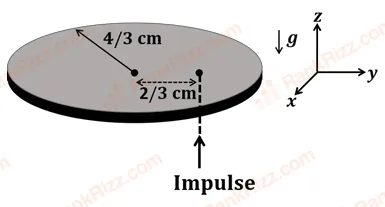
A thin circular coin of mass 5 gm and radius 4/3 cm is initially in a horizontal xyxy-plane. The coin is tossed vertically up (+z direction) by applying an impulse of π2×10⁻²\sqrt{\frac{\pi}{2}} \times 10^{-2} N-s at a distance 2/3 cm from its center. The coin spins about its diameter and moves along the +z direction. By the time the coin reaches back to its initial position, it completes nn rotations. The value of nn is ____.

[Given: The acceleration due to gravity g=10g = 10 ms−2^{-2}]

Figure for JEE Advanced 2023 Physics question on Rolling with friction, slipping and impulsive forces
SOLUTION

The coin is a thin uniform disc of mass m=5 g=0.005 kgm = 5\text{ g}=0.005\text{ kg} and radius R=43 cm=0.013333 mR=\frac{4}{3}\text{ cm}=0.013333\text{ m} that lies in the horizontal xyxy-plane.

An impulse of magnitude J=π2×10⁻² N⋅sJ=\sqrt{\frac{\pi}{2}}\times10^{-2}\ \text{N·s} is applied vertically upward (along +zz) at a point whose distance from the centre is r=23 cm=0.006667 mr=\frac{2}{3}\text{ cm}=0.006667\text{ m}. Because the line of action does not pass through the centre, the impulse produces:

• a translational momentum JJ along +zz,
• an angular momentum (about the centre) whose magnitude is L=rJL = rJ, perpendicular to both r⃗\vec r and J⃗\vec J, i.e. about a diameter of the disc.

Step 1: Translational upward velocity
Impulse-momentum theorem: J=mvcm ⇒ vcm=JmJ = m v_{\text{cm}} \ \Rightarrow\ v_{\text{cm}} = \frac{J}{m} Compute JJ first: J=π2×10−2=1.2523×10⁻² N⋅sJ = \sqrt{\frac{\pi}{2}}\times10^{-2} = 1.2523\times10^{-2}\ \text{N·s} Hence vcm=1.2523×10−20.005=2.5046 m s−1v_{\text{cm}} = \frac{1.2523\times10^{-2}}{0.005}=2.5046\ \text{m s}^{-1}

Step 2: Time of flight
The coin is projected upward with speed vcmv_{\text{cm}} and returns to its initial level under gravity. Time of flight: T=2vcmg=2(2.5046)10=0.5009 sT = \frac{2v_{\text{cm}}}{g} = \frac{2(2.5046)}{10}=0.5009\ \text{s}

Step 3: Angular speed imparted about a diameter
Magnitude of angular momentum: L=rJ=(0.006667)(1.2523×10⁻²)=8.3487×10⁻⁵ kg m2 s−1L = rJ = (0.006667)(1.2523\times10^{-2}) = 8.3487\times10^{-5}\ \text{kg m}^2\text{ s}^{-1} Moment of inertia of a thin disc about a diameter: I=14mR2I = \frac{1}{4}mR^{2} R2=(0.013333)2=1.7778×10⁻⁴ m2R^{2} = (0.013333)^{2}=1.7778\times10^{-4}\ \text{m}^{2} I=14(0.005)(1.7778×10⁻⁴)=2.2222×10⁻⁷ kg m2I = \frac{1}{4}(0.005)(1.7778\times10^{-4}) = 2.2222\times10^{-7}\ \text{kg m}^{2} Angular speed: ω=LI=8.3487×10−52.2222×10−7=3.7569×10² rad s−1\omega = \frac{L}{I} = \frac{8.3487\times10^{-5}}{2.2222\times10^{-7}} = 3.7569\times10^{2}\ \text{rad s}^{-1}

Step 4: Number of complete rotations during the flight
n=ωT2π=(3.7569×10²)(0.5009)2π=1.8803×1026.2832=29.9≈30n=\frac{\omega T}{2\pi}= \frac{(3.7569\times10^{2})(0.5009)}{2\pi} =\frac{1.8803\times10^{2}}{6.2832}=29.9\approx30

Hence, by the time the coin returns to its initial position, it completes about 30 rotations.

Answer: 30

Tagged Rolling with friction, slipping and impulsive forces. Machine-assigned, so read it as a strong shortlist rather than a verdict.

SubjectPhysics
TopicRolling with friction, slipping and impulsive forces
TypeNumerical answer