JEE Advanced 2023 Physics question — Rolling with friction, slipping and impulsive forces
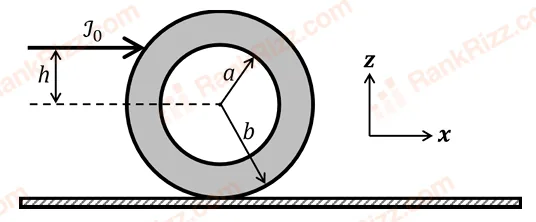
An annular disk of mass , inner radius and outer radius is placed on a horizontal surface with coefficient of friction , as shown in the figure. At some time, an impulse is applied at a height h above the center of the disk. If then the disk rolls without slipping along the x-axis. Which of the following statement(s) is(are) correct?
SOLUTION
The impulse is applied at a point situated a vertical distance above the centre of mass (COM) of the annular disc. Choose the co-ordinate system • origin at the COM, • -axis along the direction of the impulse (and of the subsequent translation), • -axis horizontal and perpendicular to the plane of the disc (i.e. along the axle), • -axis vertically upward.
1. Linear impulse-momentum relation
The impulse imparts a COM velocity
along the -direction.
2. Angular impulse-momentum relation
The position vector of the point of application is .
The impulse produces an angular impulse
Hence the disc acquires an angular momentum about the -axis equal to .
For an annular disc the moment of inertia about a diameter (the -axis here) is
Therefore the initial angular velocity about the -axis is
3. Condition for instantaneous pure rolling
For rolling without slipping, the velocity of the point of contact with the floor must be zero.
The lowest point is at a distance below the COM, i.e. .
Its velocity relative to the ground is
The rolling condition therefore gives
Substituting from step 2,
4. Optimum height
Thus the unique height at which the impulse must be delivered so that the disc starts pure rolling immediately is
5. Verification of the given options
• Take the limiting case (a solid disc).
Then
which coincides with Option A. ✅
Hence, the correct statement is:
Option A which is: For and , .
Tagged Rolling with friction, slipping and impulsive forces. Machine-assigned, so read it as a strong shortlist rather than a verdict.