JEE Advanced 2024 Physics question — Angular momentum of particles and rigid bodies
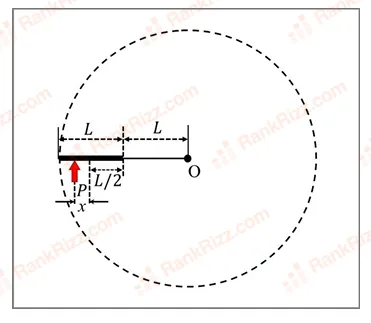
A thin uniform rod of length and certain mass is kept on a frictionless horizontal table with a massless string of length fixed to one end (top view is shown in the figure). The other end of the string is pivoted to a point . If a horizontal impulse is imparted to the rod at a distance from the mid-point of the rod (see figure), then the rod and string revolve together around the point , with the rod remaining aligned with the string. In such a case, the value of is ______.
SOLUTION
Let the mass of the uniform rod be and let its mid-point be . The string of length is attached to the rod at point (one end of the rod) and the other end of the string is fixed to the pivot . Hence the points are collinear in the order , with and , so
An impulsive force delivers a (linear) impulse perpendicular to the rod at a point that is a distance away from the mid-point along the length of the rod.
Linear motion of the centre of mass
The entire impulse is received by the rod, so the centre of mass acquires a linear momentum and hence a speed
Angular motion about the centre of mass
The same impulse produces an angular impulse (about the centre) equal to .
For a thin uniform rod, the moment of inertia about its mid-point is
Therefore the angular velocity of the rod about its own centre is
Condition for the rod to remain aligned with the string
For the rod and string to revolve rigidly about the fixed point , the motion after the impulse must be a pure rotation about .
In pure rotation, the linear speed of the centre of mass must satisfy
Substituting , and gives
Cancel from both sides:
Since the point of application was specified as from the mid-point, we equate
Hence the required value is
18
Tagged Angular momentum of particles and rigid bodies. Machine-assigned, so read it as a strong shortlist rather than a verdict.