JEE Advanced 2024 Physics question — Angular momentum of particles and rigid bodies
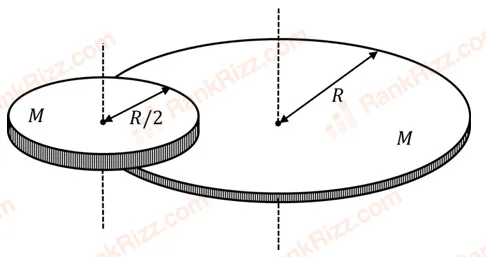
A disc of mass and radius is free to rotate about its vertical axis as shown in the figure. A battery operated motor of negligible mass is fixed to this disc at a point on its circumference. Another disc of the same mass and radius is fixed to the motor's thin shaft. Initially, both the discs are at rest. The motor is switched on so that the smaller disc rotates at a uniform angular speed . If the angular speed at which the large disc rotates is , then the value of is ______.
SOLUTION
Take the vertical axis through the centre of the larger disc as the reference (positive sense anticlockwise).
Initially both discs are at rest total angular momentum about this axis is zero and, because no external torque acts, it must remain zero.
Moments of inertia about the vertical axis
Large disc (mass , radius ):
Small disc (mass , radius ) about its own centre:
The small disc is fixed to the circumference of the big disc, so its centre is at a distance from the main axis. Hence, using the parallel-axis theorem, the small disc’s moment of inertia about the main axis is
Angular velocities
Motor keeps the small disc spinning at a constant angular speed (anticlockwise) about its own axis.
Reaction torque makes the large disc rotate clockwise with angular speed (-ve sign).
Because the small disc is rigidly fixed to the large disc, its centre also moves in a circle of radius with the same angular speed as the large disc.
Angular momenta about the main axis
1. Large disc:
2. Small disc (two parts)
a) Spin about its own axis: (anticlockwise)
b) Orbital motion of its centre:
Total angular momentum must stay zero:
Divide by :
Hence, the large disc rotates with angular speed opposite to that of the smaller disc.
Final answer: 12
Tagged Angular momentum of particles and rigid bodies. Machine-assigned, so read it as a strong shortlist rather than a verdict.