JEE Advanced 2022 Physics question — Rolling with friction, slipping and impulsive forces
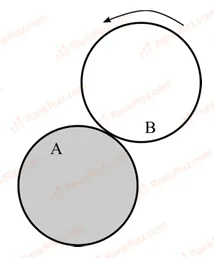
A flat surface of a thin uniform disk A of radius R is glued to a horizontal table. Another thin uniform disk B of mass M and with the same radius R rolls without slipping on the circumference of A, as shown in the figure. A flat surface of B also lies on the plane of the table. The center of mass of B has fixed angular speed about the vertical axis passing through the center of A. The angular momentum of B is with respect to the center of A. Which of the following is the value of ?
SOLUTION
1. Translational (Orbital) Angular Momentum
- Disk A is fixed at the origin. Since both disks have a radius of , the center of mass (CM) of disk B moves in a circular path of radius .
- The center of mass of disk B moves with a fixed angular speed around the center of A. Therefore, the linear velocity of its center of mass () is:
- The orbital angular momentum () of disk B relative to the center of A is given by:
2. Rotational (Spin) Angular Momentum
- Because disk B rolls without slipping on the stationary circumference of disk A, its contact point with disk A must have an instantaneous velocity of zero.
- Let be the spinning angular velocity of disk B about its own center of mass. The non-slip condition dictates:
- The moment of inertia of a uniform disk about its central axis is .
- The intrinsic spin angular momentum () about its own center is:
3. Total Angular Momentum
Since both the orbital revolution and the intrinsic spin occur in the same direction (counter-clockwise), their magnitudes add up directly:
Conclusion
Comparing our result with the expression given in the problem, :
Tagged Rolling with friction, slipping and impulsive forces. Machine-assigned, so read it as a strong shortlist rather than a verdict.