JEE Advanced 2026 Physics question — Rolling with friction, slipping and impulsive forces
Consider a large disk of radius and two smaller disks, each of radius , lying on its circumference, as shown in the figure. The smaller disks are initially in contact with each other, with an angular separation between their centers. They are made to roll without slipping in opposite directions, with constant angular velocities and while the large disk is held stationary. The time at which the smaller disks are again in contact is:
[Use and ignore gravity.]
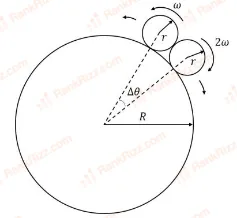
SOLUTION
For pure rolling on a stationary circular track, the angular velocity of the center of a rolling object about the track's center is related to its spin angular velocity by .
Given: , ,
Radius of the path traced by the centers of the small disks:
Initial angular separation between the centers subtended at the center of the large disk:
Angular velocities of the centers of the two disks about the track's center:
Relative angular velocity of the centers since they move in opposite directions:
Total angular distance to be covered for the next contact:
Finding the time taken :
Tagged Rolling with friction, slipping and impulsive forces. Machine-assigned, so read it as a strong shortlist rather than a verdict.