RankRizz

Atoms & Nuclei — JEE Advanced Previous Year Questions

Every Atoms & Nuclei question JEE Advanced has set from 2007–2026, grouped by the idea it tests rather than the order of the syllabus. 53 questions across 6 distinct ideas. Free to read, answer key on every one.

Questions

53

Distinct ideas

6

Share of marks

6%

Difficulty

EASY

The ideas inside Atoms & Nuclei

A chapter is not one subject — it is a handful of procedures the examiner reuses. These are the ones Atoms & Nuclei questions actually test.

01Alpha-particle scattering and Rutherford modelNot set in Advanced
02Bohr model of hydrogen-like atomsset 1×
03Hydrogen spectrum and spectral seriesset 17×
04X-rays: continuous and characteristic spectra, Moseley's lawset 2×
05Nuclear size, mass defect and binding energyset 1×
06Nuclear fission, fusion and Q-valueset 12×
07Radioactivity: decay law, half-life and decay modesset 20×

Atoms & Nuclei weightage, year by year

The share of each year’s Physics questions that came from Atoms & Nuclei, counted from the 19 papers we hold for the last 10 years, and paper by paper inside a year.

Falling: 4.0% of Physics questions in 2024–2026, down from 6.4% in 2017–2023. Its heaviest year was 2019, at 8.3%. Not asked at all in 2018.

20262 / 345.9%PAPER 1 6.3%PAPER 2 5.6%
20251 / 323.1%PAPER 1 6.3%PAPER 2 0.0%
20241 / 342.9%PAPER 1 5.9%PAPER 2 0.0%
20232 / 345.9%PAPER 1 5.9%PAPER 2 5.9%
20223 / 368.3%PAPER 1 11.1%PAPER 2 5.6%
20213 / 387.9%PAPER 1 10.5%PAPER 2 5.3%
20202 / 365.6%PAPER 1 5.6%PAPER 2 5.6%
20193 / 368.3%PAPER 1 5.6%PAPER 2 11.1%
20180 / 180.0%1 PAPER
20172 / 365.6%PAPER 1 11.1%PAPER 2 0.0%

“QS” is Atoms & Nuclei questions out of all Physics questions that year. A year with more sittings asks more questions, which is why the share, not the count, is the number to compare.

Atoms & Nuclei: quick answers

How many Atoms & Nuclei questions has JEE Advanced asked?

53 questions from 2007–2026. Over the last 20 papers, Atoms & Nuclei carried about 6% of Physics marks.

Which Atoms & Nuclei topics come up most?

Radioactivity: decay law, half-life and decay modes (20 questions), Hydrogen spectrum and spectral series (17 questions), Nuclear fission, fusion and Q-value (12 questions). Start with these, they are what the examiner keeps coming back to.

Is Atoms & Nuclei important for JEE Advanced?

Falling: 4.0% of Physics questions in 2024–2026, down from 6.4% in 2017–2023. Its heaviest year was 2019, at 8.3%. Not asked at all in 2018. It has carried about 6% of Physics marks in recent papers, rated easy on our difficulty scale. The year-by-year table above shows how that has moved.

Do these Atoms & Nuclei PYQs have answers and solutions?

Yes. Every question shows its official answer key, and a worked solution opens on the question’s own page wherever we have one. Reading and checking answers is free, no sign-up needed.

What’s the fastest way to revise Atoms & Nuclei?

Do one past question per idea first: Atoms & Nuclei has 6 distinct ideas, listed above. Then practise the topics you get wrong, or build a timed test from this chapter.

Every Atoms & Nuclei question

1–20 OF 53 · NEWEST FIRST

JEE ADVANCED 2026 · PAPER 2Radioactivity: decay law, half-life and decay modesTRANSCRIBED

A nuclear reactor starts producing a radioactive nuclide XX from t=0t=0, at a constant rate of α\alpha per second. Each decay of XX produces energy E0E_0, which is utilized to heat a liquid of mass mm and specific heat ss. Assuming no heat loss from the liquid and taking λ\lambda as the decay constant of XX, the rate of increase in the temperature of the liquid is:

  1. A

    αE0m s(1−e−λt)\dfrac{\alpha E_0}{m\,s}\left(1-e^{-\lambda t}\right)

  2. B

    αE0m s(eλt−1)\dfrac{\alpha E_0}{m\,s}\left(e^{\lambda t}-1\right)

  3. C

    λE0m s(1−e−λt)\dfrac{\lambda E_0}{m\,s}\left(1-e^{-\lambda t}\right)

  4. D

    E0m s(α−λe−λt)\dfrac{E_0}{m\,s}\left(\alpha-\lambda e^{-\lambda t}\right)

JEE ADVANCED 2026 · PAPER 1Hydrogen spectrum and spectral seriesTRANSCRIBED

Consider a hydrogen atom with vkv_k, rkr_k, and KkK_k denoting the velocity, orbital radius and kinetic energy of the electron in the kthk^{\text{th}} orbit, respectively. The electron undergoes a transition from the nthn^{\text{th}} orbit, emitting radiation corresponding to the Lyman series. Considering hh to be the Planck's constant and ϵ0\epsilon_0 the permittivity of the free space, the correct statement(s) is(are):

  1. A

    Magnitude of change in kinetic energy of electron can be expressed as h4π∣nvnrn−v1r1∣\dfrac{h}{4\pi}\left|\dfrac{n v_n}{r_n}-\dfrac{v_1}{r_1}\right|.

  2. B

    Magnitude of change in de Broglie wavelength of the electron can be expressed as e24ϵ0∣1Kn−1K1∣\dfrac{e^2}{4\epsilon_0}\left|\dfrac{1}{K_n}-\dfrac{1}{K_1}\right|.

  3. C

    Frequency of the radiation emitted can be expressed as e28πϵ0h(1r1−1rn)\dfrac{e^2}{8\pi\epsilon_0 h}\left(\dfrac{1}{r_1}-\dfrac{1}{r_n}\right).

  4. D

    Magnitude of change in total energy of the electron can be expressed as h2π∣v1r1−nvnrn∣\dfrac{h}{2\pi}\left|\dfrac{v_1}{r_1}-\dfrac{n v_n}{r_n}\right|.

JEE ADVANCED 2025 · PAPER 1Hydrogen spectrum and spectral seriesTRANSCRIBED

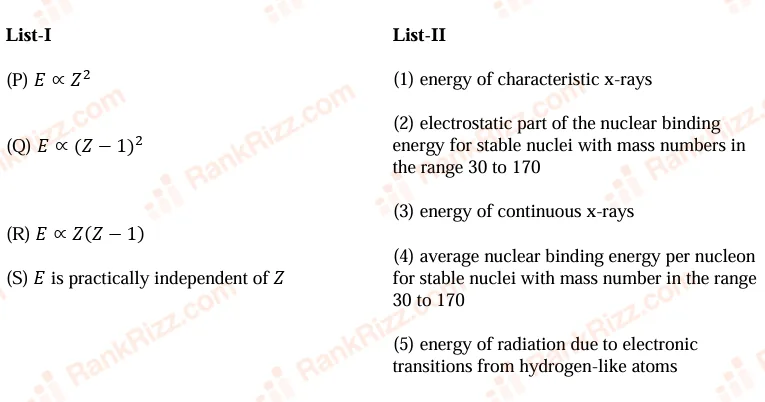
List-I shows various functional dependencies of energy (EE) on the atomic number (ZZ). Energies associated with certain phenomena are given in List-II.

Choose the option that describes the correct match between the entries in List-I to those in List-II.

Figure for JEE Advanced 2025 Physics question on Hydrogen spectrum and spectral series
  1. A

    P→\to4, Q→\to3, R→\to1, S→\to2

  2. B

    P→\to5, Q→\to2, R→\to1, S→\to4

  3. C

    P→\to5, Q→\to1, R→\to2, S→\to4

  4. D

    P→\to3, Q→\to2, R→\to1, S→\to5

JEE ADVANCED 2024 · PAPER 1Bohr model of hydrogen-like atomsTRANSCRIBED

A particle of mass mm is moving in a circular orbit under the influence of the central force F(r)=−krF(r) = -kr, corresponding to the potential energy V(r)=kr2/2V(r) = kr^2/2, where kk is a positive force constant and rr is the radial distance from the origin. According to the Bohr's quantization rule, the angular momentum of the particle is given by L=nℏL = n\hbar, where ℏ=h/(2π)\hbar = h/(2\pi), hh is the Planck's constant, and nn a positive integer. If vv and EE are the speed and total energy of the particle, respectively, then which of the following expression(s) is(are) correct?

  1. A

    r2=nℏ1mkr^2 = n\hbar\sqrt{\frac{1}{mk}}

  2. B

    v2=nℏkm3v^2 = n\hbar\sqrt{\frac{k}{m^3}}

  3. C

    Lmr2=km\frac{L}{mr^2} = \sqrt{\frac{k}{m}}

  4. D

    E=nℏ2kmE = \frac{n\hbar}{2}\sqrt{\frac{k}{m}}

JEE ADVANCED 2023 · PAPER 2Radioactivity: decay law, half-life and decay modesTRANSCRIBED

In a radioactive decay process, the activity is defined as A=−dNdtA = -\frac{dN}{dt}, where N(t)N(t) is the number of radioactive nuclei at time tt. Two radioactive sources, S1S_1 and S2S_2 have same activity at time t=0t = 0. At a later time, the activities of S1S_1 and S2S_2 are A1A_1 and A2A_2, respectively. When S1S_1 and S2S_2 have just completed their 3rd and 7th half-lives, respectively, the ratio A1/A2A_1/A_2 is ____.

JEE ADVANCED 2023 · PAPER 1Radioactivity: decay law, half-life and decay modesTRANSCRIBED

List-I shows different radioactive decay processes and List-II provides possible emitted particles. Match each entry in List-I with an appropriate entry from List-II, and choose the correct option.

List-IList-II
(P)92238U→91234Pa{}^{238}_{92}U \to {}^{234}_{91}Pa(1)one α\alpha particle and one β+\beta^+ particle
(Q)82214Pb→82210Pb{}^{214}_{82}Pb \to {}^{210}_{82}Pb(2)three β−\beta^- particles and one α\alpha particle
(R)81210Tl→82206Pb{}^{210}_{81}Tl \to {}^{206}_{82}Pb(3)two β−\beta^- particles and one α\alpha particle
(S)91228Pa→88224Ra{}^{228}_{91}Pa \to {}^{224}_{88}Ra(4)one α\alpha particle and one β−\beta^- particle
(5)one α\alpha particle and two β+\beta^+ particles
  1. A

    P →\to 4, Q →\to 3, R →\to 2, S →\to 1

  2. B

    P →\to 4, Q →\to 1, R →\to 2, S →\to 5

  3. C

    P →\to 5, Q →\to 3, R →\to 1, S →\to 4

  4. D

    P →\to 5, Q →\to 1, R →\to 3, S →\to 2

JEE ADVANCED 2022 · PAPER 2Radioactivity: decay law, half-life and decay modesTRANSCRIBED

In a radioactive decay chain reaction, 90230^{230}_{90}Th nucleus decays into 84214^{214}_{84}Po nucleus. The ratio of the number of α\alpha to number of β−\beta^- particles emitted in this process is _______.

JEE ADVANCED 2022 · PAPER 1Nuclear size, mass defect and binding energyTRANSCRIBED

The minimum kinetic energy needed by an alpha particle to cause the nuclear reaction 716N+24He→11H+819O^{16}_7N + ^4_2He \to ^1_1H + ^{19}_8O in a laboratory frame is nn (in MeV). Assume that 716N^{16}_7N is at rest in the laboratory frame. The masses of 716N^{16}_7N, 24He^4_2He, 11H^1_1H and 819O^{19}_8O can be taken to be 16.006 uu, 4.003 uu, 1.008 uu and 19.003 uu, respectively, where 1 uu = 930 MeVc−2c^{-2}. The value of nn is ______.

JEE ADVANCED 2022 · PAPER 1Radioactivity: decay law, half-life and decay modesTRANSCRIBED

The binding energy of nucleons in a nucleus can be affected by the pairwise Coulomb repulsion. Assume that all nucleons are uniformly distributed inside the nucleus. Let the binding energy of a proton be EbpE_b^p and the binding energy of a neutron be EbnE_b^n in the nucleus.

Which of the following statement(s) is(are) correct?

  1. A

    Ebp−EbnE_b^p - E_b^n is proportional to Z(Z−1)Z(Z-1) where ZZ is the atomic number of the nucleus.

  2. B

    Ebp−EbnE_b^p - E_b^n is proportional to A−1/3A^{-1/3} where AA is the mass number of the nucleus.

  3. C

    Ebp−EbnE_b^p - E_b^n is positive.

  4. D

    EbpE_b^p increases if the nucleus undergoes a beta decay emitting a positron.

JEE ADVANCED 2021 · PAPER 1Radioactivity: decay law, half-life and decay modesTRANSCRIBED

A heavy nucleus Q of half-life 20 minutes undergoes alpha-decay with probability of 60% and beta-decay with probability of 40%. Initially, the number of Q nuclei is 1000. The number of alpha-decays of Q in the first one hour is

  1. A

    50

  2. B

    75

  3. C

    350

  4. D

    525

JEE ADVANCED 2021 · PAPER 2Nuclear fission, fusion and Q-valueTRANSCRIBED

A heavy nucleus N, at rest, undergoes fission N→P+QN \rightarrow P + Q, where P and Q are two lighter nuclei. Let δ=MN−MP−MQ\delta = M_N − M_P − M_Q, where MPM_P, MQM_Q and MNM_N are the masses of P, Q and N, respectively. EP and EQ are the kinetic energies of P and Q, respectively. The speeds of P and Q are vPv_P and vQv_Q, respectively. If c is the speed of light, which of the following statement(s) is(are) correct?

  1. A

    EP+EQ=c2δE_P + E_Q = c^2 \delta

  2. B

    EP=(MPMP+MQ)c2δE_P = \left(\frac{M_P}{M_P + M_Q}\right) c^2 \delta

  3. C

    vPvQ=MQMP\frac{v_P}{v_Q} = \frac{M_Q}{M_P}

  4. D

    The magnitude of momentum for P as well as Q is c2μδc \sqrt{2 \mu \delta}, where μ=MPMQ(MP+MQ)\mu = \frac{M_P M_Q}{(M_P + M_Q)}

JEE ADVANCED 2021 · PAPER 1Hydrogen spectrum and spectral seriesTRANSCRIBED

Which of the following statement(s) is(are) correct about the spectrum of hydrogen atom?

  1. A

    The ratio of the longest wavelength to the shortest wavelength in Balmer series is 95\frac{9}{5}

  2. B

    There is an overlap between the wavelength ranges of Balmer and Paschen series

  3. C

    The wavelengths of Lyman series are given by (1+1m2)λ0\left(1 + \frac{1}{m^2}\right)\lambda_0, where λ0\lambda_0 is the shortest wavelength of Lyman series and m is an integer

  4. D

    The wavelength ranges of Lyman and Balmer series do not overlap

JEE ADVANCED 2020 · PAPER 1Hydrogen spectrum and spectral seriesTRANSCRIBED

A particle of mass m moves in circular orbits with potential energy 𝑉(𝑟) = 𝐹𝑟, where F is a positive constant and r is its distance from the origin. Its energies are calculated using the Bohr model. If the radius of the particle’s orbit is denoted by R and its speed and energy are denoted by v and E, respectively, then for the nthn^{th} orbit (here h is the Planck’s constant)

  1. A

    R∝n1/3R \propto n^{1/3} and V∝n2/3V \propto n^{2/3}

  2. B

    R∝n2/3R \propto n^{2/3} and V∝n1/3V \propto n^{1/3}

  3. C

    E=32(n2h2F24π2m)1/3E = \frac{3}{2}\left(\frac{n^{2}h^{2}F^{2}}{4\pi^{2}m}\right)^{1/3}

  4. D

    E=2(n2h2F24π2m)1/3E = 2\left(\frac{n^{2}h^{2}F^{2}}{4\pi^{2}m}\right)^{1/3}

JEE ADVANCED 2020 · PAPER 2X-rays: continuous and characteristic spectra, Moseley's lawTRANSCRIBED

In an X-ray tube, electrons emitted from a filament (cathode) carrying current I hit a target (anode) at a distance 𝑑 from the cathode. The target is kept at a potential 𝑉 higher than the cathode resulting in emission of continuous and characteristic X-rays. If the filament current 𝐼 is decreased to I2\frac{I}{2}, the potential difference 𝑉 is increased to 2𝑉, and the separation distance 𝑑 is reduced to d2\frac{d}{2}, then

  1. A

    the cut-off wavelength will reduce to half, and the wavelengths of the characteristic X-rays will remain the same

  2. B

    the cut-off wavelength as well as the wavelengths of the characteristic X-rays will remain the same

  3. C

    the cut-off wavelength will reduce to half, and the intensities of all the X-rays will decrease

  4. D

    the cut-off wavelength will become two times larger, and the intensity of all the X-rays will decrease

JEE ADVANCED 2019 · PAPER 1Radioactivity: decay law, half-life and decay modesTRANSCRIBED

In a radioactive sample, 1940K_{19}^{40}K nuclei either decay into stable 2040Ca_{20}^{40}Ca nuclei with decay constant 4.5×10−194.5 \times 10^{-19} per year or into stable 1840Ar_{18}^{40}Ar nuclei with decay constant 0.5×10−100.5 \times 10^{-10} per year. Given that in this sample all the stable 2040Ca_{20}^{40}Ca and 1840Ar_{18}^{40}Ar nuclei are produced by the 1940K_{19}^{40}K nuclei only. In time t×109t \times 10^9 years, if the ratio of the sum of stable 2040Ca_{20}^{40}Ca and 1840Ar_{18}^{40}Ar nuclei to the radioactive 1940K_{19}^{40}K nuclei is 99, the value of t will be,
[Given: ln⁡10=2.3\ln 10 = 2.3]

  1. A

    1.15

  2. B

    9.2

  3. C

    2.3

  4. D

    4.6

JEE ADVANCED 2019 · PAPER 2Radioactivity: decay law, half-life and decay modesTRANSCRIBED

A free hydrogen atom after absorbing a photon of wavelength λa\lambda_a gets excited from the state n = 1 to the state n = 4. Immediately after that the electron jumps to n = m state by emitting a photon of wavelength λe\lambda_e. Let the change in momentum of atom due to the absorption and the emission are △pa\triangle p_a and △pe,\triangle p_e, respectively. If λaλe=15\frac{\lambda_a}{\lambda_e} = \frac{1}{5} which of the option(s) is/are correct?
[Use hc = 1242 eV nm ; 1 nm = 10−910^{-9} m, h and c are Planck’s constant and speed of light, respectively]

  1. A

    m = 2

  2. B

    λe=418nm\lambda_e = 418 nm

  3. C

    △pa△pe=12\frac{\triangle p_a}{\triangle p_e} = \frac{1}{2}

  4. D

    The ratio of kinetic energy of the electron in the state n = m to the state n = 1 is 14\frac{1}{4}

JEE ADVANCED 2019 · PAPER 2Radioactivity: decay law, half-life and decay modesTRANSCRIBED

Suppose a 88226Ra_{88}^{226} Ra nucleus at rest and in ground state undergoes α−\alpha-decay to a 86222Rn_{86}^{222} Rn nucleus in its excited state. The kinetic energy of the emitted α\alpha particle is found to be 4.44 MeV. 86222Rn_{86}^{222} Rn nucleus then goes to its ground state by γ−\gamma-decay. The energy of the emitted γ\gamma photon is ________ ke V.
[Given: atomic mass of 88226Ra=226.005u,_{88}^{226} Ra = 226.005 u, atomic mass of 86222Rn=222.000u,_{86}^{222} Rn = 222.000 u, atomic mass of α\alpha particle = 4.000 u, 1u=931MeV/c2,1 u = 931 Me V/c^2, c is speed of the light]

JEE ADVANCED 2017 · PAPER 1Hydrogen spectrum and spectral seriesTRANSCRIBED

An electron in a hydrogen atom undergoes a transition from an orbit with quantum number nin_i to another with quantum number nfn_f. ViV_i and VfV_f are respectively the initial and final potential energies of the electron. If ViVf=6.25\frac{V_i}{V_f} = 6.25, then the smallest possible nfn_f is

JEE ADVANCED 2017 · PAPER 1Radioactivity: decay law, half-life and decay modesTRANSCRIBED

131I^{131}I is an isotope of Iodine that β\beta decays to an isotope of Xenon with a half-life of 8 days. A small amount of a serum labelled with 131I^{131}I is injected into the blood of a person. The activity of the amount of 131I^{131}I injected was 2.4×1052.4 \times 10^5 Becquerel (Bq). It is known that the
injected serum will get distributed uniformly in the blood stream in less than half an hour. After 11.5 hours, 2.5 ml of blood is drawn from the person’s body, and gives an activity of 115 Bq. The total volume of blood in the person’s body, in liters is approximately (you may use ex≈1+xe^x \approx 1 + x for ∣x∣≪1\mid x \mid \ll 1 and ln⁡2≈0.7\ln 2 \approx 0.7).

JEE ADVANCED 2016 · PAPER 2Nuclear fission, fusion and Q-valueTRANSCRIBED

The electrostatic energy of Z protons uniformly distributed throughout a spherical nucleus of radius R is given by
E=35Z(Z−1)e24πε0RE = \frac{3}{5}\frac{Z(Z - 1)e^2}{4 \pi ε_0 R}
The measured masses of the neutron, 11H,715N^1_1H, ^{15}_7N and 815O^{15}_8O are 1.008665 u, 1.007825 u, 15.000109 u and 15.003065 u,respectively. Given that the radii of both the 715N^{15}_7N and 815O^{15}_8O nuclei are same, 1u=931.5MeV/c21 u = 931.5 MeV/c^2 (c is the speed oflight) and e2(4πε0)=1.44MeVfm\frac{e^2}{(4 \pi ε_0)} = 1.44 MeV fm. Assumingthat the difference between the binding energies of 715N^{15}_7 N and 815O^{15}_8 O is purely due to the electrostatic energy, the radius of either of the nuclei is(1fm=10−15m)(1 fm = 10^{-15}m)

  1. A

    2.85 fm

  2. B

    3.03 fm

  3. C

    3.42 fm

  4. D

    3.80 fm