JEE Advanced 2021 Physics question — Equilibrium of rigid bodies and toppling
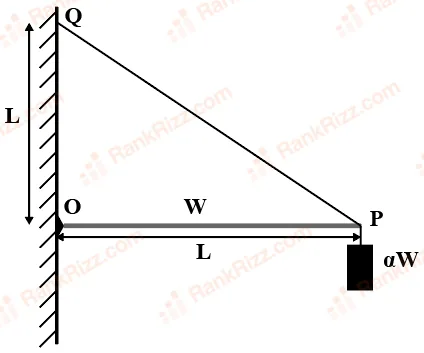
One end of a horizontal uniform beam of weight 𝑊 and length 𝐿 is hinged on a vertical wall at point O and its other end is supported by a light inextensible rope. The other end of the rope is fixed at point Q, at a height 𝐿 above the hinge at point O. A block of weight is attached at the point P of the beam, as shown in the figure (not to scale). The rope can sustain a maximum tension of ()W. Which of the following statement(s) is(are) correct?
SOLUTION
The beam OA is uniform, horizontal and of length . It is hinged at the wall at .
The light, inextensible rope is tied at the free end of the beam and at the point which is vertically above by the same distance .
Hence the rope is of length and it makes an angle of with both the horizontal and the vertical.
Let
• = weight of the beam (acts at its mid-point from the hinge).
• = weight of the block hung at the point situated at a distance from the hinge.
• = tension in the rope.
• = horizontal component of the hinge reaction, taken positive towards the right (along +x).
• = vertical component of the hinge reaction, taken positive upwards (along +y).
Step 1 : Equilibrium of forces
Horizontal balance:
Vertical balance:
Step 2 : Equilibrium of moments about the hinge O (anticlockwise positive)
The moment of the tension about is produced by the perpendicular distance of its line of action: The clockwise moments due to the two weights are
Setting the net moment equal to zero gives
Step 3 : Vertical reaction
Substituting the value of from (3) into (2):
The quantity will disappear from expression (4) only when the bracket multiplying it is zero, i.e.
This means the block must be hung from the extreme end of the beam (which is indeed the position of point in the figure). With this condition one obtains
which is a constant, completely independent of the value of . Hence statement A is correct.
Step 4 : Verifying the remaining statements
Statement BPutting and in (3):
Therefore from (1)
The horizontal reaction, however, acts towards the right (positive) while the numerical value quoted in the option carries no sign. Since direction is an essential part of a vector component, the statement is not accepted as correct.
Statement CFor we have already obtained , not . Hence statement C is wrong.
Statement DThe rope can withstand a maximum tension . From (3) with , the tension is
Equating gives
For the rope is exactly at its limiting tension; it will start snapping the instant exceeds this value, i.e. for . Because the option claims breakage only when (excluding the equality case), it is not strictly correct.
Thus, the only statement that is wholly correct is
Option A which states: “The vertical component of reaction force at O does not depend on .”
Tagged Equilibrium of rigid bodies and toppling. Machine-assigned, so read it as a strong shortlist rather than a verdict.