RankRizz

Work, Energy & Power — JEE Advanced Previous Year Questions

Every Work, Energy & Power question JEE Advanced has set from 2007–2020, grouped by the idea it tests rather than the order of the syllabus. 17 questions across 3 distinct ideas. Free to read, answer key on every one.

Questions

17

Distinct ideas

3

Share of marks

0.9%

Difficulty

MEDIUM

The ideas inside Work, Energy & Power

A chapter is not one subject — it is a handful of procedures the examiner reuses. These are the ones Work, Energy & Power questions actually test.

01Work done by constant and variable forcesset 5×
02Kinetic energy and the work-energy theoremNot set in Advanced
03Potential energy, conservative forces and energy curvesset 11×
04Conservation of mechanical energyNot set in Advanced
05Powerset 1×

Work, Energy & Power weightage, year by year

The share of each year’s Physics questions that came from Work, Energy & Power, counted from the 19 papers we hold for the last 10 years, and paper by paper inside a year.

Falling: 0.0% of Physics questions in 2024–2026, down from 1.3% in 2017–2023. Its heaviest year was 2019, at 5.6%. Not asked at all in 2017, 2018, 2021, 2022, 2023, 2024, 2025, 2026.

20260 / 340.0%PAPER 1 0.0%PAPER 2 0.0%
20250 / 320.0%PAPER 1 0.0%PAPER 2 0.0%
20240 / 340.0%PAPER 1 0.0%PAPER 2 0.0%
20230 / 340.0%PAPER 1 0.0%PAPER 2 0.0%
20220 / 360.0%PAPER 1 0.0%PAPER 2 0.0%
20210 / 380.0%PAPER 1 0.0%PAPER 2 0.0%
20201 / 362.8%PAPER 1 0.0%PAPER 2 5.6%
20192 / 365.6%PAPER 1 5.6%PAPER 2 5.6%
20180 / 180.0%1 PAPER
20170 / 360.0%PAPER 1 0.0%PAPER 2 0.0%

“QS” is Work, Energy & Power questions out of all Physics questions that year. A year with more sittings asks more questions, which is why the share, not the count, is the number to compare.

Work, Energy & Power: quick answers

How many Work, Energy & Power questions has JEE Advanced asked?

17 questions from 2007–2020. Over the last 20 papers, Work, Energy & Power carried about 0.9% of Physics marks.

Which Work, Energy & Power topics come up most?

Potential energy, conservative forces and energy curves (11 questions), Work done by constant and variable forces (5 questions), Power (1 questions). Start with these, they are what the examiner keeps coming back to.

Is Work, Energy & Power important for JEE Advanced?

Falling: 0.0% of Physics questions in 2024–2026, down from 1.3% in 2017–2023. Its heaviest year was 2019, at 5.6%. Not asked at all in 2017, 2018, 2021, 2022, 2023, 2024, 2025, 2026. It has carried about 0.9% of Physics marks in recent papers, rated medium on our difficulty scale. The year-by-year table above shows how that has moved.

Do these Work, Energy & Power PYQs have answers and solutions?

Yes. Every question shows its official answer key, and a worked solution opens on the question’s own page wherever we have one. Reading and checking answers is free, no sign-up needed.

What’s the fastest way to revise Work, Energy & Power?

Do one past question per idea first: Work, Energy & Power has 3 distinct ideas, listed above. Then practise the topics you get wrong, or build a timed test from this chapter.

Every Work, Energy & Power question

1–17 OF 17 · NEWEST FIRST

JEE ADVANCED 2020 · PAPER 2Potential energy, conservative forces and energy curvesTRANSCRIBED

A student skates up a ramp that makes an angle 30∘30^\circ with the horizontal. He/she starts (as shown in the figure) at the bottom of the ramp with speed 𝑣0𝑣_0 and wants to turn around over a semicircular path xyz of radius 𝑅 during which he/she reaches a maximum height ℎ (at point y) from the ground as shown in the figure. Assume that the energy loss is negligible and the force required for this turn at the highest point is provided by his/her weight only. Then (g is the acceleration due to gravity)
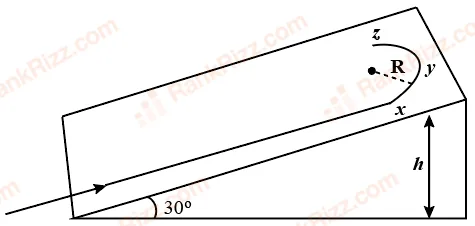
Figure for JEE Advanced 2020 Physics question on Potential energy, conservative forces and energy curves
  1. A

    v02−2gh=12gRv_0^2 - 2gh = \frac{1}{2} g R

  2. B

    v02−2gh=32gRv_0^2 - 2gh = \frac{\sqrt{3}}{2} g R

  3. C

    the centripetal force required at points x and z is zero

  4. D

    the centripetal force required is maximum at points x and z
JEE ADVANCED 2019 · PAPER 2Potential energy, conservative forces and energy curvesTRANSCRIBED

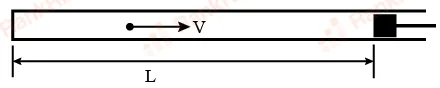
A small particle of mass m moving inside a heavy, hollow and straight tube along the tube axis undergoeselastic collision at two ends. The tube has no friction and it is closed at one end by a flat surface while the other endis fitted with a heavy movable flat piston as shown in figure. When the distance of the piston from closed end is L=L0L = L_0 the particle speed is v=v0v = v_0. The piston is moved inward at a very low speed V such that V≪dLLv0,V \ll \frac{dL}{L} v_0, where dL is the infinitesimal displacement of the piston. Which of the following statement(s) is/are correct?

Figure for JEE Advanced 2019 Physics question on Potential energy, conservative forces and energy curves
  1. A

    The rate at which the particle strikes the piston is vL\frac{v}{L}

  2. B

    After each collision with the piston, the particle speed increases by 2V2V

  3. C

    If the piston moves inward by dL, the particle speed increases by 2vdLL2v \frac{dL}{L}

  4. D

    The particle’s kinetic energy increases by a factor of 4 when the piston is moved inward from L0L_0 to 12L0\frac{1}{2}L_0

JEE ADVANCED 2019 · PAPER 1Work done by constant and variable forcesTRANSCRIBED

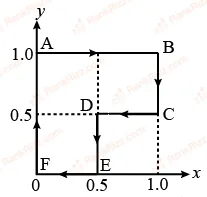
A particle is moved along a path AB-BC-CD-DE-EF-FA, as shownin figure, in presence of a force F→=(αyl^+2αxj^)N\overrightarrow{F} = (\alpha y\widehat{l} + 2\alpha x\widehat{j}) N, where x and y are in meter and α=−1Nm−1\alpha = -1 Nm^{-1}. The work done on the particle by this force F→\overrightarrow{F} will be ___ Joule.

Figure for JEE Advanced 2019 Physics question on Work done by constant and variable forces
JEE ADVANCED 2015 · PAPER 1Potential energy, conservative forces and energy curvesTRANSCRIBED

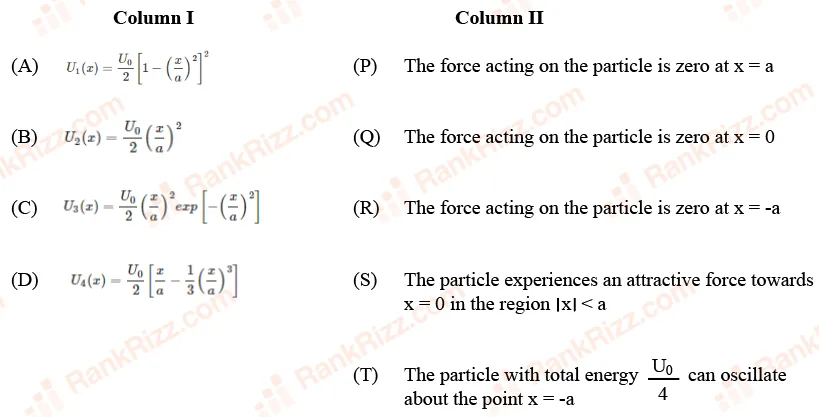
A particle of unit mass is moving along the x-axis under the influence of a force and its total energy is conserved. Four possible forms of the potential energy of the particle are given in column I (a and U0U_0 are constants). Match the potential energies in column I to the corresponding statement(s) in column II.

Figure for JEE Advanced 2015 Physics question on Potential energy, conservative forces and energy curves
JEE ADVANCED 2014 · PAPER 2Potential energy, conservative forces and energy curvesTRANSCRIBED

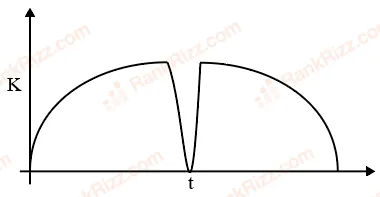
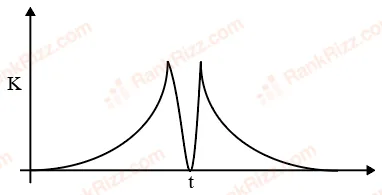
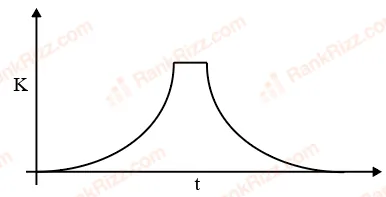
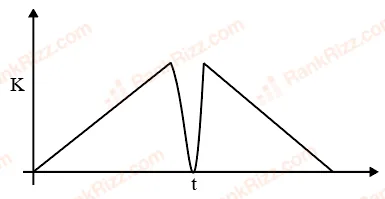
A tennis ball is dropped on a horizontal smooth surface. It bounces back to its original position after hitting the surface. The force on the ball during the collision is proportional to the length of compression of the ball. Which one of the following sketches describes the variation of its kinetic energy K with time t most appropriately? The figures are only illustrative and not to the scale.

  1. A
    Figure for JEE Advanced 2014 Physics question on Potential energy, conservative forces and energy curves
  2. B
    Figure for JEE Advanced 2014 Physics question on Potential energy, conservative forces and energy curves
  3. C
    Figure for JEE Advanced 2014 Physics question on Potential energy, conservative forces and energy curves
  4. D
    Figure for JEE Advanced 2014 Physics question on Potential energy, conservative forces and energy curves
JEE ADVANCED 2014 · PAPER 1Potential energy, conservative forces and energy curvesTRANSCRIBED

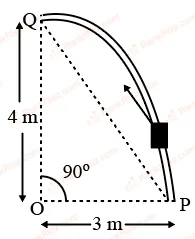
Consider an elliptically shaped rail PQ in the vertical plane with OP = 3 m and OQ = 4 m. A block of mass 1 kg is pulled along the rail from P to Q with a force of 18 N, which is always parallel to line PQ (see the figure given). Assuming no frictional losses, the kinetic energy of the block when it reaches Q is (n×10)(n \times 10) Joules. The value of n is (take acceleration due to gravity = 10 ms−2ms^{-2})

Figure for JEE Advanced 2014 Physics question on Potential energy, conservative forces and energy curves
JEE ADVANCED 2013 · PAPER 1Work done by constant and variable forcesTRANSCRIBED

The work done on a particle of mass m by a force, K[x(x2+y2)32i^+y(x2+y2)32j^]K \left[\frac {x}{\left(x^2 + y^2\right)^{\frac{3}{2}}}\widehat{i} + \frac {y}{\left(x^2 + y^2\right)^{\frac{3}{2}}}\widehat{j} \right] (K being a constant of appropriate dimensions), when the particle is taken from the point (a, 0) to the point (0, a) along a circular path of radius a about the origin in the x-y plane is

  1. A

    2Kπa\frac{2K \pi}{a}

  2. B

    Kπa\frac{K \pi}{a}

  3. C

    Kπ2a\frac{K \pi}{2a}

  4. D

    0

JEE ADVANCED 2013 · PAPER 2Potential energy, conservative forces and energy curvesTRANSCRIBED

The speed of the block whenit reachesthe point Q is

  1. A

    5 ms−1ms^{-1}

  2. B

    10 ms−1ms^{-1}

  3. C

    10 3ms−1\sqrt{3} ms^{-1}

  4. D

    20 ms−1ms^{-1}

JEE ADVANCED 2013 · PAPER 2Potential energy, conservative forces and energy curvesTRANSCRIBED

The magnitude of the normal reaction that acts on the block at the point Q is

  1. A

    7.5 N

  2. B

    8.6 N

  3. C

    11.5 N

  4. D

    22.5 N

JEE ADVANCED 2013 · PAPER 1PowerTRANSCRIBED

A particle of mass 0.2 kg is moving in one dimension under a force that delivers a constant power 0.5 W to the particle. If the initial speed (in ms−1)ms^{-1}) of the particle is zero, the speed (in ms−1)ms^{-1}) after 5 s is

JEE ADVANCED 2013 · PAPER 1Potential energy, conservative forces and energy curvesTRANSCRIBED

A bob of mass m, suspended by string of length l1l_1, is given a minimum velocity required to completea full circle in the vertical plane. At the highestpoint,it collides elastically with another bob of mass m suspendedbya string of length l2l_2, which is initially at rest. Both the strings are mass-less and inextensible. If the second bob, after collision acquires the minimum speed required to complete a full circle in the vertical plane, the ratio l1l2\frac{l_1}{l_2} is

JEE ADVANCED 2011 · PAPER 2Potential energy, conservative forces and energy curvesTRANSCRIBED

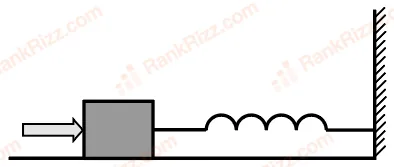
A block of mass 0.18 kg is attached to a spring of force-constant 2 N/m. The coefficient of friction between the block and the floor is 0.1. Initially the block is at rest and the spring is un-stretched. An impulse is given to the block as shown in the figure. The block slides a distance of 0.06 m and comes to rest for the first time. The initial velocity of the block in m/s is V = N/10. Then N is

Figure for JEE Advanced 2011 Physics question on Potential energy, conservative forces and energy curves
JEE ADVANCED 2010 · PAPER 2Work done by constant and variable forcesTRANSCRIBED

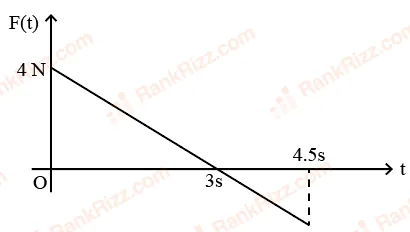
A block of mass 2 kg is free to move along the x-axis. It is at rest and from t = 0 onwards it is subjected to a time-dependent force Fit) in the x direction. The force F(t) varies with t as shown in the figure. The kinetic energy of the block after 4.5 seconds is

Figure for JEE Advanced 2010 Physics question on Work done by constant and variable forces
  1. A

    4.50 J

  2. B

    7.50 J

  3. C

    5.06 J

  4. D

    14.06 J

JEE ADVANCED 2009 · PAPER 2Work done by constant and variable forcesTRANSCRIBED

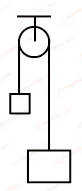
A light inextensible string that goes over a smooth fixed pulley as shown in the figure connects two blocks of masses 0.36 kg and 0.72 kg. Taking g = 10 m/s2^2, find the work
done (in joules) by the string on the block of mass 0.36 kg during the first second after the system is released from rest.

Figure for JEE Advanced 2009 Physics question on Work done by constant and variable forces
JEE ADVANCED 2008 · PAPER 2Potential energy, conservative forces and energy curvesTRANSCRIBED

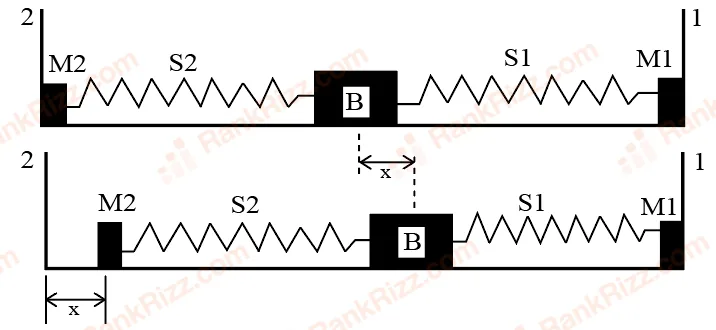
A block (B) is attached to two unstretched springs S1 and S2 with spring constants k and 4k, respectively (see figure I). The other ends are attached to identical supports M1 and M2 not attached to the walls. The springs and supports have negligible mass. There is no friction anywhere. The block B is displaced towards wall 1 by a small distance x (figure II) and released. The block returns and moves a maximum distance y towards wall 2. Displacements x and y are measured with respect to the equilibrium position of the block B. The ratio yx\frac{y}{x} is

Figure for JEE Advanced 2008 Physics question on Potential energy, conservative forces and energy curves
  1. A

    4

  2. B

    2

  3. C

    12\frac{1}{2}

  4. D

    14\frac{1}{4}

JEE ADVANCED 2008 · PAPER 2Potential energy, conservative forces and energy curvesTRANSCRIBED

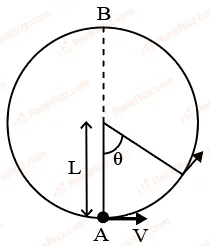
A bob of mass M is suspended by a massless string of length L. The horizontal velocity V at position A is just sufficient to make it reach the point B. The angle θ\theta at which the speed of the bob is half of that at A, satisfies 

Figure for JEE Advanced 2008 Physics question on Potential energy, conservative forces and energy curves
  1. A

    θ=π4\theta = \frac{\pi}{4}

  2. B

    π4<θ<π2\frac{\pi}{4} < \theta < \frac{\pi}{2}

  3. C

    π2<θ<3π4\frac{\pi}{2} < \theta < \frac{3 \pi}{4}

  4. D

    3π4<θ<π\frac{3 \pi}{4} < \theta < \pi

JEE ADVANCED 2007 · PAPER 1Work done by constant and variable forcesTRANSCRIBED

STATEMENT-1
A block of mass m starts moving on a rough horizontal surface with a velocity v. It stops due to friction between the block and the surface after moving through a certain distance. The surface is now tilted to an angle of 30∘30^\circ with the horizontal and the same block is made to go up on the surface with the same initial velocity v. The decrease in the mechanical energy in the second situation is smaller than thatin thefirst situation.
because
STATEMENT-2
The coefficient of friction between the block and the surface decreases with the increase in the angle of inclination.

  1. A

    Statement-1 is True, Statement-2 is True; Statement-2 is a correct explanation for Statement-1

  2. B

    Statement-1 is True, Statement-2 is True; Statement-2 is NOT a correct explanation for Statement-1

  3. C

    Statement-1 is True, Statement-2 is False

  4. D

    Statement-1 is False, Statement-2 is True