RankRizz

Mechanical Properties of Fluids — JEE Advanced Previous Year Questions

Every Mechanical Properties of Fluids question JEE Advanced has set from 2007–2026, grouped by the idea it tests rather than the order of the syllabus. 33 questions across 5 distinct ideas. Free to read, answer key on every one.

Questions

33

Distinct ideas

5

Share of marks

4.3%

Difficulty

MEDIUM

The ideas inside Mechanical Properties of Fluids

A chapter is not one subject — it is a handful of procedures the examiner reuses. These are the ones Mechanical Properties of Fluids questions actually test.

01Fluid pressure, Pascal's law and accelerated/rotating liquidsset 8×
02Archimedes' principle and floatationset 1×
03Equation of continuity and Bernoulli's theoremset 12×
04Speed of efflux and applications of Bernoulli's theoremNot set in Advanced
05Viscosity, Poiseuille's equation and Reynolds numberNot set in Advanced
06Stokes' law and terminal velocityNot set in Advanced
07Surface tension and surface energyset 10×
08Excess pressure in drops and bubblesNot set in Advanced
09Angle of contact and capillary riseset 2×

Mechanical Properties of Fluids weightage, year by year

The share of each year’s Physics questions that came from Mechanical Properties of Fluids, counted from the 19 papers we hold for the last 10 years, and paper by paper inside a year.

Falling: 3.0% of Physics questions in 2024–2026, down from 5.1% in 2017–2023. Its heaviest year was 2020, at 11.1%. Not asked at all in 2025.

20261 / 342.9%PAPER 1 0.0%PAPER 2 5.6%
20250 / 320.0%PAPER 1 0.0%PAPER 2 0.0%
20242 / 345.9%PAPER 1 5.9%PAPER 2 5.9%
20232 / 345.9%PAPER 1 0.0%PAPER 2 11.8%
20222 / 365.6%PAPER 1 5.6%PAPER 2 5.6%
20211 / 382.6%PAPER 1 5.3%PAPER 2 0.0%
20204 / 3611.1%PAPER 1 11.1%PAPER 2 11.1%
20191 / 362.8%PAPER 1 5.6%PAPER 2 0.0%
20181 / 185.6%1 PAPER
20171 / 362.8%PAPER 1 5.6%PAPER 2 0.0%

“QS” is Mechanical Properties of Fluids questions out of all Physics questions that year. A year with more sittings asks more questions, which is why the share, not the count, is the number to compare.

Mechanical Properties of Fluids: quick answers

How many Mechanical Properties of Fluids questions has JEE Advanced asked?

33 questions from 2007–2026. Over the last 20 papers, Mechanical Properties of Fluids carried about 4.3% of Physics marks.

Which Mechanical Properties of Fluids topics come up most?

Equation of continuity and Bernoulli's theorem (12 questions), Surface tension and surface energy (10 questions), Fluid pressure, Pascal's law and accelerated/rotating liquids (8 questions). Start with these, they are what the examiner keeps coming back to.

Is Mechanical Properties of Fluids important for JEE Advanced?

Falling: 3.0% of Physics questions in 2024–2026, down from 5.1% in 2017–2023. Its heaviest year was 2020, at 11.1%. Not asked at all in 2025. It has carried about 4.3% of Physics marks in recent papers, rated medium on our difficulty scale. The year-by-year table above shows how that has moved.

Do these Mechanical Properties of Fluids PYQs have answers and solutions?

Yes. Every question shows its official answer key, and a worked solution opens on the question’s own page wherever we have one. Reading and checking answers is free, no sign-up needed.

What’s the fastest way to revise Mechanical Properties of Fluids?

Do one past question per idea first: Mechanical Properties of Fluids has 5 distinct ideas, listed above. Then practise the topics you get wrong, or build a timed test from this chapter.

Every Mechanical Properties of Fluids question

1–20 OF 33 · NEWEST FIRST

JEE ADVANCED 2026 · PAPER 2Equation of continuity and Bernoulli's theoremTRANSCRIBED

Question Stem for Question Nos. 15 and 16

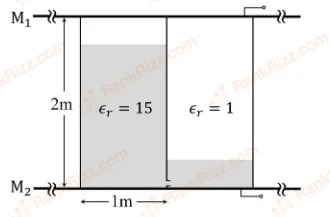
A container of height 2 m2\,\mathrm{m}, length 2 m2\,\mathrm{m} and breadth 1 m1\,\mathrm{m} is made of insulating vertical walls and two large area horizontal metal plates (M1M_1 and M2M_2) which extend far beyond the vertical walls in all directions. The container is partitioned into two equal chambers with a thin insulating vertical wall. The partition wall contains a small hole of cross-sectional area 10 cm2\sqrt{10}\,\mathrm{cm^2} near its bottom edge. Initially the hole is closed and the left chamber of the container is completely filled with a liquid of dielectric constant ϵr=15\epsilon_r=15 and the right chamber is empty (ϵr=1\epsilon_r=1). At time t=0t=0, the hole is opened and the liquid flows from the left chamber to the right chamber. In both the chambers, the space above the liquid has ϵr=1\epsilon_r=1 and is maintained at atmospheric pressure. The schematic of the container at a time t>0t>0 is shown in the figure.

[Given: acceleration due to gravity is 10 ms−210\,\mathrm{ms^{-2}}.]

Figure for JEE Advanced 2026 Physics question on Equation of continuity and Bernoulli's theorem

The height (in m) of the liquid in left chamber at t=500 st=500\,\mathrm{s} is:

JEE ADVANCED 2024 · PAPER 2Archimedes' principle and floatationTRANSCRIBED

A table tennis ball has radius (3/2)×10−2(3/2) \times 10^{-2} m and mass (22/7)×10−3(22/7) \times 10^{-3} kg. It is slowly pushed down into a swimming pool to a depth of d=0.7d = 0.7 m below the water surface and then released from rest. It emerges from the water surface at speed vv, without getting wet, and rises up to a height HH. Which of the following option(s) is (are) correct?

[Given: π=22/7\pi = 22/7, g=10g = 10 ms−2^{-2}, density of water =1×103= 1 \times 10^3 kg m−3^{-3}, viscosity of water =1×10−3= 1 \times 10^{-3} Pa·s.]

  1. A

    The work done in pushing the ball to the depth dd is 0.077 J.

  2. B

    If we neglect the viscous force in water, then the speed v=7v = 7 m/s.

  3. C

    If we neglect the viscous force in water, then the height H=1.4H = 1.4 m.

  4. D

    The ratio of the magnitudes of the net force excluding the viscous force to the maximum viscous force in water is 500/9.

JEE ADVANCED 2024 · PAPER 1Equation of continuity and Bernoulli's theoremTRANSCRIBED

Two large, identical water tanks, 1 and 2, kept on the top of a building of height HH, are filled with water up to height hh in each tank. Both the tanks contain an identical hole of small radius on their sides, close to their bottom. A pipe of the same internal radius as that of the hole is connected to tank 2, and the pipe ends at the ground level. When the water flows the tanks 1 and 2 through the holes, the times taken to empty the tanks are t1t_1 and t2t_2, respectively. If H=(169)hH = \left(\frac{16}{9}\right)h, then the ratio t1/t2t_1/t_2 is ______.

JEE ADVANCED 2023 · PAPER 2Angle of contact and capillary riseTRANSCRIBED

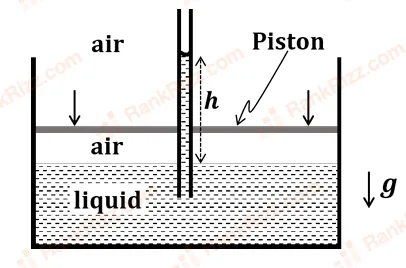
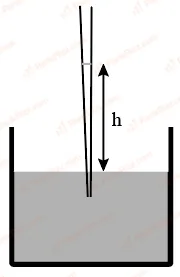
An incompressible liquid is kept in a container having a weightless piston with a hole. A capillary tube of inner radius 0.1 mm is dipped vertically into the liquid through the airtight piston hole, as shown in the figure. The air in the container is isothermally compressed from its original volume V0V_0 to 100101V0\frac{100}{101}V_0 with the movable piston. Considering air as an ideal gas, the height (hh) of the liquid column in the capillary above the liquid level in cm is ____.

[Given: Surface tension of the liquid is 0.075 Nm−1^{-1}, atmospheric pressure is 10510^5 N m−2^{-2}, acceleration due to gravity (g) is 10 m s−2^{-2}, density of the liquid is 10310^3 kg m−3^{-3} and contact angle of capillary surface with the liquid is zero]

Figure for JEE Advanced 2023 Physics question on Angle of contact and capillary rise
JEE ADVANCED 2023 · PAPER 2Equation of continuity and Bernoulli's theoremTRANSCRIBED

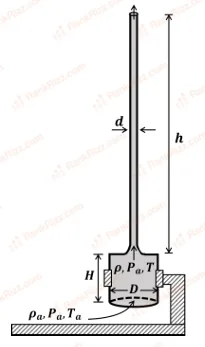
Considering the air flow to be streamline, the steady mass flow rate of air exiting the chimney is ____ gm s−1^{-1}.

Figure for JEE Advanced 2023 Physics question on Equation of continuity and Bernoulli's theorem
JEE ADVANCED 2022 · PAPER 2Angle of contact and capillary riseTRANSCRIBED

A bubble has surface tension SS. The ideal gas inside the bubble has ratio of specific heats γ=53\gamma = \dfrac{5}{3}. The bubble is exposed to the atmosphere and it always retains its spherical shape. When the atmospheric pressure is Pa1P_{a1}, the radius of the bubble is found to be r1r_1 and the temperature of the enclosed gas is T1T_1. When the atmospheric pressure is Pa2P_{a2}, the radius of the bubble and the temperature of the enclosed gas are r2r_2 and T2T_2, respectively.

Which of the following statement(s) is(are) correct?

  1. A

    If the surface of the bubble is a perfect heat insulator, then (r1r2)5=Pa2+2Sr2Pa1+2Sr1\left(\dfrac{r_1}{r_2}\right)^5 = \dfrac{P_{a2} + \dfrac{2S}{r_2}}{P_{a1} + \dfrac{2S}{r_1}}.

  2. B

    If the surface of the bubble is a perfect heat insulator, then the total internal energy of the bubble including its surface energy does not change with the external atmospheric pressure.

  3. C

    If the surface of the bubble is a perfect heat conductor and the change in atmospheric temperature is negligible, then (r1r2)3=Pa2+4Sr2Pa1+4Sr1\left(\dfrac{r_1}{r_2}\right)^3 = \dfrac{P_{a2} + \dfrac{4S}{r_2}}{P_{a1} + \dfrac{4S}{r_1}}.

  4. D

    If the surface of the bubble is a perfect heat insulator, then (T2T1)5/2=Pa2+4Sr2Pa1+4Sr1\left(\dfrac{T_2}{T_1}\right)^{5/2} = \dfrac{P_{a2} + \dfrac{4S}{r_2}}{P_{a1} + \dfrac{4S}{r_1}}.

JEE ADVANCED 2022 · PAPER 1Equation of continuity and Bernoulli's theoremTRANSCRIBED

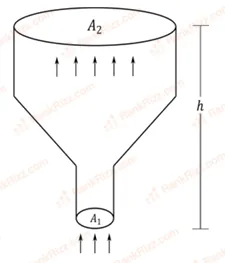
An ideal gas of density ρ=0.2\rho = 0.2 kg m−3^{-3} enters a chimney of height h at the rate of α=0.8\alpha = 0.8 kg s−1^{-1} from its lower end, and escapes through the upper end as shown in the figure. The cross-sectional area of the lower end is A1=0.1A_1 = 0.1 m2^2 and the upper end is A2=0.4A_2 = 0.4 m2^2. The pressure and the temperature of the gas at the lower end are 600 Pa and 300 K, respectively, while its temperature at the upper end is 150 K. The chimney is heat insulated so that the gas undergoes adiabatic expansion. Take g=10g = 10 ms−2^{-2} and the ratio of specific heats of the gas γ=2\gamma = 2. Ignore atmospheric pressure.

Figure for JEE Advanced 2022 Physics question on Equation of continuity and Bernoulli's theorem

Which of the following statement(s) is(are) correct?

  1. A

    The pressure of the gas at the upper end of the chimney is 300 Pa.

  2. B

    The velocity of the gas at the lower end of the chimney is 40 ms−1^{-1} and at the upper end is 20 ms−1^{-1}.

  3. C

    The height of the chimney is 590 m.

  4. D

    The density of the gas at the upper end is 0.05 kg m−3^{-3}.

JEE ADVANCED 2021 · PAPER 1Fluid pressure, Pascal's law and accelerated/rotating liquidsTRANSCRIBED

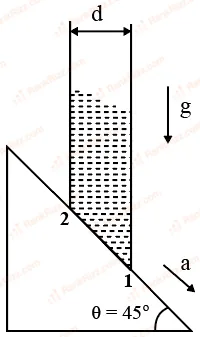
A cylindrical tube, with its base as shown in the figure, is filled with water. It is moving down with a constant acceleration 𝑎 along a fixed inclined plane with angle θ=45∘.P1\theta = 45^\circ. P_1 and P2P_2 are pressures at points 1 and 2, respectively, located at the base of the tube. Let β=(P1−P2)(ρgd)\beta = \frac{(P_1 − P_2)}{(\rho gd)}, where ρ\rho is density of water, 𝑑 is the inner diameter of the tube and 𝑔 is the acceleration due to gravity. Which of the following statement(s) is(are) correct?

Figure for JEE Advanced 2021 Physics question on Fluid pressure, Pascal's law and accelerated/rotating liquids
  1. A

    β=0\beta = 0 when a=g2a = \frac{g}{\sqrt{2}}

  2. B

    β>0\beta > 0 when a=g2a = \frac{g}{\sqrt{2}}

  3. C

    β=2−12\beta = \frac{\sqrt{2} - 1}{\sqrt{2}} when a=g2a = \frac{g}{2}

  4. D

    β=12\beta = \frac{1}{\sqrt{2}} when a=g2a = \frac{g}{2}

JEE ADVANCED 2020 · PAPER 2Equation of continuity and Bernoulli's theoremTRANSCRIBED

A train with cross-sectional area StS_t is moving with speed vtv_t inside a long tunnel of cross-sectional area S0(S0=4St)S_0(S_0 = 4S_t). Assume that almost all the air (density ρ\rho)in front of the train flows back between its sides and the walls of the tunnel. Also, the air flow with respect to the train is steady and laminar. Take the ambient pressure and that inside the train to be p0p_0. If the pressure in the region between the sides of the train and the tunnel walls is 𝑝, then p0−p=72Nρvt2p_0 - p = \frac{7}{2N}\rho v_t^2. The value of N is _____________.

JEE ADVANCED 2020 · PAPER 2Fluid pressure, Pascal's law and accelerated/rotating liquidsTRANSCRIBED

A hot air balloon is carrying some passengers, and a few sandbags of mass 1 kg each so that its total mass is 480 kg. Its effective volume giving the balloon its buoyancy is 𝑉. The balloon is floating at an equilibrium height of 100 m. When 𝑁 number of sandbags are thrown out, the balloon rises to a new equilibrium height close to 150 m with its volume 𝑉 remaining unchanged. If the variation of the density of air with height ℎ from the ground is ρ(h)=ρ0e−hh0\rho(h) = \rho_0 e^{-\frac{h}{h_0}}, where ρ0=1.25\rho_0 = 1.25 kg m−3^{-3} and h0=6000h_0 = 6000 m, the value of N is ________________.

JEE ADVANCED 2020 · PAPER 1Fluid pressure, Pascal's law and accelerated/rotating liquidsTRANSCRIBED

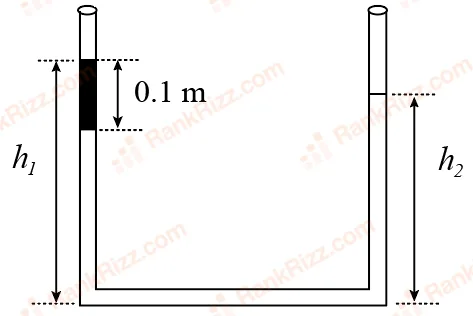
An open-ended U-tube of uniform cross-sectional area contains water (density 103kgm−310^{3}kg m^{−3}). Initially the water level stands at 0.29 m from the bottom in each arm. Kerosene oil (a water-immiscible liquid) of density 800 kgm−3m^{−3} is added to the left arm until its length is 0.1 m, as shown in the schematic figure below. The ratio (h1h2)\left(\frac{ℎ1}{ℎ2}\right) of the heights of the liquid in the two arms is 

Figure for JEE Advanced 2020 Physics question on Fluid pressure, Pascal's law and accelerated/rotating liquids
  1. A

    1535\frac{15}{35}

  2. B

    3533\frac{35}{33}

  3. C

    76\frac{7}{6}

  4. D

    54\frac{5}{4}

JEE ADVANCED 2020 · PAPER 1Surface tension and surface energyTRANSCRIBED

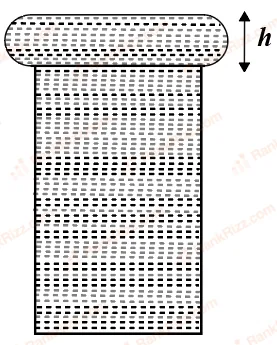
When water is filled carefully in a glass, one can fill it to a height h above the rim of the glass due to the surface tension of water. To calculate h just before water starts flowing, model the shape of the water above the rim as a disc of thickness h having semicircular edges, as shown schematically in the figure. When the pressure of water at the bottom of this disc exceeds what can be withstood due to the surface tension, the water surface breaks near the rim and water starts flowing from there. If the density of water, its surface tension and the acceleration due to gravity are 103kgm−3,0.07Nm−110^{3}kg m^{−3}, 0.07 Nm^{−1} and 10ms−210 ms^{−2}, respectively, the value of h (in mm) is _________.

Figure for JEE Advanced 2020 Physics question on Surface tension and surface energy
JEE ADVANCED 2019 · PAPER 1Surface tension and surface energyTRANSCRIBED

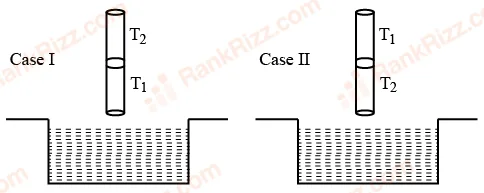
A cylindrical capillary tube of 0.2 mm radius is made by joining two capillaries T1 and T2 of different materials having water contact angles of 0∘0^\circ and 60∘60^\circ, respectively. The capillary tube is dipped vertically in water in two different configurations, case I and II as shown in figure. Which of the following option(s) is(are) correct?
[Surface tension of water = 0.075 N/m, density of water = 1000kg/m31000 kg/m^3, take g=10m/s2g = 10 m/s^2]

Figure for JEE Advanced 2019 Physics question on Surface tension and surface energy
  1. A

    The correction in the height of water column raised in the tube, due to weight of water contained in the meniscus, will be different for both cases.

  2. B

    For case II, if the capillary joint is 5 cm above the water surface, the height of water column raised in the tube will be 3.75 cm. (Neglect the weight of the water in the meniscus)

  3. C

    For case I, if the joint is kept at 8 cm above the water surface, the height of water column in the tube will be 7.5 cm. (Neglect the weight of the water in the meniscus)

  4. D

    For case I, if the capillary joint is 5 cm above the water surface, the height of water column raised in the tube will be more than 8.75 cm. (Neglect the weight of the water in the meniscus)

JEE ADVANCED 2018 · PAPER 1Surface tension and surface energyTRANSCRIBED

A uniform capillary tube of inner radius 𝑟 is dipped vertically into a beaker filled with water. The water rises to a height ℎ in the capillary tube above the water surface in the beaker. The surface tension of water is σ\sigma The angle of contact between water and the wall of the capillary tube is θ\theta. Ignore the mass of water in the meniscus. Which of the following statements is (are) true?

  1. A

    For a given material of the capillary tube, ℎ decreases with increase in r

  2. B

    For a given material of the capillary tube, ℎ is independent of σ\sigma

  3. C

    If this experiment is performed in a lift going up with a constant acceleration, then ℎ decreases

  4. D

    ℎ is proportional to contact angle θ\theta

JEE ADVANCED 2017 · PAPER 1Surface tension and surface energyTRANSCRIBED

A drop of liquid of radius R=10−2mR = 10^{-2} m having surface tension S=0.14πNm−1S = \frac{0.1}{4 \pi} Nm^{-1} divides itself into 𝐾 identical drops. In this process the total change in the surface energy △U=10−3J\triangle U = 10^{-3} J. If K=10αK = 10^\alpha then the value of α\alpha is

JEE ADVANCED 2016 · PAPER 1Equation of continuity and Bernoulli's theoremTRANSCRIBED

Consider two solid spheres P and Q each of density 8 gm cm−3^{-3} and diameters 1 cm and 0.5 cm, respectively. Sphere P is dropped into a liquid of density 0.8 gm cm−3^{-3} and viscosity η=3\eta = 3 poiseulles. Sphere Q is dropped into a liquid of density 1.6 gm cm−3^{-3} and viscosity η=2\eta = 2 poiseulles. The ratio of the terminal velocities of P and Q is

JEE ADVANCED 2015 · PAPER 2Equation of continuity and Bernoulli's theoremTRANSCRIBED

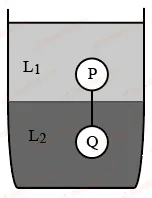
Two spheres P and Q of equal radii have densities ρ1\rho_1 and ρ2\rho_2 respectively. The spheres are connected by a massless string and placed in liquids L1L_1 and L2L_2 of densities σ1\sigma_1 and σ2\sigma_2 and viscosities η1\eta_1 and η2\eta_2 respectively. They float in equilibrium with the sphere P in L1L_1 and sphere Q in L2L_2 and the string being taut (see figure). If sphere P alone in L2L_2 has terminal velocity V→P\overrightarrow{V}_P and Q alone in L1L_1 has terminal velocity V→Q\overrightarrow{V}_Q, then

Figure for JEE Advanced 2015 Physics question on Equation of continuity and Bernoulli's theorem
  1. A

    ∣V→P∣∣V→Q∣=η1η2\frac{|\overrightarrow{V}_P|}{|\overrightarrow{V}_Q|} = \frac{\eta_1}{\eta_2}

  2. B

    ∣V→P∣∣V→Q∣=η2η1\frac{|\overrightarrow{V}_P|}{|\overrightarrow{V}_Q|} = \frac{\eta_2}{\eta_1}

  3. C

    V→P.V→Q>0\overrightarrow{V}_P . \overrightarrow{V}_Q > 0

  4. D

    V→P.V→Q<0\overrightarrow{V}_P . \overrightarrow{V}_Q < 0

JEE ADVANCED 2015 · PAPER 2Fluid pressure, Pascal's law and accelerated/rotating liquidsTRANSCRIBED

A spherical body of radius R consists of a fluid of constant density and is in equilibrium under its own gravity. If P(r) is the pressure at r(r < R), then the correct option(s) is(are)

  1. A

    P(r=0)=0P (r = 0) = 0

  2. B

    P(r=3R4)P(r=2R3)=6380\frac{P \left(r = \frac{3R}{4}\right)}{P \left(r = \frac{2R}{3}\right)} = \frac{63}{80}

  3. C

    P(r=3R5)P(r=2R5)=1621\frac{P \left(r = \frac{3R}{5}\right)}{P \left(r = \frac{2R}{5}\right)} = \frac{16}{21}

  4. D

    P(r=R2)P(r=R3)=2027\frac{P \left(r = \frac{R}{2}\right)}{P \left(r = \frac{R}{3}\right)} = \frac{20}{27}

JEE ADVANCED 2014 · PAPER 2Surface tension and surface energyTRANSCRIBED

A glass capillary tube is of the shape of a truncated cone with an apex angle α\alpha so that its two ends have cross sections of different radii. When dipped in water vertically, water rises in it to a height h, where the radius of its cross section is b. If the surface tension of water is S, its density is ρ\rho, and its contact angle with glass is θ\theta, the value of h will be (g is the acceleration due to gravity)

Figure for JEE Advanced 2014 Physics question on Surface tension and surface energy
  1. A

    2Sbpgcos⁡(θ−α)\frac{2S}{bpg} \cos (\theta - \alpha)

  2. B

    2Sbpgcos⁡(θ+α)\frac{2S}{bpg} \cos (\theta + \alpha)

  3. C

    2Sbpgcos⁡(θ−α2)\frac{2S}{bpg} \cos \left(\theta - {\frac{\alpha}{2}}\right)

  4. D

    2Sbpgcos⁡(θ+α2)\frac{2S}{bpg} \cos \left(\theta + {\frac{\alpha}{2}}\right)

JEE ADVANCED 2014 · PAPER 2Equation of continuity and Bernoulli's theoremTRANSCRIBED

If the piston is pushed at a speed of 5mms−15 mms^{-1}, the air comes out of the nozzle with a speed of

  1. A

    0.1ms−10.1 ms^{-1}

  2. B

    1ms−11 ms^{-1}

  3. C

    2ms−12 ms^{-1}

  4. D

    8ms−18 ms^{-1}