RankRizz

Dual Nature of Radiation & Matter — JEE Advanced Previous Year Questions

Every Dual Nature of Radiation & Matter question JEE Advanced has set from 2007–2025, grouped by the idea it tests rather than the order of the syllabus. 25 questions across 3 distinct ideas. Free to read, answer key on every one.

Questions

25

Distinct ideas

3

Share of marks

2.6%

Difficulty

EASY

The ideas inside Dual Nature of Radiation & Matter

A chapter is not one subject — it is a handful of procedures the examiner reuses. These are the ones Dual Nature of Radiation & Matter questions actually test.

01Photons: energy, momentum and radiation pressureset 4×
02Photoelectric effect and Einstein's equationset 13×
03de Broglie wavelength of matter wavesset 8×
04Davisson-Germer experimentNot set in Advanced

Dual Nature of Radiation & Matter weightage, year by year

The share of each year’s Physics questions that came from Dual Nature of Radiation & Matter, counted from the 19 papers we hold for the last 10 years, and paper by paper inside a year.

Rising: 3.0% of Physics questions in 2024–2026, up from 2.1% in 2017–2023. Its heaviest year was 2025, at 6.3%. Not asked at all in 2018, 2020, 2026.

20260 / 340.0%PAPER 1 0.0%PAPER 2 0.0%
20252 / 326.3%PAPER 1 6.3%PAPER 2 6.3%
20241 / 342.9%PAPER 1 0.0%PAPER 2 5.9%
20231 / 342.9%PAPER 1 5.9%PAPER 2 0.0%
20221 / 362.8%PAPER 1 0.0%PAPER 2 5.6%
20211 / 382.6%PAPER 1 0.0%PAPER 2 5.3%
20200 / 360.0%PAPER 1 0.0%PAPER 2 0.0%
20191 / 362.8%PAPER 1 0.0%PAPER 2 5.6%
20180 / 180.0%1 PAPER
20171 / 362.8%PAPER 1 0.0%PAPER 2 5.6%

“QS” is Dual Nature of Radiation & Matter questions out of all Physics questions that year. A year with more sittings asks more questions, which is why the share, not the count, is the number to compare.

Dual Nature of Radiation & Matter: quick answers

How many Dual Nature of Radiation & Matter questions has JEE Advanced asked?

25 questions from 2007–2025. Over the last 20 papers, Dual Nature of Radiation & Matter carried about 2.6% of Physics marks.

Which Dual Nature of Radiation & Matter topics come up most?

Photoelectric effect and Einstein's equation (13 questions), de Broglie wavelength of matter waves (8 questions), Photons: energy, momentum and radiation pressure (4 questions). Start with these, they are what the examiner keeps coming back to.

Is Dual Nature of Radiation & Matter important for JEE Advanced?

Rising: 3.0% of Physics questions in 2024–2026, up from 2.1% in 2017–2023. Its heaviest year was 2025, at 6.3%. Not asked at all in 2018, 2020, 2026. It has carried about 2.6% of Physics marks in recent papers, rated easy on our difficulty scale. The year-by-year table above shows how that has moved.

Do these Dual Nature of Radiation & Matter PYQs have answers and solutions?

Yes. Every question shows its official answer key, and a worked solution opens on the question’s own page wherever we have one. Reading and checking answers is free, no sign-up needed.

What’s the fastest way to revise Dual Nature of Radiation & Matter?

Do one past question per idea first: Dual Nature of Radiation & Matter has 3 distinct ideas, listed above. Then practise the topics you get wrong, or build a timed test from this chapter.

Every Dual Nature of Radiation & Matter question

1–20 OF 25 · NEWEST FIRST

JEE ADVANCED 2025 · PAPER 2Photons: energy, momentum and radiation pressureTRANSCRIBED

A hydrogen atom, initially at rest in its ground state, absorbs a photon of frequency ν1\nu_1 and ejects the electron with a kinetic energy of 10 eV. The electron then combines with a positron at rest to form a positronium atom in its ground state and simultaneously emits a photon of frequency ν2\nu_2. The center of mass of the resulting positronium atom moves with a kinetic energy of 5 eV. It is given that positron has the same mass as that of electron and the positronium atom can be considered as a Bohr atom, in which the electron and the positron orbit around their center of mass. Considering no other energy loss during the whole process, the difference between the two photon energies (in eV) is ______.
JEE ADVANCED 2025 · PAPER 1de Broglie wavelength of matter wavesTRANSCRIBED

Consider an electron in the n=3n = 3 orbit of a hydrogen-like atom with atomic number ZZ. At absolute temperature TT, a neutron having thermal energy kBTk_B T has the same de Broglie wavelength as that of this electron. If this temperature is given by T=Z2h2απ2a02mNkBT = \frac{Z^2 h^2}{\alpha \pi^2 a_0^2 m_N k_B}, (where hh is the Planck's constant, kBk_B is the Boltzmann constant, mNm_N is the mass of the neutron and a0a_0 is the first Bohr radius of hydrogen atom) then the value of α\alpha is ________.

JEE ADVANCED 2024 · PAPER 2Photons: energy, momentum and radiation pressureTRANSCRIBED

A metal target with atomic number Z=46Z = 46 is bombarded with a high energy electron beam. The emission of X-rays from the target is analyzed. The ratio rr of the wavelengths of the KαK_\alpha-line and the cut-off is found to be r=2r = 2. If the same electron beam bombards another metal target with Z=41Z = 41, the value of rr will be

  1. A

    2.53

  2. B

    1.27

  3. C

    2.24

  4. D

    1.58

JEE ADVANCED 2023 · PAPER 1Photoelectric effect and Einstein's equationTRANSCRIBED

A Hydrogen-like atom has atomic number ZZ. Photons emitted in the electronic transitions from level n=4n = 4 to level n=3n = 3 in these atoms are used to perform photoelectric effect experiment on a target metal. The maximum kinetic energy of the photoelectrons generated is 1.95 eV. If the photoelectric threshold wavelength for the target metal is 310 nm, the value of ZZ is ______.

[Given: hc=1240hc = 1240 eV-nm and Rhc=13.6Rhc = 13.6 eV, where RR is the Rydberg constant, hh is the Planck's constant and cc is the speed of light in vacuum]

JEE ADVANCED 2022 · PAPER 2Photoelectric effect and Einstein's equationTRANSCRIBED

When light of a given wavelength is incident on a metallic surface, the minimum potential needed to stop the emitted photoelectrons is 6.0 V. This potential drops to 0.6 V if another source with wavelength four times that of the first one and intensity half of the first one is used. What are the wavelength of the first source and the work function of the metal, respectively?

[Take hce=1.24×10⁻⁶\dfrac{hc}{e} = 1.24 \times 10^{-6} J m C−1^{-1}.]

  1. A

    1.72 ×\times 10−7^{-7} m, 1.20 eV

  2. B

    1.72 ×\times 10−7^{-7} m, 5.60 eV

  3. C

    3.78 ×\times 10−7^{-7} m, 5.60 eV

  4. D

    3.78 ×\times 10−7^{-7} m, 1.20 eV

JEE ADVANCED 2021 · PAPER 2Photoelectric effect and Einstein's equationTRANSCRIBED

In a photoemission experiment, the maximum kinetic energies of photoelectrons from metals 𝑃, 𝑄 and 𝑅 are EP,EQE_P, E_Q and ERE_R, respectively, and they are related by EP=2EQ=2ERE_P = 2 E_Q = 2 E_R. In this experiment, the same source of monochromatic light is used for metals 𝑃 and 𝑄 while a different source of monochromatic light is used for the metal 𝑅. The work functions for metals 𝑃, 𝑄 and 𝑅 are 4.0 eV, 4.5 eV and 5.5 eV, respectively. The energy of the incident photon used for metal 𝑅, in eV, is ___.

JEE ADVANCED 2019 · PAPER 2Photons: energy, momentum and radiation pressureTRANSCRIBED

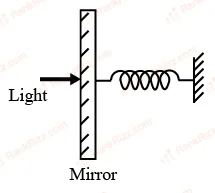
A perfectly reflecting mirror of mass M mounted on a spring constitutes a spring-mass system of angular frequency ΩΩ such that 4πMΩh=1024m−2\frac{4 \pi M Ω}{h} = 10^{24} m^{-2} with h as Planck’s constant. N photons of wavelength λ=8π×10−6m\lambda = 8 \pi \times 10^{-6} m strike the mirror simultaneously at normal incidence such that the mirror gets displaced by 1μm.1 \mu m. If the value of N is x×1012,x \times 10^{12}, then the value of x is ________ .
[Consider the spring as mass less]

Figure for JEE Advanced 2019 Physics question on Photons: energy, momentum and radiation pressure
JEE ADVANCED 2017 · PAPER 2Photoelectric effect and Einstein's equationTRANSCRIBED

A photoelectric material having work-function ϕ0\phi_{0} is illuminated with light of wavelength λ(λ<hcϕ0)\lambda (\lambda < \frac{hc}{\phi_{0}}). The fastest photoelectron has a de Broglie wavelength λd\lambda_{d}. A change in wavelength of the incident light by △λ\triangle \lambda results in a change △λd\triangle \lambda_{d} in λd\lambda_{d}. Then the ratio △λd△λ\frac{\triangle\lambda_{d}}{\triangle\lambda} is proportional to

  1. A

    λdλ\frac{\lambda_{d}}{\lambda}

  2. B

    λd2λ2\frac{\lambda^{2}_{d}}{\lambda^{2}}

  3. C

    λd3λ\frac{\lambda^{3}_{d}}{\lambda}

  4. D

    λd3λ2\frac{\lambda^{3}_{d}}{\lambda^{2}}

JEE ADVANCED 2016 · PAPER 1Photoelectric effect and Einstein's equationTRANSCRIBED

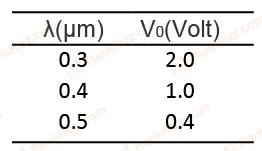
In a historical experiment to determine Planck’s constant, a metal surface was irradiated with light of different wavelengths. The emitted photo electron energies were measured by applying a stopping potential. The relevant data for the wavelength (λ\lambda) of incident light and the corresponding stopping potential (V0V_0) are given below :

Figure for JEE Advanced 2016 Physics question on Photoelectric effect and Einstein's equation

Given that c=3×10⁸ms−1c = 3 \times 10^8 ms^{-1} and e=1.6×10⁻¹⁹Ce = 1.6 \times 10^{-19} C, Planck’s constant (in units of J s) found from such an experiment is

  1. A

    6.0×10−346.0 \times 10^{-34}

  2. B

    6.4×10−346.4 \times 10^{-34}

  3. C

    6.6×10−346.6 \times 10^{-34}

  4. D

    6.8×10−346.8 \times 10^{-34}

JEE ADVANCED 2016 · PAPER 2Photoelectric effect and Einstein's equationTRANSCRIBED

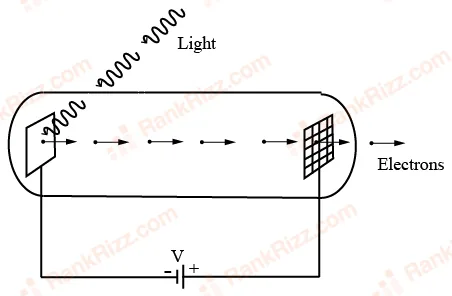
Light of wave length λph\lambda_{ph} falls on a cathode plate inside a vacuumtube as shown in the figure. The work function of the cathode surface is ϕ\phi and the anode is a wire mesh of conducting material kept at a distance d from the cathode. A potential difference V is maintained between the electrodes. If the minimum de Broglie wavelength of the electrons passing through the anode is λe\lambda_{e}, which of the following statement(s) is(are) true?

Figure for JEE Advanced 2016 Physics question on Photoelectric effect and Einstein's equation
  1. A

    λe\lambda_e decreases with increase in ϕ\phi and λph\lambda_{ph}

  2. B

    λe\lambda_e is approximately halved, if d is doubled

  3. C

    For large potential difference (V>>ϕ/e),λe(V >> \phi/e), \lambda_e is approximately halved if V is made four times

  4. D

    λe\lambda_e increases at the same rate as λph\lambda_{ph} for λph<hc/ϕ\lambda_{ph} < hc/\phi

JEE ADVANCED 2015 · PAPER 2de Broglie wavelength of matter wavesTRANSCRIBED

An electron in an excited state of Li2+Li^{2+}ion has angular momentum 3h2π.\frac{3h}{2\pi}. The de Broglie wavelength of the electron in this state is pπa0p \pi a_0 (where a0a_0 is the Bohr radius). The value of p is

JEE ADVANCED 2015 · PAPER 1Photoelectric effect and Einstein's equationTRANSCRIBED

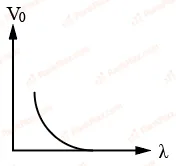
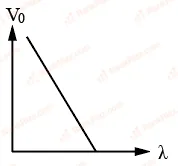
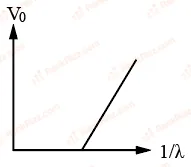
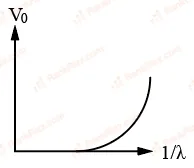
For photo-electric effect with incident photon wavelength λ\lambda, the stopping potential is V0V_0. Identify the correct variation(s) of V0V_0 with λ\lambda and 1λ\frac{1}{\lambda}.

  1. A
    Figure for JEE Advanced 2015 Physics question on Photoelectric effect and Einstein's equation
  2. B
    Figure for JEE Advanced 2015 Physics question on Photoelectric effect and Einstein's equation
  3. C
    Figure for JEE Advanced 2015 Physics question on Photoelectric effect and Einstein's equation
  4. D
    Figure for JEE Advanced 2015 Physics question on Photoelectric effect and Einstein's equation
JEE ADVANCED 2014 · PAPER 2Photoelectric effect and Einstein's equationTRANSCRIBED

A metal surface is illuminated by light of two different wavelengths 248 nm and 310 nm. The maximum speeds of the photoelectrons corresponding to these wavelengths are u1u_1 and u2u_2,respectively. If the ratio u1:u2=2:1u_1 : u_2 = 2 : 1 and hc = 1240 eV nm, the work function of the metal is nearly

  1. A

    3.7 eV

  2. B

    3.2 eV

  3. C

    2.8 eV

  4. D

    2.5 eV

JEE ADVANCED 2013 · PAPER 1Photoelectric effect and Einstein's equationTRANSCRIBED

The work functions of Silver and Sodium are 4.6 and 2.3 eV, respectively. The ratio of the slope of the stopping potential versus frequencyplot for Silver to that of Sodium is

JEE ADVANCED 2012 · PAPER 1de Broglie wavelength of matter wavesTRANSCRIBED

A proton is fired from very far away towards a nucleus with charge Q = 120 e, where e is the electronic charge. It makes a closest approach of 10 fm to the nucleus. The de Broglie wavelength (in units of fm) of the protonatits start is: (take the proton mass, mp=(53)×10−27m_p = \left(\frac{5}{3}\right) \times 10^{-27} kg; h/e=4.2×10−15h/e = 4.2 \times 10^{-15} J.s/C; 14πε0=9×10⁹\frac{1}{4 \pi ε_0} = 9 \times 10^9 m/f; 1 fm = 10−1510^{-15} m)

JEE ADVANCED 2011 · PAPER 2Photoelectric effect and Einstein's equationTRANSCRIBED

A silver sphere of radius 1 cm and work function 4.7 eV is suspended from an insulating thread in free-space. It is under continuous illumination of 200 nm wavelength light. As photoelectrons are emitted, the sphere gets charged and acquires a potential. The maximum number of photoelectrons emitted from the sphere is A×10ZA \times 10^Z (where 1 < A < 10). The value of ‘Z’ is

JEE ADVANCED 2010 · PAPER 1de Broglie wavelength of matter wavesTRANSCRIBED

An α\alpha-particle and a proton are accelerated from rest by a potential difference of 100V. After this, their de Broglie wavelengths are λα\lambda_{\alpha} and λp\lambda_{p} respectively. The ratio \frac{\lambda_p}{\lambda_{\alpha}, to the nearest integer, is

JEE ADVANCED 2009 · PAPER 2Photoelectric effect and Einstein's equationTRANSCRIBED

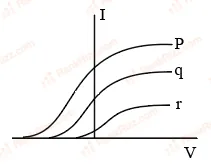
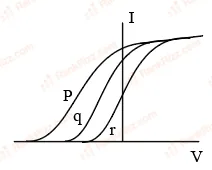
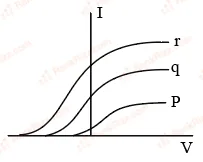
Photoelectric effect experiments are performed using three different metal plates p, q and r having work functions ϕp=2.0\phi_p = 2.0 eV, ϕq=2.5\phi_q = 2.5 eV and ϕr=3.0\phi_r = 3.0 eV, respectively. A light beam containing wavelengths of 550 nm, 450 nm and 350 nm with equal intensities illuminates each of the plates. The correct I-V graph for the experiment is [Take hc = 1240 eV nm]

  1. A
    Figure for JEE Advanced 2009 Physics question on Photoelectric effect and Einstein's equation
  2. B
    Figure for JEE Advanced 2009 Physics question on Photoelectric effect and Einstein's equation
  3. C
    Figure for JEE Advanced 2009 Physics question on Photoelectric effect and Einstein's equation
  4. D
    Figure for JEE Advanced 2009 Physics question on Photoelectric effect and Einstein's equation
JEE ADVANCED 2009 · PAPER 1de Broglie wavelength of matter wavesTRANSCRIBED

The allowed energy for the particle for a particular value of n is proportional to -

  1. A

    a−2a^{-2}

  2. B

    a−32a^{\frac{-3}{2}}

  3. C

    a−1a^{-1}

  4. D

    a2a^{2}

JEE ADVANCED 2009 · PAPER 1de Broglie wavelength of matter wavesTRANSCRIBED

If the mass of the particle is m=1.0×10⁻³⁰m = 1.0 \times 10^{-30} kg and a = 6.6 nm, the energy of the particle in its ground state is closest to -

  1. A

    0.8 meV

  2. B

    8 meV

  3. C

    80 meV

  4. D

    800 meV