RankRizz

Rotational Motion — JEE Advanced Previous Year Questions

Every Rotational Motion question JEE Advanced has set from 2007–2026, grouped by the idea it tests rather than the order of the syllabus. 64 questions across 5 distinct ideas. Free to read, answer key on every one.

Questions

64

Distinct ideas

5

Share of marks

9.1%

Difficulty

HARD

The ideas inside Rotational Motion

A chapter is not one subject — it is a handful of procedures the examiner reuses. These are the ones Rotational Motion questions actually test.

01Moment of inertia of standard bodies and composite systemsset 6×
02Parallel and perpendicular axis theoremsNot set in Advanced
03Torque and the rotational form of Newton's second lawset 1×
04Fixed-axis rotation: kinematics, rotational energy and pulleysNot set in Advanced
05Equilibrium of rigid bodies and topplingset 9×
06Angular momentum of particles and rigid bodiesset 16×
07Conservation of angular momentumNot set in Advanced
08Rolling without slipping: kinematics and energyNot set in Advanced
09Rolling with friction, slipping and impulsive forcesset 32×
10Collisions involving rigid bodiesNot set in Advanced

Every Rotational Motion question

21–40 OF 64 · NEWEST FIRST

JEE ADVANCED 2020 · PAPER 2Rolling with friction, slipping and impulsive forcesTRANSCRIBED

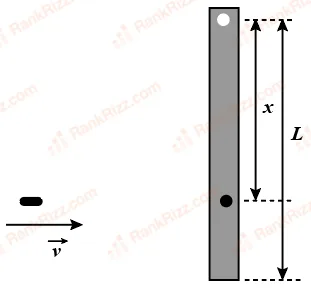
A rod of mass 𝑚 and length 𝐿, pivoted at one of its ends, is hanging vertically. A bullet of the same mass moving at speed 𝑣 strikes the rod horizontally at a distance 𝑥 from its pivoted end and gets embedded in it. The combined system now rotates with angular speed ω\omega about the pivot. The maximum angular speed ωM\omega_M is achieved for x=xMx = x_M. Then

Figure for JEE Advanced 2020 Physics question on Rolling with friction, slipping and impulsive forces
  1. A

    ω=3vxL2+3x2\omega = \frac{3vx}{L^2 + 3x^2}

  2. B

    ω=12vxL2+12x2\omega = \frac{12 vx}{L^2 + 12x^2}

  3. C

    xM=L3x_M = \frac{L}{\sqrt{3}}

  4. D

    ωM=v2L3\omega_M = \frac{v}{2L}\sqrt{3}

JEE ADVANCED 2019 · PAPER 2Rolling with friction, slipping and impulsive forcesTRANSCRIBED

A thin and uniform rod of mass M and length L is held vertical on a floor with large friction. The rod is released from rest so that it falls by rotating about its contact-point with the floor without slipping. Which of the following statement(s) is/are correct, when the rod makes an angle 60∘60^\circ with vertical?
[g is the acceleration due to gravity]

  1. A

    The angular speed of the rod will be 3g2L\sqrt {\frac{3g}{2L}}

  2. B

    The angular acceleration of the rod will be 2gL\frac{2g}{L}

  3. C

    The radial acceleration ofthe rod’s center of mass will be 3g4\frac{3g}{4}

  4. D

    The normal reaction force from the floor on the rod will be Mg16\frac{Mg}{16}

JEE ADVANCED 2018 · PAPER 1Angular momentum of particles and rigid bodiesTRANSCRIBED

The potential energy of a particle of mass 𝑚 at a distance 𝑟 from a fixed point 𝑂 is given by v(r)=kr22v(r)=\frac{kr^{2}}{2}where 𝑘 is a positive constant of appropriate dimensions. This particle is moving in a circular orbit of radius 𝑅 about the point 𝑂. If 𝑣 is the speed of the particle and 𝐿 is the magnitude of its angular momentum about 𝑂, which of the following statements is (are) true?where 𝑘 is a positive constant of appropriate dimensions. This particle is moving in a circular orbit of radius 𝑅 about the point 𝑂. If 𝑣 is the speed of the particle and 𝐿 is the magnitude of its angular momentum about 𝑂, which of the following statements is (are) true?

  1. A

    ν=k2m\nu=\sqrt{\frac{k}{2m}}R

  2. B

    ν=km\nu=\sqrt{\frac{k}{m}}R

  3. C

    L=mkR2L=\sqrt{mk} R^{2}

  4. D

    L=mk2R2L=\sqrt{\frac{mk}{2}} R^{2}

JEE ADVANCED 2018 · PAPER 1Equilibrium of rigid bodies and topplingTRANSCRIBED

Consider a body of mass 1.0 𝑘𝑔 at rest at the origin at time 𝑡 = 0. A force F→=(αti^+βj^)\overrightarrow{F}=(\alpha t \hat{i}+\beta \hat{j}) is applied on the body, where α=1.0NS−1\alpha=1.0 N S^{-1} and β=1.0\beta=1.0N The torque acting on the body about the origin at time 𝑡 = 1.0 𝑠 is 𝜏⃗. Which of the following statements is (are) true?

  1. A

    ∣τ→∣=13\mid\overrightarrow{\tau} \mid= \frac{1}{3} Nm

  2. B

    The torque τ→\overrightarrow{\tau} is in the direction of the unit vector +K^+ \hat{K}

  3. C

    The velocity of the body at t=1st = 1 s is V→=12(i^+2j^)ms−1\overrightarrow{V} = \frac{1}{2}(\hat{i} + 2\hat{j})ms^{-1}

  4. D

    The magnitude of displacement of the body at t=1st = 1 s is 16\frac{1}{6} m

JEE ADVANCED 2018 · PAPER 1Rolling with friction, slipping and impulsive forcesTRANSCRIBED

Two vectors A^andB^\hat{A} and \hat{B} are defined as A^\hat{A}=a i^\hat{i} and B→=a(cos⁡ωti^+sin⁡ωtj^)\overrightarrow{B}=a(\cos \omega t \hat{i}+\sin \omega t \hat{j}), where a is a constant and ω=π6rads−1\omega=\frac{\pi}{6} rad s^{-1}.If ∣A→+B→∣\mid \overrightarrow{A}+\overrightarrow{B}\mid=3A→−B→\sqrt{3} \overrightarrow{A}-\overrightarrow{B} at time t = τ\tau for the first time,
the value of τ\tau, in Seconds, is .................

JEE ADVANCED 2018 · PAPER 1Rolling with friction, slipping and impulsive forcesTRANSCRIBED

A ring and a disc are initially at rest, side by side, at the top of an inclined plane which makes an angle 60∘60^\circ with the horizontal. They start to roll without slipping at the same instant of time along the shortest path. If the time difference between their reaching the ground is 2−310\frac{2-\sqrt{3}}{\sqrt{10}} S then the height of the top of the inclined plane, in meters, is __________. Take g=10ms−2g = 10 ms^{-2}

JEE ADVANCED 2017 · PAPER 2Rolling with friction, slipping and impulsive forcesTRANSCRIBED

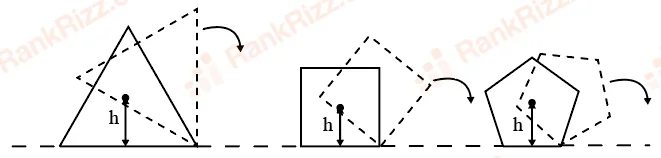
Consider regular polygons with number of sides n=3,4,5.....as shown in the figure. The center of mass of all the polygons is at height h from the ground. They roll on a horizontal surface about the leading vertex without slipping and sliding as depicted. The maximum increase in height of the locus of the center of mass for each polygon is △\triangle. Then △\triangle depends on n and has

Figure for JEE Advanced 2017 Physics question on Rolling with friction, slipping and impulsive forces
  1. A

    △=hsin⁡2(πn)\triangle=h \sin^{2}(\frac{\pi}{n})

  2. B

    △=h(1cos⁡(πn)−1)\triangle=h (\frac{1}{\cos(\frac{\pi}{n})}-1)

  3. C

    △=hsin⁡(2πn)\triangle=h \sin(\frac{2\pi}{n})

  4. D

    △=htan⁡2(π2n)\triangle=h \tan^{2}(\frac{\pi}{2n})

JEE ADVANCED 2017 · PAPER 2Rolling with friction, slipping and impulsive forcesTRANSCRIBED

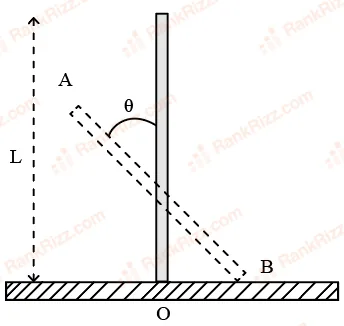
A rigid uniform bar AB of length L is slipping from its vertical position on a frictionless floor (as shown in the figure). At some instant of time, the angle made by the bar with the vertical is θ\theta Which of the following statements about its motion is/are correct?

Figure for JEE Advanced 2017 Physics question on Rolling with friction, slipping and impulsive forces
  1. A

    The midpoint of the bar will fall vertically downward

  2. B

    The trajectory of the point A is a parabola

  3. C

    Instantaneous torque about the point in contact with the floor is proportional to sin θsin\ \theta

  4. D

    When the bar makes an angle θ\theta with the vertical, the displacement of its midpoint from the initial position is proportional to (1−Cos θ)(1-Cos\ \theta)

JEE ADVANCED 2017 · PAPER 2Equilibrium of rigid bodies and topplingTRANSCRIBED

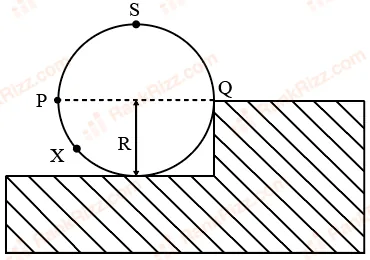
A wheel of radius R and mass M is placed at the bottom of a fixed step of height R as shown in the figure. A constant force is continuously applied on the surface of the wheel so that it just climbs the step without slipping. Consider the torque τ\tau about an axis normal to the plane of the paper passing through the point Q. Which of the following options is/are correct?

Figure for JEE Advanced 2017 Physics question on Equilibrium of rigid bodies and toppling
  1. A

    If the force is applied at point P tangentially then τ\tau decreases continuously as the wheel climbs

  2. B

    If the force is applied normal to the circumference at point X then τ\tau is constant

  3. C

    If the force is applied normal to the circumference at point P then τ\tau is zero

  4. D

    If the force is applied tangentially at point S then τ≠0\tau\neq0 but the wheel never climbs the step

JEE ADVANCED 2017 · PAPER 2Moment of inertia of standard bodies and composite systemsTRANSCRIBED

The total kinetic energy of the ring is

  1. A

    Mω02R2M\omega_{0}^{2}R^{2}

  2. B

    12Mω02(R−r)2\frac{1}{2}M\omega_{0}^{2}(R-r)^{2}

  3. C

    Mω02(R−r)2M\omega_{0}^{2}(R-r)^{2}

  4. D

    32Mω02(R−r)2\frac{3}{2}M\omega_{0}^{2}(R-r)^{2}

JEE ADVANCED 2017 · PAPER 2Rolling with friction, slipping and impulsive forcesTRANSCRIBED

The minimum value of μ\mu below which the ring will drop down is

  1. A

    gμ(R−r)\sqrt{\frac{g}{\mu(R-r)}}

  2. B

    2gμ(R−r)\sqrt{\frac{2g}{\mu(R-r)}}

  3. C

    3g2μ(R−r)\sqrt{\frac{3g}{2\mu(R-r)}}

  4. D

    g2μ(R−r)\sqrt{\frac{g}{2\mu(R-r)}}

JEE ADVANCED 2016 · PAPER 1Equilibrium of rigid bodies and topplingTRANSCRIBED

A uniform wooden stick of mass 1.6 kg and length / rests in an inclined manneron a smooth, vertical wall of height A(</) such that a small portion of the stick extends beyond the wall. The reaction force of the wall on the stick is perpendicular to the stick. The stick makes an angle of 30∘30^\circ with the wall and the bottom of the stick is on a roughfloor. The reaction of the wall on the stick is equal in magnitudeto the reaction of the floor on the stick. The ratio h/l and thefrictional force f at the bottom of the stick are (g = 10 ms2^2)

  1. A

    hl=316,f=1633N\frac{h}{l} = \frac{\sqrt{3}}{16}, f = \frac{16\sqrt{3}}{3} N

  2. B

    hl=316,f=1633N\frac{h}{l} = \frac{3}{16}, f = \frac{16\sqrt{3}}{3} N

  3. C

    hl=3316,f=833N\frac{h}{l} = \frac{3\sqrt{3}}{16}, f = \frac{8\sqrt{3}}{3} N

  4. D

    hl=3316,f=1633N\frac{h}{l} = \frac{3\sqrt{3}}{16}, f = \frac{16\sqrt{3}}{3} N

JEE ADVANCED 2016 · PAPER 2Angular momentum of particles and rigid bodiesTRANSCRIBED

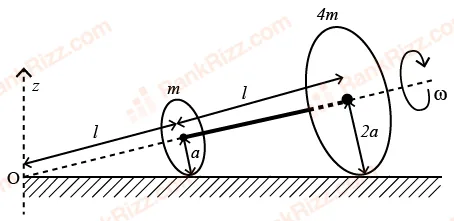
Two thin circular discs of mass m and 4m, having radii of a and 2a, respectively, are rigidly fixed by a mass less, rigid rod of length l=2424al = 24\sqrt{24} a through their centers. This assembly is laid on a firm and flat surface, and set rolling without slipping on the surface so that the angular speed about the axis of the rod is ω\omega. The angular momentum of the entire assembly about the point ‘O’ is L→\overrightarrow{L} (see the figure). Which of the following statement(s) is(are) true?

Figure for JEE Advanced 2016 Physics question on Angular momentum of particles and rigid bodies
  1. A

    The center of mass of the assembly rotates aboutthe z-axis with an angularspeed of ω5\frac{\omega}{5}

  2. B

    The magnitude of angular momentum of center of mass of the assembly about the point O is 81ma2ω81 ma^2 \omega

  3. C

    The magnitude of angular momentumofthe assembly aboutits center of mass is 17ma2ω/217 ma^2 \omega/2

  4. D

    The magnitude of the z-component of L→\overrightarrow{L} is 55ma2ω55 ma^2 \omega

JEE ADVANCED 2016 · PAPER 1Angular momentum of particles and rigid bodiesTRANSCRIBED

The position vector r→\overrightarrow{r} of a particle of mass m is given by the following equation 

r→(t)=αt3i^+βt2j^\overrightarrow{r}(t) = \alpha t^3 \hat{i} + \beta t^2 \hat{j}
where α=103ms−3,β=5ms−2\alpha = \frac{10}{3} ms^{-3}, \beta = 5 ms^{-2} and m=0.1 kg. At t=1 s, which of the following statement(s) is(are) true about the particle?

  1. A

    The velocity U→\overrightarrow{U} is given by U→=(10i^+10j^)ms−1\overrightarrow{U} = (10 \hat{i} + 10 \hat{j}) ms^{-1}

  2. B

    The angular momentum L→\overrightarrow{L} with respect to the origin is given by L→=−(53)k^Nms\overrightarrow{L} = - \left(\frac{5}{3}\right) \hat{k} N ms

  3. C

    The force F→\overrightarrow{F} is given by F→=(i^+2j^)N\overrightarrow{F} = (\hat{i} + 2 \hat{j}) N

  4. D

    The torque τ→\overrightarrow{\tau} with respect to the origin is given by τ→=(203)k^Nm\overrightarrow{\tau} = \left(\frac{20}{3}\right) \hat{k} Nm

JEE ADVANCED 2015 · PAPER 2Moment of inertia of standard bodies and composite systemsTRANSCRIBED

The densities of two solid spheres A and B of the same radii R vary with radial distance r as ρA(r)=k(rR)\rho_A(r) = k \left(\frac{r}{R}\right) and ρB(r)=k(rR)5,\rho_B(r) = k \left(\frac{r}{R}\right)^5, respectively, where k is a constant. The moments of inertia of the individual spheres about axes passing through their centres are IAI_A and IB,I_B, respectively. If IBIA=n10,\frac{I_B}{I_A} = \frac{n}{10}, the value of n is

JEE ADVANCED 2015 · PAPER 1Rolling with friction, slipping and impulsive forcesTRANSCRIBED

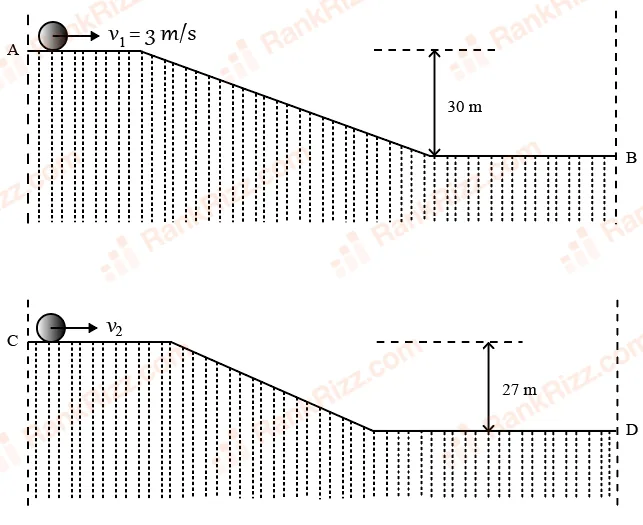
Two identical uniform discs roll without slipping on two different surfaces AB and CD (see figure) starting at A and C with linear speeds v1v_1 and v2v_2, respectively, and always remain in contact with the surfaces. If they reach B and D with the samelinear speed and v1=3m/sv_1 = 3 m/s, the v2v_2 in m/s is (g=10m/s2g = 10 m/s^2)

Figure for JEE Advanced 2015 Physics question on Rolling with friction, slipping and impulsive forces
JEE ADVANCED 2015 · PAPER 1Angular momentum of particles and rigid bodiesTRANSCRIBED

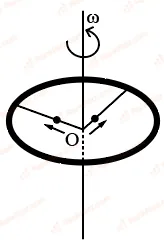
A ring of mass M and radius R is rotating with angular speed ω\omega about a fixed vertical axis passing through its centre O with two point masses each of mass M8\frac{M}{8} at rest at O. These masses can move radially outwards along two massless rods fixed on the ring as shown in the figure. At some instant the angular speed of the system is 89ω\frac{8}{9}\omega and one of the masses is at a distance of 35R\frac{3}{5}R from O. At this instant the distance of the other mass from O is

Figure for JEE Advanced 2015 Physics question on Angular momentum of particles and rigid bodies
  1. A

    23R\frac{2}{3}R

  2. B

    13R\frac{1}{3}R

  3. C

    35R\frac{3}{5}R

  4. D

    45R\frac{4}{5}R

JEE ADVANCED 2014 · PAPER 1Equilibrium of rigid bodies and topplingTRANSCRIBED

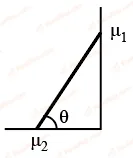
In the figure, a ladder of mass m is shown leaning against a wall. It is in static equilibrium making an angle θ\theta with the horizontal floor. The coefficient of friction between the wall and the ladder is μ1\mu_1 and that between the floor and the ladder is μ2\mu_2. The normal reaction of the wall on the ladder is N1N_1 and that of the floor is N2N_2. If the ladder is about to slip, then

Figure for JEE Advanced 2014 Physics question on Equilibrium of rigid bodies and toppling
  1. A

    μ1=0μ2≠0\mu_1 = 0 \mu_2 \neq 0 and N2tan⁡θ=mg2N_2 \tan \theta = \frac{mg}{2}

  2. B

    μ1≠0μ2=0\mu_1 \neq 0 \mu_2 = 0 and N1tan⁡θ=mg2N_1 \tan \theta = \frac{mg}{2}

  3. C

    μ1≠0μ2≠0\mu_1 \neq 0 \mu_2 \neq 0 and N2=mg1+μ1μ2N_2 = \frac{mg}{1 + \mu_1 \mu_2}

  4. D

    μ1=0μ2≠0\mu_1 = 0 \mu_2 \neq 0 and N1tan⁡θ=mg2N_1 \tan \theta = \frac{mg}{2}

JEE ADVANCED 2014 · PAPER 1Equilibrium of rigid bodies and topplingTRANSCRIBED

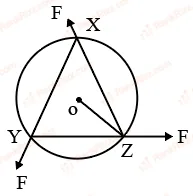
A uniform circular disc of mass 1.5 kg and radius 0.5 m is initially at rest on a horizontal frictionless surface. Three forces of equal magnitude F = 0.5 N are applied simultaneously along the three sides of an equilateral triangle XYZ with its vertices on the perimeter of the disc (see figure). One second after applying the forces, the angular speed of the disc in rads−1rads^{-1} is

Figure for JEE Advanced 2014 Physics question on Equilibrium of rigid bodies and toppling
JEE ADVANCED 2014 · PAPER 1Angular momentum of particles and rigid bodiesTRANSCRIBED

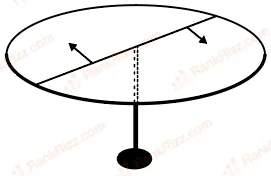
A horizontal circular platform of radius 0.5 m and mass 0.45 kg is free to rotate about its axis. Two massless spring toy-guns, each carrying a steel ball of mass 0.05 kg are attached to the platform at a distance 0.25 m from the centre on its either sides along its diameter (see figure). Each gun simultaneously fires the balls horizontally and perpendicular to the diameter in opposite directions. After leaving the platform, the balls have horizontal speed of 9ms−19 ms^{-1} with respect to the ground. The rotational speed of the platform in rads−1rads^{-1} after the balls leave the platform is

Figure for JEE Advanced 2014 Physics question on Angular momentum of particles and rigid bodies