JEE Advanced 2022 Physics question — Electric flux and Gauss's law
Six charges are placed around a regular hexagon of side length as shown in the figure. Five of them have charge , and the remaining one has charge . The perpendicular from each charge to the nearest hexagon side passes through the center O of the hexagon and is bisected by the side.
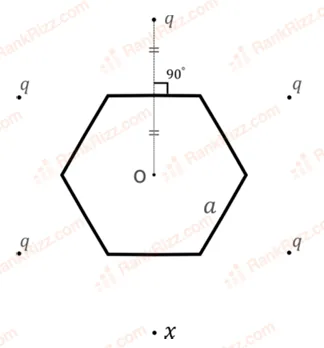
Which of the following statement(s) is(are) correct in SI units?
SOLUTION
Let the six charges be placed at the six vertices of a regular hexagon of side length . For a regular hexagon the distance of every vertex from the centre (the circumscribed radius) is also equal to . Therefore, for every charge the distance to the point is
Denote for brevity.
Electric field at
For a point charge the magnitude of the electric field at a distance is
and it is directed along the line joining the charge to the point of observation.
Label the six vertices in order as with vertex 1 on the positive -axis. Five of the charges are and the sixth (placed at vertex 1) is .
The six radial directions are separated by . If all six charges were equal to the vector sum of the six fields would be zero because the six vectors form a closed regular hexagon. Hence
When the charge at vertex 1 is changed from to , every field vector except the one coming from vertex 1 remains the same. Thus the resultant field becomes
The two vectors on the right-hand side have the same line of action (the radius through vertex 1), so the net magnitude is
Special cases:
• When , .
• When , .
Option B claims the value , which differs by a factor of and is therefore incorrect.
Electric potential at
The potential produced by a point charge at distance is
(scalar quantity).
With five charges equal to and one charge equal to the total potential is
Special cases:
• For , .
Option C contains the extra factor in the denominator, so it is incorrect.
• For , .
Option D again has the spurious factor and a different numerical multiplier, hence is incorrect.
Conclusion: only the statement in Option A is correct.
Correct choice: Option A which is: When , the magnitude of the electric field at is zero.
Tagged Electric flux and Gauss's law. Machine-assigned, so read it as a strong shortlist rather than a verdict.