RankRizz
JEE ADVANCED 2025 · PAPER 2+3 / −1HARDTRANSCRIBED

JEE Advanced 2025 Physics question — Electric flux and Gauss's law

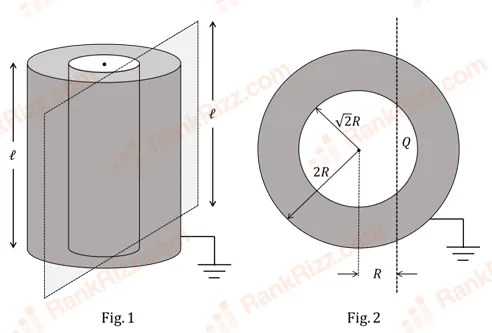
Two co-axial conducting cylinders of same length ℓ\ell with radii 2R\sqrt{2}R and 2R2R are kept, as shown in Fig. 1. The charge on the inner cylinder is QQ and the outer cylinder is grounded. The annular region between the cylinders is filled with a material of dielectric constant κ=5\kappa = 5. Consider an imaginary plane of the same length ℓ\ell at a distance RR from the common axis of the cylinders. This plane is parallel to the axis of the cylinders. The cross-sectional view of this arrangement is shown in Fig. 2. Ignoring edge effects, the flux of the electric field through the plane is (ϵ0\epsilon_0 is the permittivity of free space):

Figure for JEE Advanced 2025 Physics question on Electric flux and Gauss's law
SOLUTION

Let the inner and outer conducting cylinders be coaxial with the common zz-axis.
Radius of inner cylinder  : 2 R\sqrt{2}\,R
Radius of outer cylinder  : 2 R2\,R
Free charge on inner cylinder  : QQ (uniformly distributed along its length ℓ\ell)
Surface charge density per unit length (line charge)  : λ=Qℓ\lambda=\dfrac{Q}{\ell}.

The space between the two cylinders is filled with a dielectric of relative permittivity κ=5\kappa=5.
The outer cylinder is earthed, hence the electric field exists only in the dielectric region 2 R≤r≤2R\sqrt{2}\,R \le r \le 2R and is purely radial.

Electric field inside the dielectric
Take a cylindrical Gaussian surface of radius rr (with 2 R≤r≤2R\sqrt{2}\,R \le r \le 2R) and length ℓ\ell. Using Gauss’s law in dielectrics,

∮D⋅dA=Qfree enclosed  ⟹  D(2πrℓ)=λℓ⇒D=λ2πr.\oint \mathbf{D}\cdot d\mathbf{A}=Q_{\text{free enclosed}}\; \Longrightarrow \; D(2\pi r\ell)=\lambda\ell \Rightarrow D=\dfrac{\lambda}{2\pi r}. Since D=κε0E\mathbf{D}=\kappa\varepsilon_0\mathbf{E}, we get

E(r)=λ2πκε0 r,E=E(r) r^.E(r)=\dfrac{\lambda}{2\pi\kappa\varepsilon_0\,r}, \qquad \mathbf{E}=E(r)\,\hat{\mathbf{r}}. (Inside r<2 Rr\lt \sqrt{2}\,R the electric field is zero.)

The required open surface
We need the electric flux through a plane that

  • is parallel to the axis, of length ℓ\ell,
  • is at a perpendicular distance RR from the axis (take it as the plane x=Rx=R).

In the cross-section (the xyxy-plane) this surface appears as the straight line x=Rx=R. Only the part of this line lying in the dielectric region (r≥2 Rr\ge\sqrt{2}\,R) contributes to flux.

Limits of the contributing strip on the plane
Put x=Rx=R and write r=x2+y2=R2+y2.r=\sqrt{x^{2}+y^{2}}=\sqrt{R^{2}+y^{2}}.

  • Inner boundary: r=2 R  ⇒  y=±Rr=\sqrt{2}\,R \;\Rightarrow\; y=\pm R
  • Outer boundary: r=2 R  ⇒  y=±3 Rr=2\,R \;\Rightarrow\; y=\pm\sqrt{3}\,R
Hence the dielectric occupies y∈[−3R,−R]∪[R,3R]y\in[-\sqrt{3}R,-R]\cup[R,\sqrt{3}R] on the plane.

Element of area and flux through it
For a strip of width dydy on this plane, area element dA=ℓ dy.dA=\ell\,dy. The unit normal to the plane is n^=x^\hat{\mathbf{n}}=\hat{\mathbf{x}} (along +x+x), while the electric field is radial, so the cosine of the angle between E\mathbf{E} and n^\hat{\mathbf{n}} equals xr=Rr.\dfrac{x}{r}=\dfrac{R}{r}. Therefore, the differential flux is

dΦ=E(r)(Rr)dA=λ2πκε0 r(Rr)ℓ dy=λRℓ2πκε0dy(R2+y2).d\Phi=E(r)\left(\dfrac{R}{r}\right)dA =\dfrac{\lambda}{2\pi\kappa\varepsilon_0\,r}\left(\dfrac{R}{r}\right)\ell\,dy =\dfrac{\lambda R\ell}{2\pi\kappa\varepsilon_0}\dfrac{dy}{(R^{2}+y^{2})}.

Total flux through the plane

Φ=∫−3R−R+∫R3RλRℓ2πκε0  dyR2+y2=λRℓπκε0∫R3RdyR2+y2(using symmetry).\Phi=\int_{-\sqrt{3}R}^{-R}+\int_{R}^{\sqrt{3}R} \dfrac{\lambda R\ell}{2\pi\kappa\varepsilon_0}\; \dfrac{dy}{R^{2}+y^{2}} =\dfrac{\lambda R\ell}{\pi\kappa\varepsilon_0} \int_{R}^{\sqrt{3}R}\dfrac{dy}{R^{2}+y^{2}} \quad (\text{using symmetry}).

Evaluate the integral:

∫R3RdyR2+y2=[1Rarctan⁡(yR)]R3R=1R[arctan⁡(3)−arctan⁡(1)]=1R(π3−π4)=π12R.\int_{R}^{\sqrt{3}R}\dfrac{dy}{R^{2}+y^{2}} =\left[\dfrac{1}{R}\arctan\left(\dfrac{y}{R}\right)\right]_{R}^{\sqrt{3}R} =\dfrac{1}{R}\left[\arctan(\sqrt{3})-\arctan(1)\right] =\dfrac{1}{R}\left(\dfrac{\pi}{3}-\dfrac{\pi}{4}\right) =\dfrac{\pi}{12R}.

Substituting,

Φ=λRℓπκε0⋅π12R=λℓ12κε0=Q12κε0.\Phi=\dfrac{\lambda R\ell}{\pi\kappa\varepsilon_0}\cdot\dfrac{\pi}{12R} =\dfrac{\lambda\ell}{12\kappa\varepsilon_0} =\dfrac{Q}{12\kappa\varepsilon_0}.

With κ=5\kappa=5,

Φ=Q12×5  ε0=Q60 ε0.\Phi=\dfrac{Q}{12\times5\;\varepsilon_0} =\dfrac{Q}{60\,\varepsilon_0}.

Therefore, the electric flux through the given plane is Q60ε0\dfrac{Q}{60\varepsilon_0}.

Option C which is: Q60ε0\displaystyle\frac{Q}{60\varepsilon_0}

Tagged Electric flux and Gauss's law. Machine-assigned, so read it as a strong shortlist rather than a verdict.

SubjectPhysics
TopicElectric flux and Gauss's law
TypeMultiple choice