JEE ADVANCED 2011 · PAPER 1Electric flux and Gauss's lawTRANSCRIBED
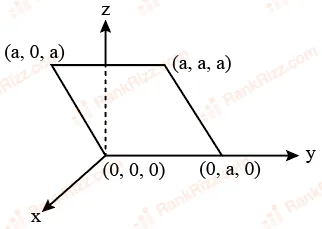
Consider an electric field , where is a constant. The flux through the shaded area (as shown in the figure) due to this field is-
- A
- B
- C
- D
Every Electrostatics question JEE Advanced has set from 2007–2026, grouped by the idea it tests rather than the order of the syllabus. 61 questions across 6 distinct ideas. Free to read, answer key on every one.
Questions
61
Distinct ideas
6
Share of marks
7.4%
Difficulty
HARD
A chapter is not one subject — it is a handful of procedures the examiner reuses. These are the ones Electrostatics questions actually test.
41–60 OF 61 · NEWEST FIRST
Consider an electric field , where is a constant. The flux through the shaded area (as shown in the figure) due to this field is-
A spherical metal shall A of radius and a solid metal sphere B of radius are kept far apart and each is given charge '+Q'. Now they are connected by a thin metal wire. Then-
Which of the following statement(s) is/are correct?
If the electric field due to a point charge varies as instead of , then the Gausslaw will still be valid.
The Gauss law can be used to calculate the field distribution around an electric dipole.
If the electric field between two point charges is zero somewhere, then the sign of the two chargesis the same.
The work doneby the external force in moving a unit positive charge from point A at potential to point B at potential is .
Four point charge, each of +q, are rigidly fixed at the four corners of a square planar soap film of side 'a'. The surface tension of the soap film is . The system of charges and planar film are in equilibrium, and , where 'k' is a constant. Then N is
A tiny spherical oil drop carrying a net charge q is balanced instill air with a vertical uniform electric field of strength . When the field switched off, the drop is observed to fall with terminal velocity . Given , viscosity of the air = and the density of oil = , the magnitude of q is
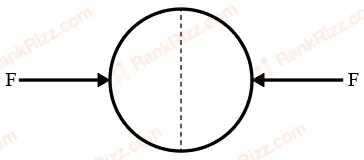
A uniformly charged thin spherical shell of radius R carries uniform surface charge density of per unit area. It is made of two hemispherical shells, held together by pressing them with force F (see figure). F is proportional to
A few electric field lines for a system of two charges and fixed at two different points on the x-axis are shown in the figure. These lines suggest that
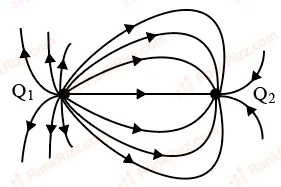
at a finite distance to the left of the electric field is zero
at a finite distance to the right of the electric field is zero
Three concentric metallic spherical shells of radii R, 2R, 3R are given charges respectively. It is found that the surface charge densities on the outer surfaces of the shells are equal. Then, the ratio of the charges given to the shells, is-
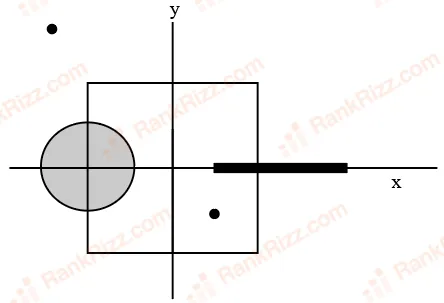
A disk of radius having a uniformly distributed charge 6C is placed in the x-y plane with its centre at . A rod of length 'a' carrying a uniformly distributed charge 8C is placed on the x-axis from to . Two point charges -7C and 3C are placed at and respectively. Consider a cubical surface formed by six surfaces . The electric flux this cubical surface is-
Under the influence of the Coulomb field of charge +Q, a charge -q is moving around it in an elliptical orbit. Find out the correct statement(s).
The angular momentum of the charge —q is constant
The linear momentum of the charge —g is constant
The angular velocity of the charge —q is constant
Thelinear speed of the charge —q is constant
A solid sphere of radius R has a charge Q distributed in its volume with a charge densityy , where k and a are constants and r is the distance from its center. If the electric field at is times that at r = R, find the value of a,
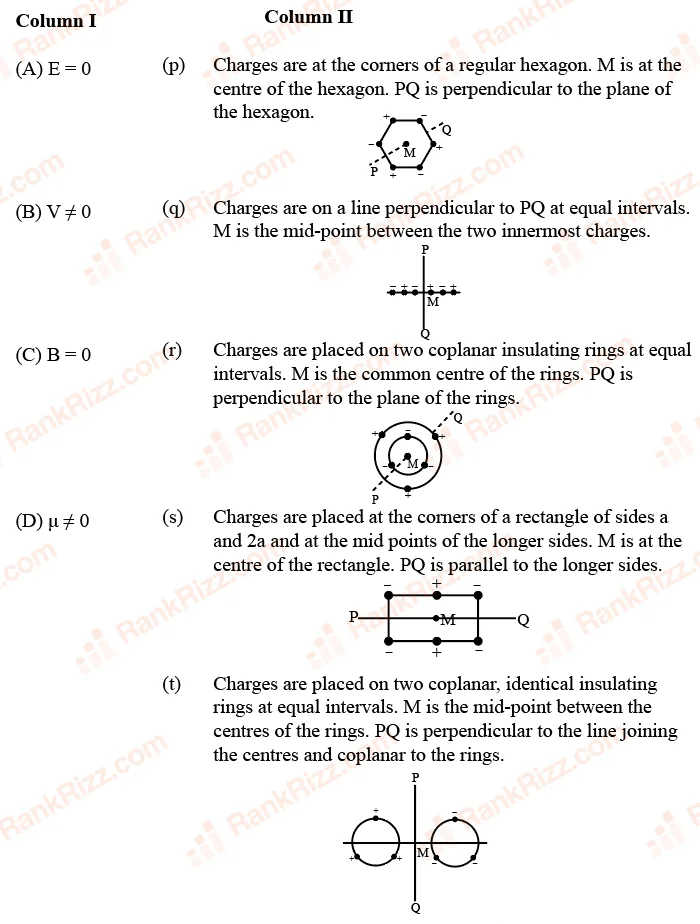
Six point charges, each of the same magnitude q, are arranged in different manners as shown in Column II. In each case, a point M and a line PQ passing through M are shown. Let E be the electric field and V be the electric potential at M (potential at infinity is zero) due to the given charge distribution when it is at rest. Now, the whole system is set into rotation with a constant angular velocity about the line PQ. Let B be the magnetic field at M and be the magnetic moment of the system in this condition. Assume each rotating charge to be equivalent to a steady current.
Consider a system of three charges and placed at points A, B and C, respectively, as shown in the figure. Take O to be the centre of the circle of radius R and angle
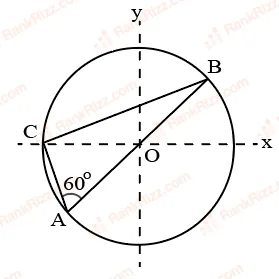
The electric field at point O is directed along the negative x-axis
The potential energy of the system is zero
The magnitude of the force between the charges at C and B is
The potential at point O is
STATEMENT-1
For practical purposes, the earth is used as a reference at zero potential in electrical circuits.
and
STATEMENT-2
The electrical potential of a sphere of radius R with charge Q uniformly distributed on the surface is given by .
STATEMENT-1 is True, STATEMENT-2 is True; STATEMENT-2 is a correct explanation for STATEMENT-1
STATEMENT-1 is True, STATEMENT-2 is True; STATEMENT-2 is NOT a correct explanation for STATEMENT-1
STATEMENT-1 is True, STATEMENT-2 is False
STATEMENT-1 is False, STATEMENT-2 is True
The electric field at r = R is
independent of a
directly proportional to a
directly proportional to
inversely proportional to a
For a = 0, the value of d (maximum value of as shown in the figure) is
The electric field within the nucleus is generally observed to be linearly dependent on r. This implies
a = 0
a = R
A long, hollow conducting cylinder is kept coaxially inside another long, hollow conducting cylinder of larger radius. Both the cylinders are initially electrically neutral.
A potential difference appears between the two cylinders when a charge density is given to the inner cylinder
A potential difference appears between the two cylinders when a charge density is given to the outer cylinder
No potential difference appears between the two cylinders when a uniform line charge is kept along the axis of the cylinders
No potential difference appears between the two cylinders when same charge density is given to both the cylinders
Consider a neutral conducting sphere. A positive point charge is placed outside the sphere. The net charge on the sphere is then,
negative and distributed uniformly over the surface of the sphere
negative and appears only at the pointon the sphere closest to the point charge
negative and distributed non-uniformly over the entire surface of the sphere
zero
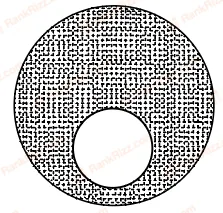
A spherical portion has been removed from a solid sphere having a charge distributed uniformly in its volume as showing the figure. The electric field inside the emptied space is
zero everywhere
non-zero and uniform
non-uniform
zero only at its center
JEE Main has set 294 Electrostatics questions too. Electrostatics JEE Main PYQs →
OTHER PHYSICS CHAPTERS