RankRizz

Electrostatics — JEE Advanced Previous Year Questions

Every Electrostatics question JEE Advanced has set from 2007–2026, grouped by the idea it tests rather than the order of the syllabus. 61 questions across 6 distinct ideas. Free to read, answer key on every one.

Questions

61

Distinct ideas

6

Share of marks

7.4%

Difficulty

HARD

The ideas inside Electrostatics

A chapter is not one subject — it is a handful of procedures the examiner reuses. These are the ones Electrostatics questions actually test.

01Electric charge and Coulomb's lawset 6×
02Electric field due to point charges and superpositionNot set in Advanced
03Electric field of continuous charge distributionsset 16×
04Motion and equilibrium of charged bodies in electric fieldsNot set in Advanced
05Electric flux and Gauss's lawset 21×
06Electric potential and potential energyset 1×
07Relation between field and potential, equipotential surfacesset 10×
08Electric dipole and dipole in external fieldset 7×
09Conductors, concentric shells and earthingNot set in Advanced

Every Electrostatics question

21–40 OF 61 · NEWEST FIRST

JEE ADVANCED 2020 · PAPER 1Electric flux and Gauss's lawTRANSCRIBED

A circular disc of radius 𝑅 carries surface charge density \sigma (𝑟) = \sigma 0 (1 − \frac{r}{R}\right), where σ0\sigma_{0} is a constant and 𝑟 is the distance from the center of the disc. Electric flux through a large spherical surface that encloses the charged disc completely is ϕ0\phi_{0}. Electric flux through another spherical surface of radius R4\frac{R}{4} and concentric with the disc is ϕ\phi. Then the ratio ϕ0ϕ\frac{\phi_{0}}{\phi} is_________.

JEE ADVANCED 2019 · PAPER 1Electric flux and Gauss's lawTRANSCRIBED

A thin spherical insulating shell of radius R carries a uniformly distributed charge such that the potential at its surface is V0V_0. A hole with a small area α4πR2(α≪1)\alpha 4 \pi R^2 (\alpha \ll 1) is made on the shell without affecting the rest of the shell. Which one of the following statements is correct?

  1. A

    The potential at the center of the shell is reduced by 2αV02 \alpha V_0

  2. B

    The magnitude ofelectric field at the center of the shell is reduced by αV02R\frac{\alpha V_0}{2R}

  3. C

    The ratio of the potential at the center of the shell to that of the point at 12R\frac{1}{2}R from center towards the hole will be 1−α1−2α\frac{1 - \alpha}{1 - 2 \alpha}

  4. D

    The magnitude of electric field at a point, located on a line passing through the hole and shell’s center, on a distance 2R from the center of the spherical shell will be reduced by αV02R\frac{\alpha V_0}{2R}

JEE ADVANCED 2019 · PAPER 2Electric dipole and dipole in external fieldTRANSCRIBED

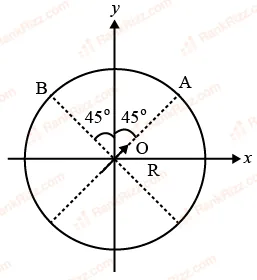
An electric dipole with dipole moment po2(l^J^)\frac{p_o}{\sqrt 2} (\widehat{l}\widehat{J}) is held fixed at the origin O in the presence of an uniform electric field of magnitude E0E_0. If the potential is constant on a circle of radius R centered at the origin as shown in figure, then the correct statement(s) is/are:
(ϵ0\epsilon_0 is permittivity of free space. R≫R \gg dipole size)

Figure for JEE Advanced 2019 Physics question on Electric dipole and dipole in external field
  1. A

    R=(p04πϵ0E0)13R = \left(\frac{p_0}{4\pi \epsilon_0 E_0}\right)^{\frac{1}{3}}

  2. B

    Total electric field at point A is E→A=2E0(l^j^)\overrightarrow{E}_A = \sqrt 2 E_0 (\widehat{l}\widehat{j})

  3. C

    Total electric field at point B is E→B=0\overrightarrow{E}_B = 0

  4. D

    The magnitude of total electric field on any two points of the circle will be same.

JEE ADVANCED 2019 · PAPER 1Electric flux and Gauss's lawTRANSCRIBED

A charged shell of radius R carries a total charge Q. Given ϕ\phi as the flux of electric field through a closed cylindrical surface of height h, radius r and with its center same as that of the shell. Here, center of the cylinder is a point on the axis of the cylinder which is equidistant from its top and bottom surfaces. Which of the following option(s) is/are correct?
[ϵ0\epsilon_0 is the permittivity of free space]

  1. A

    Ifh > 2R andr > R then ϕ=Q/ϵ0\phi = Q/\epsilon_0

  2. B

    Ifh < 8R/5 and r = 3R/5 then ϕ=0\phi = 0

  3. C

    Ifh > 2R andr = 3R/5 then ϕ=Q/5ϵ0\phi = Q/5 \epsilon_0

  4. D

    Ifh > 2R and r = 4R/5 then ϕ=Q/5ϵ0\phi = Q/ 5 \epsilon_0

JEE ADVANCED 2017 · PAPER 2Electric flux and Gauss's lawTRANSCRIBED

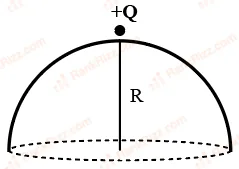
A point charge +Q+Q is placed just outside an imaginary hemispherical surface of radius R as shown in the figure. Which of the following statements is/are correct?

Figure for JEE Advanced 2017 Physics question on Electric flux and Gauss's law
  1. A

    The electric flux passing through the curved surface of the hemisphere is −Q2ϵ0(1−12)-\frac{Q}{2\epsilon _{0}}(1-\frac{1}{\sqrt{2}})

  2. B

    Total flux through the curved and the flat surfaces is Qϵ0\frac{Q}{\epsilon _{0}}

  3. C

    The component of the electric field normal to the flat surface is constant over the surface

  4. D

    The circumference of the flat surface is an equipotential

JEE ADVANCED 2016 · PAPER 2Relation between field and potential, equipotential surfacesTRANSCRIBED

Which one of the following statementsis correct?

  1. A

    The balls will stick to the top plate and remain there

  2. B

    The balls will bounce back to the bottom plate carrying the same charge they went up with

  3. C

    The balls will bounce back to the bottom plate carrying the opposite charge they went up with

  4. D

    The balls will execute simple harmonic motion between the two plates

JEE ADVANCED 2015 · PAPER 1Electric flux and Gauss's lawTRANSCRIBED

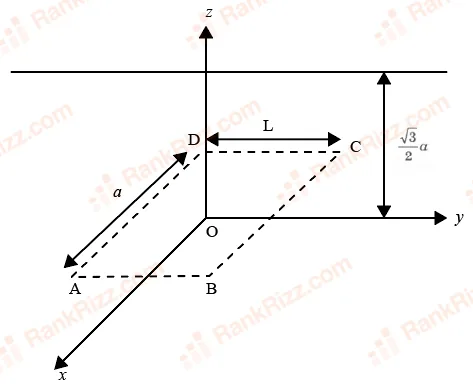
An infinitely long uniform line charge distribution of charge per unit length λ\lambda lies parallel to the y-axis in the y-z plane at z=32az = \frac{\sqrt{3}}{2} a (see figure). If the magnitude of the flux of the electric field through the rectangular surface ABCD lying in the x-y plane with its centre at the origin is λLnε0\frac{\lambda L}{n ε_0} (ε0ε_0 = permittivity of free space), then the value of n is

Figure for JEE Advanced 2015 Physics question on Electric flux and Gauss's law
JEE ADVANCED 2015 · PAPER 2Electric field of continuous charge distributionsTRANSCRIBED

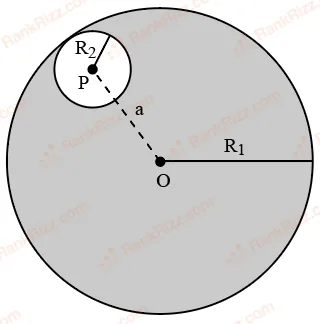
Consider a uniform spherical charge distribution of radius R1R_1 centred at the origin O. In this distribution, a spherical cavity of radius R2R_2 centred at P with distance OP=a=R1−R2OP = a = R_1 - R_2 (see figure) is made. If the electric field inside the cavity at position r→\overrightarrow{r} is E→(r→)\overrightarrow{E} (\overrightarrow{r}) , then the correct statement(s) is(are)

Figure for JEE Advanced 2015 Physics question on Electric field of continuous charge distributions
  1. A

    E→\overrightarrow{E} is uniform, its magnitude is independentof R2R_2 but its direction depends on r→\overrightarrow{r}

  2. B

    E→\overrightarrow{E} is uniform, its magnitude depends on R2R_2 and its direction depends on r→\overrightarrow{r}

  3. C

    E→\overrightarrow{E} is uniform, its magnitude is independentof a but its direction depends on a→\overrightarrow{a}

  4. D

    E→\overrightarrow{E} is uniform and both its magnitude and direction depend on a→\overrightarrow{a}

JEE ADVANCED 2015 · PAPER 1Electric field of continuous charge distributionsTRANSCRIBED

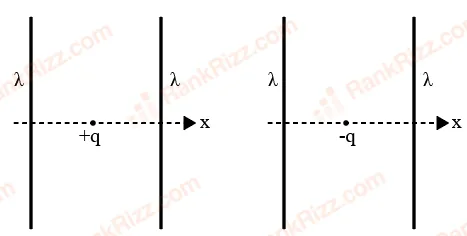
The figures below depict two situations in which two infinitely long static line charges of constant positive line charge density λ\lambda are kept parallel to each other. In their resulting electric field, point charges q and -q are kept in equilibrium between them. The point charges are confined to move in the x direction only. If they are given a small displacement about their equilibrium positions, then the correct statement(s) is(are)

Figure for JEE Advanced 2015 Physics question on Electric field of continuous charge distributions
  1. A

    Both charges execute simple harmonic motion.

  2. B

    Both charges will continue moving in the direction of their displacement.

  3. C

    Charge +q executes simple harmonic motion while charge -q continues moving in the direction of its displacement.

  4. D

    Charge -q executes simple harmonic motion while charge +q continues moving in the direction of its displacement.

JEE ADVANCED 2014 · PAPER 2Electric field of continuous charge distributionsTRANSCRIBED

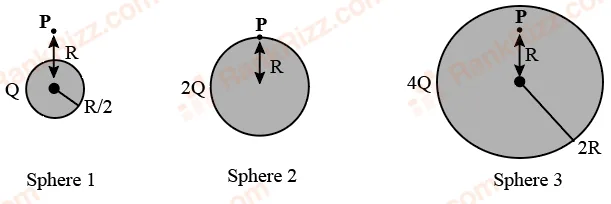
Charges Q, 2Q and 4Q are uniformly distributed in three dielectric solid spheres 1, 2 and 3 of radii R/2, R and 2R, respectively, as shown in figure. If magnitudes of the electric fields at point P at a distance R from the center of spheres 1, 2 and 3 are E1,E2E_1 , E_2 and E3E_3 respectively, then

Figure for JEE Advanced 2014 Physics question on Electric field of continuous charge distributions
  1. A

    E1>E2>E3E_1 > E_2 > E_3

  2. B

    E3>E1>E2E_3 > E_1 > E_2

  3. C

    E2>E1>E3E_2 > E_1 > E_3

  4. D

    E3>E2>E1E_3 > E_2 > E_1

JEE ADVANCED 2014 · PAPER 1Electric flux and Gauss's lawTRANSCRIBED

Let E1(r),E2(r)E_1 (r), E_2 (r) and E3(r)E_3 (r) be the respective electric fields at a distance r from a point charge Q, an infinitely long wire with constant linear charge density λ\lambda, and an infinite plane with uniform surface charge density σ\sigma. If E1(r0)=E2(r0)=E3(r0)E_1 (r_0) = E_2 (r_0) = E_3 (r_0) at a given distance r0r_0, then

  1. A

    Q=4σπr02Q = 4 \sigma \pi r_0^2

  2. B

    r0=λ2πσr_0 = \frac{\lambda}{2 \pi \sigma}

  3. C

    E1(r02)=2E2(r02)E_1 (\frac{r_0}{2}) = 2E_2 (\frac{r_0}{2})

  4. D

    E2(r02)=4E3(r02)E_2 (\frac{r_0}{2}) = 4E_3 (\frac{r_0}{2})

JEE ADVANCED 2014 · PAPER 2Electric field of continuous charge distributionsTRANSCRIBED

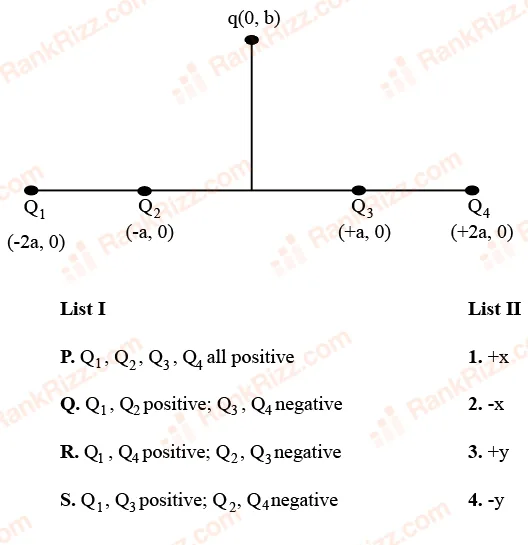
Four charges Q1,Q2,Q3Q_1, Q_2, Q_3 and Q4Q_4 of same magnitude are fixed along the x axis at x = −2a, −a, +a and +2a, respectively. A positive charge q is placed on the positive y axis at a distance b > 0. Four options of the signs of these charges are given in List I. The direction of the forces on the charge q is given in List II. Match List I with List II and select the correct answer using the code given below the lists.

Figure for JEE Advanced 2014 Physics question on Electric field of continuous charge distributions
  1. A

    P-3, Q-1, R-4, S-2

  2. B

    P-4, Q-2, R-3, S-1

  3. C

    P-3, Q-1, R-2, S-4

  4. D

    P-4, Q-2, R-1, S-3

JEE ADVANCED 2013 · PAPER 2Relation between field and potential, equipotential surfacesTRANSCRIBED

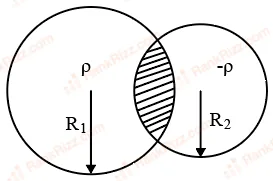
Two non-conducting spheres of radii R1R_1 and R2R_2 and carrying uniform volume charge densities ρ\rho and ρ\rho respectively, are placed such that they partially overlap, as shown in the figure. At all points in the overlapping region,

Figure for JEE Advanced 2013 Physics question on Relation between field and potential, equipotential surfaces
  1. A

    the electrostatic field is zero.

  2. B

    the electrostatic potential is constant.

  3. C

    the electrostatic field is constant in magnitude.

  4. D

    the electrostatic field has same direction.

JEE ADVANCED 2013 · PAPER 1Electric flux and Gauss's lawTRANSCRIBED

Two non-conducting solid spheres of radii R and 2R, having uniform volume charge densities ρ1\rho_1 and ρ2\rho_2 respectively, touch each other. The net electric field at a distance 2R from the centre of the smaller sphere, along the line joining the centres of the spheres, is zero. The ratio ρ1ρ2\frac{\rho_1}{\rho_2} can be

  1. A

    -4

  2. B

    −3225-\frac{32}{25}

  3. C

    3225\frac{32}{25}

  4. D

    4

JEE ADVANCED 2012 · PAPER 1Relation between field and potential, equipotential surfacesTRANSCRIBED

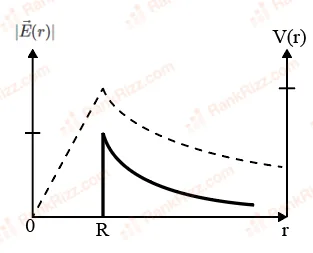
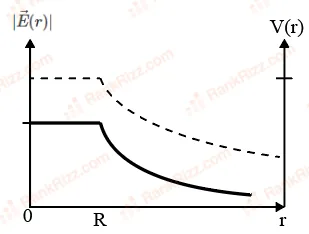
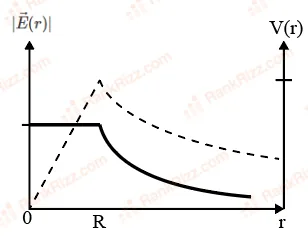
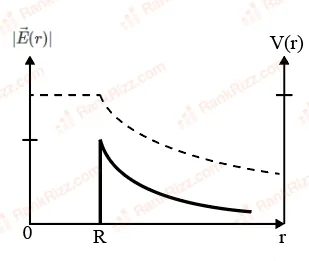
Consider a thin spherical shell of radius R with its centre at the origin, carrying uniform positive surface charge density. The variation of the magnitude of the electric field ∣E→(r)∣\mid \overrightarrow{E}(r) \mid and the electric potential V(r) with the distance r from the centre, is best represented by which graph?

  1. A
    Figure for JEE Advanced 2012 Physics question on Relation between field and potential, equipotential surfaces
  2. B
    Figure for JEE Advanced 2012 Physics question on Relation between field and potential, equipotential surfaces
  3. C
    Figure for JEE Advanced 2012 Physics question on Relation between field and potential, equipotential surfaces
  4. D
    Figure for JEE Advanced 2012 Physics question on Relation between field and potential, equipotential surfaces
JEE ADVANCED 2012 · PAPER 1Electric field of continuous charge distributionsTRANSCRIBED

Two large vertical and parallel metal plates having a separation of 1 cm are connected to a DC voltage source of potential difference X . A protonis released at rest midway between the two plates. It is found to move at 45∘45^\circ to the vertical JUSTafter release. Then X is nearly

  1. A

    1×10−51 \times 10^{-5} V

  2. B

    1×10−71 \times 10^{-7} V

  3. C

    1×10−91 \times 10^{-9} V

  4. D

    1×10−101 \times 10^{-10} V

JEE ADVANCED 2012 · PAPER 1Electric flux and Gauss's lawTRANSCRIBED

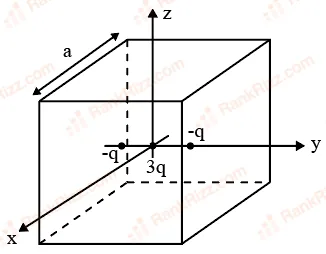
A cubical region of side a has its centre at the origin. It encloses three fixed point charges, -q at (0, -a/4,0), +3qg at (0, 0, 0) and -q at (0, +a/4, 0). Choose the correct option(s).

Figure for JEE Advanced 2012 Physics question on Electric flux and Gauss's law
  1. A

    The net electric flux crossing the plane x = +a/2 is equal to the net electric flux crossing the plane x = -a/2.

  2. B

    The netelectric flux crossing the plane y = +a/2 is more than the net electric flux crossing the plane y = -a/2.

  3. C

    The netelectric flux crossing the entire region is qε0\frac{q}{ε_0}.

  4. D

    The netelectric flux crossing the plane z = +a/2 is equalto the netelectric flux crossing the plane x = +a/2.

JEE ADVANCED 2012 · PAPER 1Electric flux and Gauss's lawTRANSCRIBED

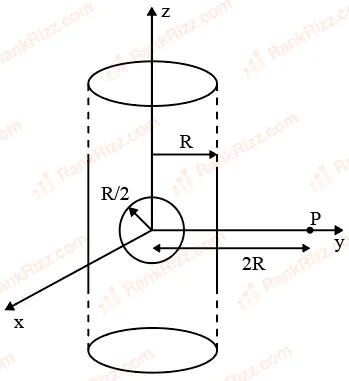
An infinitely long solid cylinder of radius R has a uniform volume charge density p. It has a spherical cavity of radius R/2 with its centre on the axis of the cylinder, as shown in the figure. The magnitude of the electric field at the point P, which is at a distance 2R from the axis of the cylinder, is given by the expression 23ρR16kε0\frac{23 \rho R}{16k ε_0}. The value of k is

Figure for JEE Advanced 2012 Physics question on Electric flux and Gauss's law
JEE ADVANCED 2012 · PAPER 2Relation between field and potential, equipotential surfacesTRANSCRIBED

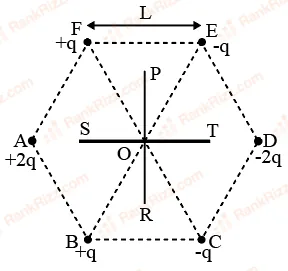
Six point charges are kept at the vertices of a regular hexagon of side L and centre O, as shown in the figure. Given that K=14πε0qL2K = \frac{1}{4 \pi ε_0}\frac{q}{L^2}, which of the following statement (s) is (are) correct?

Figure for JEE Advanced 2012 Physics question on Relation between field and potential, equipotential surfaces
  1. A

    the elecric field at O is 6K along OD

  2. B

    The potential at O is zero

  3. C

    The potential at all points on the line PR is same

  4. D

    The potential at all points on the line ST is same.

JEE ADVANCED 2011 · PAPER 2Electric field of continuous charge distributionsTRANSCRIBED

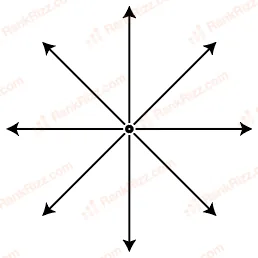
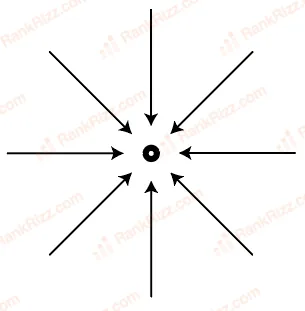
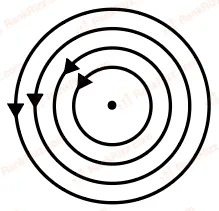
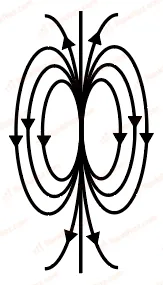
Which of the field patterns given below is valid for electric field as well as for magnetic field?

  1. A
    Figure for JEE Advanced 2011 Physics question on Electric field of continuous charge distributions
  2. B
    Figure for JEE Advanced 2011 Physics question on Electric field of continuous charge distributions
  3. C
    Figure for JEE Advanced 2011 Physics question on Electric field of continuous charge distributions
  4. D
    Figure for JEE Advanced 2011 Physics question on Electric field of continuous charge distributions