JEE Advanced 2022 Physics question — Electric flux and Gauss's law
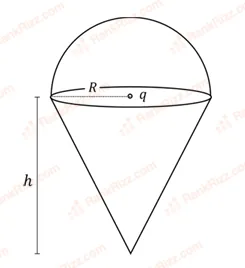
A charge is surrounded by a closed surface consisting of an inverted cone of height and base radius , and a hemisphere of radius as shown in the figure. The electric flux through the conical surface is (in SI units). The value of is _______.
SOLUTION
Gauss law states that the total electric flux emerging out of any closed surface that encloses a point charge is
The given closed surface has two parts.
• Curved surface of a hemisphere of radius .
• Curved surface of an inverted cone whose base circle (radius ) coincides with the rim of the hemisphere.
The point charge is at the common centre of the hemisphere, i.e. at the centre of the complete sphere of radius . (This is implied because the hemisphere is specified only by its radius.)
Flux through the hemispherical surface
Because the charge is at the centre of the full sphere of radius , the electric field on the spherical surface is radial and of equal magnitude at every point. Hence the flux through the entire sphere would be . The hemisphere is exactly half of this sphere, so its share of flux is
Flux through the conical surface
Let be the flux through the curved surface of the inverted cone. The hemisphere and the cone together form a closed surface, so
Substituting ,
The question states that this flux equals , so
Therefore, the required value of is 3.
Tagged Electric flux and Gauss's law. Machine-assigned, so read it as a strong shortlist rather than a verdict.