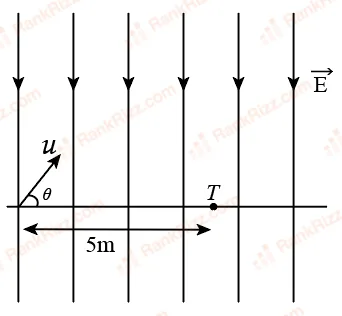
The electric field is uniform and points in the negative y y y E → = − 400 3 y ^ N C − 1 \overrightarrow{E}= -400\sqrt3\,\hat y\;{\rm N\,C^{-1}} E = − 400 3 y ^ N C − 1 F → = q E → \overrightarrow{F}=q\overrightarrow{E} F = q E
a → = q m E → = − q m 400 3 y ^ . \overrightarrow a=\frac{q}{m}\overrightarrow{E}= -\frac{q}{m}\,400\sqrt3\,\hat y. a = m q E = − m q 400 3 y ^ .
With q m = 10 10 C k g − 1 , \dfrac{q}{m}=10^{10}\;{\rm C\,kg^{-1}}, m q = 1 0 10 C k g − 1 , ∣ a ∣ = 400 3 × 10 10 m s − 2 ≈ 6.928 × 10 12 m s − 2 . |a|=400\sqrt3\times10^{10}\;{\rm m\,s^{-2}}\approx6.928\times10^{12}\;{\rm m\,s^{-2}}. ∣ a ∣ = 400 3 × 1 0 10 m s − 2 ≈ 6.928 × 1 0 12 m s − 2 .
The particle enters the field with speedv 0 = 2 10 × 10 6 m s − 1 = 6.324 × 10 6 m s − 1 . v_0 = 2\sqrt{10}\times10^6\;{\rm m\,s^{-1}}
=6.324\times10^{6}\;{\rm m\,s^{-1}}. v 0 = 2 10 × 1 0 6 m s − 1 = 6.324 × 1 0 6 m s − 1 .
Let the projection angle with the horizontal be θ \theta θ v 0 x = v 0 cos θ , v 0 y = v 0 sin θ . v_{0x}=v_0\cos\theta,\qquad v_{0y}=v_0\sin\theta. v 0 x = v 0 cos θ , v 0 y = v 0 sin θ .
The target T lies 5 m horizontally from the entry point and is on the same vertical level.
If t t t
Horizontal motion: x ( t ) = v 0 x t = 5 ⇒ t = 5 v 0 cos θ − ( 1 ) x(t)=v_{0x}t=5\;\Rightarrow\;t=\dfrac{5}{v_0\cos\theta}\;-(1) x ( t ) = v 0 x t = 5 ⇒ t = v 0 cos θ 5 − ( 1 )
Vertical motion: y ( t ) = v 0 y t + 1 2 a t 2 = 0 − ( 2 ) y(t)=v_{0y}t+\tfrac12 a t^2=0\;-(2) y ( t ) = v 0 y t + 2 1 a t 2 = 0 − ( 2 )
Substituting t t t ( 1 ) (1) ( 1 ) ( 2 ) (2) ( 2 )
v 0 sin θ 5 v 0 cos θ + 1 2 a ( 5 v 0 cos θ ) 2 = 0. v_0\sin\theta\;\frac{5}{v_0\cos\theta}
+\frac12 a\!\left(\frac{5}{v_0\cos\theta}\right)^{\!2}=0. v 0 sin θ v 0 c o s θ 5 + 2 1 a ( v 0 c o s θ 5 ) 2 = 0.
After cancelling v 0 v_0 v 0
5 tan θ + 25 a 2 v 0 2 cos 2 θ = 0 ⟹ tan θ = − 5 a 2 v 0 2 cos 2 θ . 5\tan\theta+\frac{25a}{2v_0^{2}\cos^{2}\theta}=0
\;\;\Longrightarrow\;\;
\tan\theta=-\frac{5a}{2v_0^{2}\cos^{2}\theta}. 5 tan θ + 2 v 0 2 c o s 2 θ 25 a = 0 ⟹ tan θ = − 2 v 0 2 c o s 2 θ 5 a .
Because a a a a = − ∣ a ∣ a=-|a| a = − ∣ a ∣
tan θ = 5 ∣ a ∣ 2 v 0 2 cos 2 θ . \tan\theta=\frac{5|a|}{2v_0^{2}\cos^{2}\theta}. tan θ = 2 v 0 2 c o s 2 θ 5∣ a ∣ .
Multiply by cos 2 θ \cos^{2}\theta cos 2 θ
sin θ cos θ = 5 ∣ a ∣ 2 v 0 2 . \sin\theta\cos\theta=\frac{5|a|}{2v_0^{2}}. sin θ cos θ = 2 v 0 2 5∣ a ∣ .
Using sin θ cos θ = 1 2 sin 2 θ \sin\theta\cos\theta=\tfrac12\sin2\theta sin θ cos θ = 2 1 sin 2 θ
1 2 sin 2 θ = 5 ∣ a ∣ 2 v 0 2 ⟹ sin 2 θ = 5 ∣ a ∣ v 0 2 . \tfrac12\sin2\theta=\frac{5|a|}{2v_0^{2}}
\quad\Longrightarrow\quad
\sin2\theta=\frac{5|a|}{v_0^{2}}. 2 1 sin 2 θ = 2 v 0 2 5∣ a ∣ ⟹ sin 2 θ = v 0 2 5∣ a ∣ .
Compute the right-hand side:
5 ∣ a ∣ v 0 2 = 5 ( 6.928 × 10 12 ) ( 6.324 × 10 6 ) 2 = 3.464 × 10 13 4.000 × 10 13 ≈ 0.866 = 3 2 . \frac{5|a|}{v_0^{2}}
=\frac{5(6.928\times10^{12})}{(6.324\times10^{6})^{2}}
=\frac{3.464\times10^{13}}{4.000\times10^{13}}
\approx0.866=\frac{\sqrt3}{2}. v 0 2 5∣ a ∣ = ( 6.324 × 1 0 6 ) 2 5 ( 6.928 × 1 0 12 ) = 4.000 × 1 0 13 3.464 × 1 0 13 ≈ 0.866 = 2 3 .
Hence sin 2 θ = 3 2 , \sin2\theta= \frac{\sqrt3}{2}\;, sin 2 θ = 2 3 ,
2 θ = 60 ∘ o r 120 ∘ ⟹ θ = 30 ∘ o r 60 ∘ . 2\theta = 60^{\circ}\;\;{\rm or}\;\;120^{\circ}
\quad\Longrightarrow\quad
\theta = 30^{\circ}\;\;{\rm or}\;\;60^{\circ}. 2 θ = 6 0 ∘ or 12 0 ∘ ⟹ θ = 3 0 ∘ or 6 0 ∘ .
Thus the particle can hit T when projected at either 30 ∘ 30^{\circ} 3 0 ∘ 60 ∘ 60^{\circ} 6 0 ∘
Next, compute the time of flight for each angle using ( 1 ) (1) ( 1 )
Case 1: θ = 30 ∘ \theta = 30^{\circ} θ = 3 0 ∘
cos 30 ∘ = 0.866 , \cos30^{\circ}=0.866, cos 3 0 ∘ = 0.866 , t 1 = 5 6.324 × 10 6 × 0.866 = 9.14 × 10 − 7 s = 0.9136 μ s . t_1=\frac{5}{6.324\times10^{6}\times0.866}
=9.14\times10^{-7}\;{\rm s}
=0.9136\;\mu{\rm s}. t 1 = 6.324 × 1 0 6 × 0.866 5 = 9.14 × 1 0 − 7 s = 0.9136 μ s .
Numerically,
5 6 μ s = 0.8333 μ s = 0.9129 μ s , \sqrt{\frac{5}{6}}\;\mu{\rm s}
=\sqrt{0.8333}\;\mu{\rm s}
=0.9129\;\mu{\rm s}, 6 5 μ s = 0.8333 μ s = 0.9129 μ s , t 1 t_1 t 1
Case 2: θ = 60 ∘ \theta = 60^{\circ} θ = 6 0 ∘
cos 60 ∘ = 0.5 , \cos60^{\circ}=0.5, cos 6 0 ∘ = 0.5 , t 2 = 5 6.324 × 10 6 × 0.5 = 1.582 × 10 − 6 s = 1.582 μ s . t_2=\frac{5}{6.324\times10^{6}\times0.5}
=1.582\times10^{-6}\;{\rm s}
=1.582\;\mu{\rm s}. t 2 = 6.324 × 1 0 6 × 0.5 5 = 1.582 × 1 0 − 6 s = 1.582 μ s .
Numerically,
5 2 μ s = 2.5 μ s = 1.582 μ s , \sqrt{\frac{5}{2}}\;\mu{\rm s}
=\sqrt{2.5}\;\mu{\rm s}
=1.582\;\mu{\rm s}, 2 5 μ s = 2.5 μ s = 1.582 μ s , t 2 t_2 t 2
Therefore two different times of flight are possible:
t = 5 6 μ s or t = 5 2 μ s . t=\sqrt{\frac{5}{6}}\;\mu{\rm s}\quad\text{or}\quad
t=\sqrt{\frac{5}{2}}\;\mu{\rm s}. t = 6 5 μ s or t = 2 5 μ s .
Checking the given statements:
Option A: angle 45 ∘ 45^{\circ} 4 5 ∘ ⇒ \Rightarrow ⇒
Option B: angles 30 ∘ 30^{\circ} 3 0 ∘ 60 ∘ 60^{\circ} 6 0 ∘ ⇒ \Rightarrow ⇒
Option C: time could be 5 / 6 μ s \sqrt{5/6}\ \mu{\rm s} 5/6 μ s 5 / 2 μ s \sqrt{5/2}\ \mu{\rm s} 5/2 μ s ⇒ \Rightarrow ⇒
Option D: time is 5 / 3 μ s \sqrt{5/3}\ \mu{\rm s} 5/3 μ s ⇒ \Rightarrow ⇒
Hence the correct options are: