JEE Advanced 2022 Physics question — Electric flux and Gauss's law
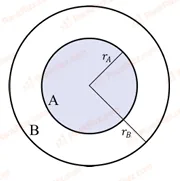
In the figure, the inner (shaded) region A represents a sphere of radius rA=1, within which the electrostatic charge density varies with the radial distance r from the center as ρA=kr, where k is positive. In the spherical shell B of outer radius rB, the electrostatic charge density varies as ρB=r2k. Assume that dimensions are taken care of. All physical quantities are in their SI units.
Which of the following statement(s) is(are) correct?
SOLUTION
The charge distribution is spherically symmetric, so we can treat every region with Gauss’s law.
1. Charge enclosed by the inner solid sphere A (rA=1)
Density: ρA=kr for 0≤r≤1. QA=∫01ρA4πr2dr=4πk∫01r3dr=4πk[4r4]01=πk
2. Charge enclosed in the shell B up to an outer radius rB
Density: ρB=r2k for 1≤r≤rB. QB=∫1rBρB4πr2dr=4π∫1rBr2kr2dr=8πk∫1rBrdr=8πk[2r2]1rB=4πk(rB2−1)
3. Total charge of the whole distribution Qtot=QA+QB=πk+4πk(rB2−1)=πk[4rB2−3]
4. Electric field outside the shell ( r > rB )
Outside the outer radius the entire charge behaves like a point charge at the centre: E(r)=4πϵ01r2Qtot,r≥rB
5. Checking each option
Case A:rB=23(≈1.225) Qtot=πk[4(3/2)−3]=πk(6−3)=3πk=0
Field outside is not zero. Option A is false.Case B:rB=23 Qtot=πk[4(9/4)−3]=πk(9−3)=6πk
Potential just outside B is V(rB+)=4πϵ01rBQtot=4πϵ013/26πk=4πϵ01(4πk)=ϵ0k
Matches the statement. Option B is correct.Case C:rB=2 Qtot=πk[4(4)−3]=πk(16−3)=13πk
The option claims 15πk, so Option C is false.Case D:rB=25 Qtot=πk[4(25/4)−3]=πk(25−3)=22πk
Field just outside is E(rB+)=4πϵ01(5/2)222πk=4πϵ0125/422πk=25ϵ022k
The option states ϵ013πk, so Option D is false.
Hence, the only correct statement is:
Option B which is: If rB=23, then the electric potential just outside B is ϵ0k.
Tagged Electric flux and Gauss's law. Machine-assigned, so read it as a strong shortlist rather than a verdict.