JEE Advanced 2024 Physics question — Electric flux and Gauss's law
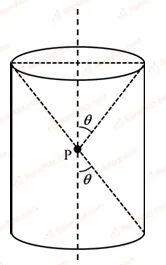
A charge is kept at the central point of a cylindrical region. The two edges subtend a half-angle at , as shown in the figure. When , then the electric flux through the curved surface of the cylinder is . If , then the electric flux through the curved surface becomes , where the value of is ________.
SOLUTION
Gauss law states that the electric flux through any open surface kept in the field of a point charge placed at the origin is proportional to the solid angle subtended by that surface at the charge:
Hence, for two different geometries of the same charge, the ratio of fluxes equals the ratio of the corresponding solid angles.
The cylindrical surface is coaxial with the charge located at its centre . Each end‐edge of the cylinder makes a half-angle with the axis (figure in the question). In spherical polar coordinates with the axis of the cylinder as the polar axis, any direction from is specified by polar angle (measured from the +z-axis) and azimuth .
• For the ray meets the top circular face.
• For the ray meets the curved surface.
• For the ray meets the bottom circular face.
Thus the curved surface subtends the full azimuth but only the polar band . The solid angle of that band is
The flux through the curved surface is therefore
Case 1: (i.e. )
Case 2: (i.e. )
The problem states that . Taking the ratio of the two fluxes:
Equating,
Therefore, the required value of is 3.
Tagged Electric flux and Gauss's law. Machine-assigned, so read it as a strong shortlist rather than a verdict.