RankRizz

Mechanical Properties of Solids — JEE Main Previous Year Questions

Every Mechanical Properties of Solids question JEE Main has set from 2004–2026, grouped by the idea it tests rather than the order of the syllabus. 126 questions across 6 distinct ideas. Free to read, answer key on every one.

Questions

126

Distinct ideas

6

Share of marks

3.4%

Difficulty

EASY

The ideas inside Mechanical Properties of Solids

A chapter is not one subject — it is a handful of procedures the examiner reuses. These are the ones Mechanical Properties of Solids questions actually test.

Every Mechanical Properties of Solids question

101–120 OF 126 · NEWEST FIRST

JEE MAIN 2019 · 08 APR S2Stress, strain, Hooke's law and Young's modulusTRANSCRIBED

Young's moduli of two wires A and B are in the ratio 7:4. Wire A is 2 m long and has radius R. Wire B is 1.5 m long and has radius 2 mm. If the two wires stretch by the same length for a given load, the value of R is close to:

  1. A

    1.3 mm

  2. B

    1.9 mm

  3. C

    1.5 mm

  4. D

    1.7 mm

JEE MAIN 2019 · 10 APR S2Stress, strain, Hooke's law and Young's modulusTRANSCRIBED

In an experiment, brass and steel wires of length 1 m each with areas of cross section 1 mm2^2 are used. The wires are connected in series and one end of the combined wire is connected to a rigid support and other end is subjected to elongation. The stress required to produce a net elongation of 0.2 mm is,
[Given, the Young's Modulus for steel and brass are, respectively, 120×109120 \times 10^9 N/m2^2 and 60×10960 \times 10^9 N/m2^2]

  1. A

    8.0×1068.0 \times 10^6 N/m2^2

  2. B

    1.2×1061.2 \times 10^6 N/m2^2

  3. C

    0.2×1060.2 \times 10^6 N/m2^2

  4. D

    1.8×1061.8 \times 10^6 N/m2^2

JEE MAIN 2019 · 12 JAN S2Stress, strain, Hooke's law and Young's modulusTRANSCRIBED

A load of mass M kg is suspended from a steel wire of length 2m and radius 1.0 mm in Searle's apparatus experiment. The increase in length produced in the wire is 4.0 mm. Now the load is fully immersed in a liquid of relative density 2. The relative density of the material of load is 8. The new value of increase in length of the steel wire is:

  1. A

    4.0 mm

  2. B

    Zero

  3. C

    5.0 mm

  4. D

    3.0 mm

JEE MAIN 2018 · 15 APR S2Modulus of rigidity and Poisson's ratioTRANSCRIBED

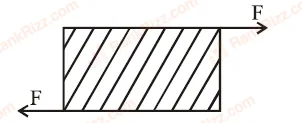
As shown in the figure, forces of 10510^5 N each are applied in opposite directions, on the upper and lower faces of a cube of side 10 cm, shifting the upper face parallel to itself by 0.5 cm. If the side of another cube of the same material is, 20 cm then under similar conditions as above, the displacement will be:

Figure for JEE Main 2018 Physics question on Modulus of rigidity and Poisson's ratio
  1. A

    1.00 cm

  2. B

    0.25 cm

  3. C

    0.37 cm

  4. D

    0.75 cm

JEE MAIN 2018 · 08 APR OFFLINEBulk modulus and compressibilityTRANSCRIBED

A solid sphere of radius r made of a soft material of bulk modulus K is surrounded by a liquid in a cylindrical container. A massless piston of area a floats on the surface of the liquid, covering entire cross-section of cylindrical container. When a mass m is placed on the surface of the piston to compress the liquid, the fractional decrement in the radius of the sphere (drr)\left(\frac{dr}{r}\right), is:

  1. A

    mgKa\frac{mg}{Ka}

  2. B

    Kamg\frac{Ka}{mg}

  3. C

    Ka3mg\frac{Ka}{3mg}

  4. D

    mg3Ka\frac{mg}{3Ka}

JEE MAIN 2017 · 02 APR OFFLINEStress, strain, Hooke's law and Young's modulusTRANSCRIBED

A man grows into a giant such that his linear dimensions increase by a factor of 9. Assuming that his density remains same, the stress in the leg will change by a factor of:

  1. A

    181\frac{1}{81}

  2. B

    9

  3. C

    19\frac{1}{9}

  4. D

    81

JEE MAIN 2017 · 08 APR ONLINEThermal stressTRANSCRIBED

A compressive force, FF is applied at the two ends of a long thin steel rod. It is heated, simultaneously, such that its temperature increases by ΔT\Delta T. The net change in its length is zero. Let ll be the length of the rod, AA its area of cross-section, YY its Young's modulus, and α\alpha its coefficient of linear expansion. Then, FF is equal to:

  1. A

    lAYαΔTlAY\alpha \Delta T

  2. B

    AYαΔTAY\alpha \Delta T

  3. C

    AYαΔT\frac{AY}{\alpha \Delta T}

  4. D

    l2YαΔTl^2 Y\alpha \Delta T

JEE MAIN 2017 · 09 APR ONLINEThermal stressTRANSCRIBED

A steel rail of length 5 m and area of cross section 40 cm2^2 is prevented from expanding along its length while the temperature rises by 10°C. If coefficient of linear expansion and Young's modulus of steel are 1.2×10−51.2 \times 10^{-5} K−1^{-1} and 2×10112 \times 10^{11} N m−2^{-2} respectively, the force developed in the rail is approximately:

  1. A

    2×1072 \times 10^7 N

  2. B

    2×1092 \times 10^9 N

  3. C

    3×10−53 \times 10^{-5} N

  4. D

    1×1051 \times 10^5 N

JEE MAIN 2017 · 02 APR OFFLINEThermal stressTRANSCRIBED

An external pressure PP is applied on a cube at 0°C so that it is equally compressed from all sides. KK is the bulk modulus of the material of the cube and α\alpha is its coefficient of linear expansion. Suppose we want to bring the cube to its original size by heating. The temperature should be raised by:

  1. A

    3PKα3PK\alpha

  2. B

    P3αK\frac{P}{3\alpha K}

  3. C

    PαK\frac{P}{\alpha K}

  4. D

    3αPK\frac{3\alpha}{PK}

JEE MAIN 2016 · 09 APR ONLINEStress, strain, Hooke's law and Young's modulusTRANSCRIBED

A uniformly tapering conical wire is made from a material of Young's modulus YY and has a normal, unextended length LL. The radii, at the upper and lower ends of this conical wire, have values RR and 3R3R, respectively. The upper end of the wire is fixed to a rigid support and a mass MM is suspended from its lower end. The equilibrium extended length, of this wire, would equal:

  1. A

    L(1+29MgπYR2)L\left(1 + \frac{2}{9}\frac{Mg}{\pi YR^2}\right)

  2. B

    L(1+19MgπYR2)L\left(1 + \frac{1}{9}\frac{Mg}{\pi YR^2}\right)

  3. C

    L(1+13MgπYR2)L\left(1 + \frac{1}{3}\frac{Mg}{\pi YR^2}\right)

  4. D

    L(1+23MgπYR2)L\left(1 + \frac{2}{3}\frac{Mg}{\pi YR^2}\right)

JEE MAIN 2016 · 10 APR ONLINEBulk modulus and compressibilityTRANSCRIBED

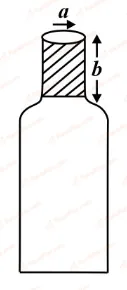
A bottle has an opening of radius a and length b. A cork of length b and radius (a+Δa)(a + \Delta a) where (Δa≪a)(\Delta a \ll a), is compressed to fit into the opening completely (see figure). If the bulk modulus of the cork is B and the coefficient of friction between the bottle and the cork is μ\mu, then the force needed to push the cork into the bottle is

Figure for JEE Main 2016 Physics question on Bulk modulus and compressibility
  1. A

    (πμBb)a(\pi \mu Bb)a

  2. B

    (2πμBb)Δa(2\pi \mu Bb) \Delta a

  3. C

    (πμBb)Δa(\pi \mu Bb) \Delta a

  4. D

    (4πμBb)Δa(4\pi \mu Bb) \Delta a

JEE MAIN 2014 · 09 APR ONLINEModulus of rigidity and Poisson's ratioTRANSCRIBED

In materials like aluminium and copper, the correct order of magnitude of various elastic modulii is:

  1. A

    Young's modulii < shear modulii < bulk modulii

  2. B

    Bulk modulii < shear modulii < Young's modulii

  3. C

    Shear modulii < Young's modulii < bulk modulii

  4. D

    Bulk modulii < Young's modulii < shear modulii

JEE MAIN 2014 · 11 APR ONLINEBulk modulus and compressibilityTRANSCRIBED

The bulk moduli of ethanol, mercury and water are given as 0.9, 25 and 2.2 respectively in units of 10910^9 Nm−2^{-2}. For a given value of pressure, the fractional compression in volume is ΔVV\frac{\Delta V}{V}. Which of the following statements about ΔVV\frac{\Delta V}{V} for these three liquids is correct?

  1. A

    Ethanol > Water > Mercury

  2. B

    Water > Ethanol > Mercury

  3. C

    Mercury > Ethanol > Water

  4. D

    Ethanol > Mercury > Water

JEE MAIN 2014 · 12 APR ONLINEModulus of rigidity and Poisson's ratioTRANSCRIBED

Steel ruptures when a shear of 3.5×1083.5 \times 10^8 N m−2^{-2} is applied. The force needed to punch a 1 cm diameter hole in a steel sheet 0.3 cm thick is nearly:

  1. A

    1.4×1041.4 \times 10^4 N

  2. B

    2.7×1042.7 \times 10^4 N

  3. C

    3.3×1043.3 \times 10^4 N

  4. D

    1.1×1041.1 \times 10^4 N

JEE MAIN 2014 · 06 APR OFFLINEThermal stressTRANSCRIBED

The pressure that has to be applied to the ends of a steel wire of length 10 cm to keep its length constant when its temperature is raised by 100 °C is: (For steel, Young's modulus is 2×10112 \times 10^{11} N m−2^{-2} and coefficient of thermal expansion is 1.1×10−51.1 \times 10^{-5} K−1^{-1})

  1. A

    2.2×1082.2 \times 10^8 Pa

  2. B

    2.2×1092.2 \times 10^9 Pa

  3. C

    2.2×1072.2 \times 10^7 Pa

  4. D

    2.2×1062.2 \times 10^6 Pa

JEE MAIN 2013 · 09 APR ONLINEStress, strain, Hooke's law and Young's modulusTRANSCRIBED

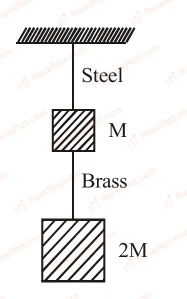
If the ratio of lengths, radii and Young's moduli of steel and brass wires in the figure are a, b and c respectively, then the corresponding ratio of increase in their lengths is :

Figure for JEE Main 2013 Physics question on Stress, strain, Hooke's law and Young's modulus
  1. A

    3c2ab2\frac{3c}{2ab^2}

  2. B

    2a2cb\frac{2a^2c}{b}

  3. C

    3a2b2c\frac{3a}{2b^2c}

  4. D

    2acb2\frac{2ac}{b^2}

JEE MAIN 2013 · 22 APR ONLINEModulus of rigidity and Poisson's ratioTRANSCRIBED

A uniform wire (Young's modulus 2×10112 \times 10^{11} Nm−2^{-2}) is subjected to longitudinal tensile stress of 5×1075 \times 10^7 Nm−2^{-2}. If the overall volume change in the wire is 0.02%, the fractional decrease in the radius of the wire is close to:

  1. A

    1.0×10−41.0 \times 10^{-4}

  2. B

    1.5×10−41.5 \times 10^{-4}

  3. C

    0.25×10−40.25 \times 10^{-4}

  4. D

    5×10−45 \times 10^{-4}

JEE MAIN 2013 · 23 APR ONLINEStress, strain, Hooke's law and Young's modulusTRANSCRIBED

A copper wire of length 1.0 m and a steel wire of length 0.5 m having equal cross-sectional areas are joined end to end. The composite wire is stretched by a certain load which stretches the copper wire by 1 mm. If the Young's modulii of copper and steel are respectively 1.0×10111.0 \times 10^{11} Nm−2^{-2} and 2.0×10112.0 \times 10^{11} Nm−2^{-2}, the total extension of the composite wire is :

  1. A

    1.75 mm

  2. B

    2.0 mm

  3. C

    1.50 mm

  4. D

    1.25 mm

JEE MAIN 2012Thermal stressTRANSCRIBED

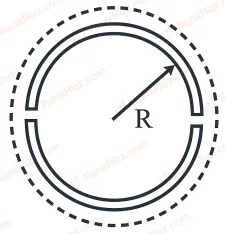
A wooden wheel of radius RR is made of two semicircular parts (see figure). The two parts are held together by a ring made of a metal strip of cross sectional area SS and length LL. LL is slightly less than 2πR2\pi R. To fit the ring on the wheel, it is heated so that its temperature rises by ΔT\Delta T and it just steps over the wheel. As it cools down to surrounding temperature, it presses the semicircular parts together. If the coefficient of linear expansion of the metal is α\alpha, and its Young's modulus is YY, the force that one part of the wheel applies on the other part is :

Figure for JEE Main 2012 Physics question on Thermal stress
  1. A

    2πSYαΔT2\pi SY\alpha\Delta T

  2. B

    SYαΔTSY\alpha\Delta T

  3. C

    πSYαΔT\pi SY\alpha\Delta T

  4. D

    2SYαΔT2SY\alpha\Delta T

JEE MAIN 2012Stress, strain, Hooke's law and Young's modulusTRANSCRIBED

A structural steel rod has a radius of 10 mm and length of 1.0 m. A 100 kN force stretches it along its length. Young's modulus of structural steel is 2×10¹¹ Nm−22 \times 10^{11}\ \text{Nm}^{-2}. The percentage strain is about

  1. A

    0.16%

  2. B

    0.32%

  3. C

    0.08%

  4. D

    0.24%