RankRizz

Centre of Mass, Momentum & Collisions — JEE Main Previous Year Questions

Every Centre of Mass, Momentum & Collisions question JEE Main has set from 2004–2026, grouped by the idea it tests rather than the order of the syllabus. 135 questions across 8 distinct ideas. Free to read, answer key on every one.

Questions

135

Distinct ideas

8

Share of marks

1.4%

Difficulty

MEDIUM

The ideas inside Centre of Mass, Momentum & Collisions

A chapter is not one subject — it is a handful of procedures the examiner reuses. These are the ones Centre of Mass, Momentum & Collisions questions actually test.

Centre of Mass, Momentum & Collisions weightage, year by year

The share of each year’s Physics questions that came from Centre of Mass, Momentum & Collisions, counted from the 168 papers we hold for the last 10 years, and session by session inside a year.

Falling: 1.4% of Physics questions in 2024–2026, down from 2.5% in 2017–2023. Its heaviest year was 2020, at 4.3%.

20267 / 4751.5%JAN 1.6%APR 1.3%
20256 / 4751.3%JAN 1.6%APR 0.9%
20249 / 6001.5%JAN 2.0%APR 1.0%
202312 / 7501.6%JAN 2.1%APR 1.1%
202214 / 6602.1%JUN 1.7%JUL 2.7%
202119 / 7202.6%FEB 2.0%MAR 4.0%JUL 2.4%AUG 2.4%
202017 / 4004.3%JAN 5.3%SEP 3.6%
201917 / 4803.5%JAN 2.9%APR 4.2%
20182 / 1201.7%4 PAPERS, ONE SESSION
20171 / 901.1%3 PAPERS, ONE SESSION

“QS” is Centre of Mass, Momentum & Collisions questions out of all Physics questions that year. A year with more sittings asks more questions, which is why the share, not the count, is the number to compare.

Centre of Mass, Momentum & Collisions: quick answers

How many Centre of Mass, Momentum & Collisions questions has JEE Main asked?

135 questions from 2004–2026. Over the last 20 papers, Centre of Mass, Momentum & Collisions carried about 1.4% of Physics marks.

Which Centre of Mass, Momentum & Collisions topics come up most?

Head-on collisions and coefficient of restitution (48 questions), Impulse and impulse-momentum theorem (24 questions), Motion of centre of mass, momentum conservation and explosions (23 questions). Start with these, they are what the examiner keeps coming back to.

Is Centre of Mass, Momentum & Collisions important for JEE Main?

Falling: 1.4% of Physics questions in 2024–2026, down from 2.5% in 2017–2023. Its heaviest year was 2020, at 4.3%. It has carried about 1.4% of Physics marks in recent papers, rated medium on our difficulty scale. The year-by-year table above shows how that has moved.

Do these Centre of Mass, Momentum & Collisions PYQs have answers and solutions?

Yes. Every question shows its official answer key, and a worked solution opens on the question’s own page wherever we have one. Reading and checking answers is free, no sign-up needed.

What’s the fastest way to revise Centre of Mass, Momentum & Collisions?

Do one past question per idea first: Centre of Mass, Momentum & Collisions has 8 distinct ideas, listed above. Then practise the topics you get wrong, or build a timed test from this chapter.

Every Centre of Mass, Momentum & Collisions question

1–20 OF 135 · NEWEST FIRST

JEE MAIN 2026 · 23 JAN S2Motion of centre of mass, momentum conservation and explosionsTRANSCRIBED

A body of mass 14 kg initially at rest explodes and breaks into three fragments of masses in the ratio 2 : 2 : 3. The two pieces of equal masses fly off perpendicular to each other with a speed of 18 m/s each. The velocity of the heavier fragment is ______m/s.

  1. A

    12212\sqrt{2}

  2. B

    10210\sqrt{2}

  3. C

    12

  4. D

    24224\sqrt{2}

JEE MAIN 2026 · 06 APR S2Motion of centre of mass, momentum conservation and explosionsTRANSCRIBED

Two identical bodies A and B of equal masses have initial velocities v1⃗=4i^\vec{v_1} = 4\hat{i} m/s and v2⃗=4j^\vec{v_2} = 4\hat{j} m/s respectively. The body A has acceleration a1⃗=6i^+6j^\vec{a_1} = 6\hat{i} + 6\hat{j} m/s2^2 while the acceleration of the other body B is zero. The centre of mass of the two bodies moves in __________ path.

  1. A

    circular

  2. B

    parabolic

  3. C

    straight line

  4. D

    elliptical

JEE MAIN 2026 · 23 JAN S1Head-on collisions and coefficient of restitutionTRANSCRIBED

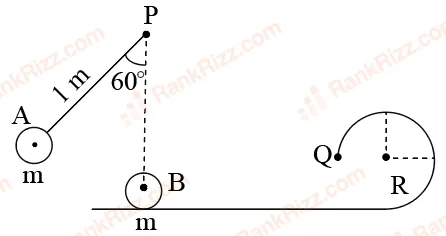
A small bob A of mass m is attached to a massless rigid rod of length 1 m pivoted at point P and kept at an angle of 60° with vertical as shown in figure. At distance of 1 m below point P, an identical bob B is kept at rest on a smooth horizontal surface that extends to a circular track of radius R as shown in figure. If bob B just manages to complete the circular path of radius R upto a point Q after being hit elastically by bob A, then radius R is ____ m.

Figure for JEE Main 2026 Physics question on Head-on collisions and coefficient of restitution
  1. A

    2+35\frac{2+\sqrt{3}}{5}

  2. B

    2−35\frac{2-\sqrt{3}}{5}

  3. C

    35\frac{3}{5}

  4. D

    15\frac{1}{5}

JEE MAIN 2026 · 02 APR S2Motion of centre of mass, momentum conservation and explosionsTRANSCRIBED

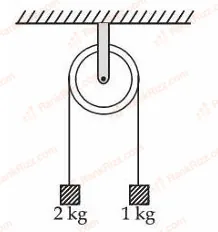
Two blocks of masses 2 kg and 1 kg respectively, are tied to the ends of a string which passes over a light frictionless pulley as shown in the figure. The masses are held at rest at the same horizontal level and then released. The distance traversed by the centre of mass in 2 s is _________ m. (Take g=10g = 10 m/s2^2)

Figure for JEE Main 2026 Physics question on Motion of centre of mass, momentum conservation and explosions
  1. A

    3.333.33

  2. B

    3.123.12

  3. C

    2.222.22

  4. D

    1.421.42

JEE MAIN 2026 · 06 APR S1Centre of mass of a system of particlesTRANSCRIBED

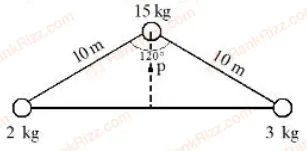
The position of center of mass of three masses 2 kg, 3 kg and 15 kg placed with respect to mid point (p) of normal bisector, as shown in the figure is _______.

Figure for JEE Main 2026 Physics question on Centre of mass of a system of particles
  1. A

    (34,1.25)\left(\frac{\sqrt{3}}{4}, 1.25\right)

  2. B

    (34,1.0)\left(\frac{\sqrt{3}}{4}, 1.0\right)

  3. C

    (0,0)(0, 0)

  4. D

    (1.25,0)(1.25, 0)

JEE MAIN 2026 · 22 JAN S2Motion of centre of mass, momentum conservation and explosionsTRANSCRIBED

Given below are two statements:
Statement I : For a mechanical system of many particles total kinetic energy is the sum of kinetic energies of all the particles.
Statement II: The total kinetic energy can be the sum of kinetic energy of the center of mass w.r.t to the origin and the kinetic energy of all the particles w.r.t. the center of mass as the reference.
In the light of the above statements, choose the correct answer from the options given below :

  1. A

    Both Statement I a:nd Statement II are false

  2. B

    Statement I is false but Statement II is true

  3. C

    Both Statement I and Statement II are true

  4. D

    Statement I is true but Statement II is false

JEE MAIN 2026 · 23 JAN S1Head-on collisions and coefficient of restitutionTRANSCRIBED

In a perfectly inelastic collision, two spheres made of the same material with masses 15 kg and 25 kg, moving in opposite directions with speeds of 10 m/s and 30 m/s, respectively, strike each other and stick together. The rise in temperature (in ∘C^{\circ}C), if all the heat produced during the collision is retained by these spheres, is :
(specific heat of sphere material 31 cal/kg.∘C^{\circ}C and 1 cal =4.2 J)

  1. A

    1.75

  2. B

    1.15

  3. C

    1.95

  4. D

    1.44

JEE MAIN 2025 · 29 JAN S2Head-on collisions and coefficient of restitutionTRANSCRIBED

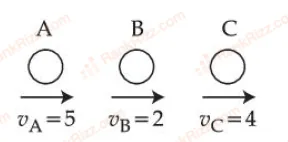
Given below are two statements. One is labelled as Assertion (A) and the other is labelled as Reason (R).
page3_img1


Assertion (A) :
Three identical spheres of same mass undergo one dimensional motion as shown in figure with initial velocities vA=5 m/s,  vB=2 m/s,  vC=4 m/sv_A = 5\,\text{m/s},\; v_B = 2\,\text{m/s},\; v_C = 4\,\text{m/s}. If we wait sufficiently long for elastic collision to happen, then vA=4 m/s,  vB=2 m/s,  vC=5 m/sv_A = 4\,\text{m/s},\; v_B = 2\,\text{m/s},\; v_C = 5\,\text{m/s}, will be the final velocities.
Reason (R): In an elastic collision between identical masses, two objects exchange their velocities. In the light of the above statements, choose the correct answer from the options given below :
  1. A

    (A) is false but (R) is true

  2. B

    Both (A) and (R) are true but (R) is NOT the correct explanation of (A)

  3. C

    Both (A) and (R) are true and (R) is the correct explanation of (A)

  4. D

    (A) is true but (R) is false

JEE MAIN 2025 · 29 JAN S1Head-on collisions and coefficient of restitutionTRANSCRIBED

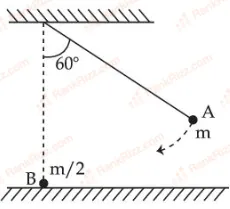
As shown below, bob A of a pendulum having massless string of length 'R' is released from 60∘60^{\circ} to the vertical. It hits another bob B of half the mass that is at rest on a friction less table in the center. Assuming elastic collision, the magnitude of the velocity of bob A after the collision will be (take g as acceleration due to gravity.)

page4_img1
  1. A

    43Rg\frac{4}{3}\sqrt{Rg}

  2. B

    23Rg\frac{2}{3}\sqrt{Rg}

  3. C

    Rg\sqrt{Rg}

  4. D

    13Rg\frac{1}{3}\sqrt{Rg}

JEE MAIN 2025 · 07 APR S1Centre of mass of continuous bodies and cavitiesTRANSCRIBED

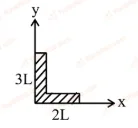
A rod of length 5L is bent right angle keeping one side length as 2L.

Figure for JEE Main 2025 Physics question on Centre of mass of continuous bodies and cavities

The position of the centre of mass of the system: (Consider L = 10 cm)

  1. A

    2i^+3j^2\hat{i} + 3\hat{j}

  2. B

    3i^+7j^3\hat{i} + 7\hat{j}

  3. C

    5i^+8j^5\hat{i} + 8\hat{j}

  4. D

    4i^+9j^4\hat{i} + 9\hat{j}

JEE MAIN 2025 · 23 JAN S1Centre of mass of continuous bodies and cavitiesTRANSCRIBED

Consider a circular disc of radius 20 cm with centre located at the origin. A circular hole of radius 5 cm is cut from this disc in such a way that the edge of the hole touches the edge of the disc. The distance of centre of mass of residual or remaining disc from the origin will be

  1. A

    2.0 cm

  2. B

    1.5 cm

  3. C

    1.0 cm

  4. D

    0.5 cm

JEE MAIN 2025 · 03 APR S2Two-body systems connected by springsTRANSCRIBED
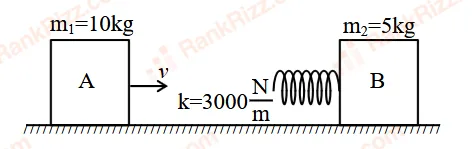
Figure for JEE Main 2025 Physics question on Two-body systems connected by springs

Consider two blocks A and B of masses m1=10m_1 = 10 kg and m2=5m_2 = 5 kg that are placed on a frictionless table. The block A moves with a constant speed v=3v = 3 m/s towards the block B kept at rest. A spring with spring constant k=3000k = 3000 N/m is attached with the block B as shown in the figure. After the collision, suppose that the blocks A and B, along with the spring in constant compression state, move together, then the compression in the spring is, (Neglect the mass of the spring)

  1. A

    0.2 m

  2. B

    0.4 m

  3. C

    0.1 m

  4. D

    0.3 m

JEE MAIN 2025 · 28 JAN S1Centre of mass of continuous bodies and cavitiesTRANSCRIBED

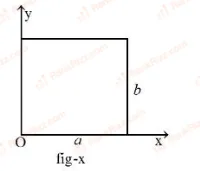
The center of mass of a thin rectangular plate (fig - x) with sides of length a and b, whose mass per unit area (σ)(\sigma) varies as σ=σ∘xab\sigma = \frac{\sigma_{\circ}x}{ab} (where σ∘\sigma_{\circ} is a constant), would be

page7_img1
  1. A

    (23a,b2)\left(\frac{2}{3}a,\frac{b}{2}\right)

  2. B

    (a2,b2)\left(\frac{a}{2},\frac{b}{2}\right)

  3. C

    (13a,b2)\left(\frac{1}{3}a,\frac{b}{2}\right)

  4. D

    (23a,23b)\left(\frac{2}{3}a,\frac{2}{3}b\right)

JEE MAIN 2024 · 27 JAN S1Motion of centre of mass, momentum conservation and explosionsTRANSCRIBED

Two bodies of mass 44 g and 2525 g are moving with equal kinetic energies. The ratio of magnitude of their linear momentum is :

  1. A

    3:53 : 5

  2. B

    5:45 : 4

  3. C

    2:52 : 5

  4. D

    4:54 : 5

JEE MAIN 2024 · 08 APR S1Head-on collisions and coefficient of restitutionTRANSCRIBED

A stationary particle breaks into two parts of masses mAm_A and mBm_B which move with velocities vAv_A and vBv_B respectively. The ratio of their kinetic energies (KB:KA)(K_B : K_A) is :

  1. A

    vB:vAv_B : v_A

  2. B

    mB:mAm_B : m_A

  3. C

    mBvB:mAvAm_B v_B : m_A v_A

  4. D

    1:11 : 1

JEE MAIN 2024 · 01 FEB S1Head-on collisions and coefficient of restitutionTRANSCRIBED

A simple pendulum of length 11 m has a wooden bob of mass 11 kg. It is struck by a bullet of mass 10−210^{-2} kg moving with a speed of 2×10²² \times 10^{2} m s−1^{-1}. The bullet gets embedded into the bob. The height to which the bob rises before swinging back is. (use g=10g = 10 m s−2^{-2})

  1. A

    0.300.30 m

  2. B

    0.200.20 m

  3. C

    0.350.35 m

  4. D

    0.400.40 m

JEE MAIN 2024 · 27 JAN S1Impulse and impulse-momentum theoremTRANSCRIBED

A body of mass 10001000 kg is moving horizontally with a velocity 6 m s−16 \text{ m s}^{-1}. If 200200 kg extra mass is added, the final velocity (in m s−1\text{m s}^{-1}) is:

  1. A

    6

  2. B

    2

  3. C

    3

  4. D

    5

JEE MAIN 2024 · 30 JAN S1Motion of centre of mass, momentum conservation and explosionsTRANSCRIBED

A spherical body of mass 100 g100 \text{ g} is dropped from a height of 10 m10 \text{ m} from the ground. After hitting the ground, the body rebounds to a height of 5 m5 \text{ m}. The impulse of force imparted by the ground to the body is given by: (given g=9.8 m s−2g = 9.8 \text{ m s}^{-2})

  1. A

    4.32 kg m s−14.32 \text{ kg m s}^{-1}

  2. B

    43.2 kg m s−143.2 \text{ kg m s}^{-1}

  3. C

    23.9 kg m s−123.9 \text{ kg m s}^{-1}

  4. D

    2.39 kg m s−12.39 \text{ kg m s}^{-1}

JEE MAIN 2024 · 31 JAN S1Motion of centre of mass, momentum conservation and explosionsTRANSCRIBED

An artillery piece of mass M1M_1 fires a shell of mass M2M_2 horizontally. Instantaneously after the firing, the ratio of kinetic energy of the artillery and that of the shell is :

  1. A

    M1(M1+M2)\frac{M_1}{(M_1 + M_2)}

  2. B

    M2M1\frac{M_2}{M_1}

  3. C

    M2(M1+M2)\frac{M_2}{(M_1 + M_2)}

  4. D

    M1M2\frac{M_1}{M_2}

JEE MAIN 2024 · 01 FEB S1Centre of mass of a system of particlesTRANSCRIBED

The identical spheres each of mass 2M2M are placed at the corners of a right angled triangle with mutually perpendicular sides equal to 44 m each. Taking point of intersection of these two sides as origin, the magnitude of position vector of the centre of mass of the system is 42x\frac{4\sqrt{2}}{x}, where the value of xx is ________.