Mechanical Properties of Solids — JEE Main Previous Year Questions
Every Mechanical Properties of Solids question JEE Main has set from 2004–2026, grouped by the idea it tests rather than the order of the syllabus. 126 questions across 6 distinct ideas. Free to read, answer key on every one.
A chapter is not one subject — it is a handful of procedures the examiner reuses. These are the ones Mechanical Properties of Solids questions actually test.
JEE MAIN 2021 · 31 AUG S2Stress, strain, Hooke's law and Young's modulusTRANSCRIBED
Four identical hollow cylindrical columns of mild steel support a big structure of mass 50×103 kg. The inner and outer radii of each column are 50 cm and 100 cm respectively. Assuming uniform local distribution, calculate the compression strain of each column. [use Y=2.0×10¹¹ Pa, g=9.8 m s−2]
JEE MAIN 2021 · 26 AUG S2Stress, strain, Hooke's law and Young's modulusTRANSCRIBED
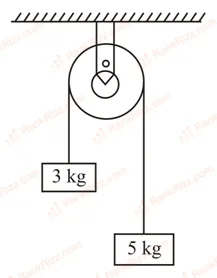
Two blocks of masses 3 kg and 5 kg are connected by a metal wire going over a smooth pulley. The breaking stress of the metal is π24×102 N m−2. What is the minimum radius of the wire?
JEE MAIN 2021 · 27 JUL S1Elastic potential energy in stretched wiresTRANSCRIBED
A stone of mass 20 g is projected from a rubber catapult of length 0.1 m and area of cross section 10−6 m2 stretched by an amount 0.04 m. The velocity of the projected stone is _________ m s−1. (Young's modulus of rubber = 0.5×10⁹ N m−2)
JEE MAIN 2021 · 27 AUG S2Stress, strain, Hooke's law and Young's modulusTRANSCRIBED
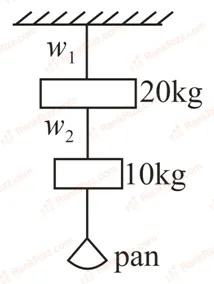
Wires W1 and W2 are made of same material having the breaking stress of 1.25×10⁹ N m−2. W1 and W2 have cross-sectional area of 8×10⁻⁷ m2 and 4×10⁻⁷ m2, respectively. Masses of 20 kg and 10 kg hang from them as shown in the figure. The maximum mass that can be placed in the pan without breaking the wires is _________ kg (Use g = 10 m s−2)
JEE MAIN 2021 · 24 FEB S2Stress, strain, Hooke's law and Young's modulusTRANSCRIBED
A uniform metallic wire is elongated by 0.04 m when subjected to a linear force F. The elongation, if its length and diameter is doubled and subjected to the same force will be ______ cm.
JEE MAIN 2021 · 31 AUG S1Bulk modulus and compressibilityTRANSCRIBED
When a rubber ball is taken to a depth of _________ m in deep sea, its volume decreases by 0.5%. (The bulk modulus of rubber = 9.8×10⁸ N m−2, Density of sea water = 103 kg m−3, g = 9.8 m s−2)
JEE MAIN 2021 · 22 JUL S1Thermal stressTRANSCRIBED
The area of cross-section of a railway track is 0.01 m2. The temperature variation is 10 ∘C. Coefficient of linear expansion of material of track is 10−5∘C−1. The energy stored per meter in the track is J m−1. (Young's modulus of material of track is 1011 N m−2)
JEE MAIN 2021 · 01 SEP S2Thermal stressTRANSCRIBED
A steel rod with y=2.0×10¹¹ N m−2 and α=10−5 °C−1 of length 4 m and area of cross-section 10 cm2 is heated from 0°C to 400°C without being allowed to extend. The tension produced in the rod is x×105 N where the value of x is _________.
JEE MAIN 2020 · 09 JAN S2Elastic potential energy in stretched wiresTRANSCRIBED
Two steel wires having same length are suspended from a ceiling under the same load. If the ratio of their energy stored per unit volume is 1 : 4, the ratio of their diameters is:
JEE MAIN 2020 · 06 SEP S1Stress, strain, Hooke's law and Young's modulusTRANSCRIBED
An object of mass m is suspended at the end of a massless wire of length L and area of cross-section, A. Young modulus of the material of the wire is Y. If the mass is pulled down slightly its frequency of oscillation along the vertical direction is:
JEE MAIN 2020 · 04 SEP S2Bulk modulus and compressibilityTRANSCRIBED
A cube of metal is subjected to a hydrostatic pressure 4 GPa. The percentage change in the length of the side of the cube is close to: (Given bulk modulus of metal, B=8×10¹⁰ Pa)
JEE MAIN 2020 · 09 JAN S1Stress, strain, Hooke's law and Young's modulusTRANSCRIBED
A body of mass m=10 kg is attached to one end of a wire of length 0.3 m. What is the maximum angular speed (in rad s−1) with which it can be rotated about its other end in a space station without breaking the wire? [Breaking stress of wire (σ)=4.8×10⁷ N m−2 and area of cross-section of the wire =10−2cm2]
JEE MAIN 2019 · 08 APR S1Elastic potential energy in stretched wiresTRANSCRIBED
A boy's catapult is made of rubber cord which is 42 cm long, with 6 mm diameter of cross-section and of negligible mass. The boy keeps a stone weighing 0.02 kg on it and stretches the cord by 20 cm by applying a constant force. When released, the stone flies off with a velocity of 20 ms−1. Neglect the change in the area of cross-section of the cord while stretched. The Young's modulus of rubber is closest to:
JEE MAIN 2019 · 12 APR S1Thermal stressTRANSCRIBED
At 40°C, a brass wire of 1 mm radius is hung from the ceiling. A small mass, M is hung from the free end of the wire. When the wire is cooled down from 40°C to 20°C it regains its original length of 0.2 m. The value of M is close to: (Coefficient of linear expansion of brass are 10−5/°C and Young's modulus of brass is 1011 N/m2, respectively; g = 10 m s−2)
JEE MAIN 2019 · 08 APR S1Stress, strain, Hooke's law and Young's modulusTRANSCRIBED
A steel wire having a radius of 2.0 mm, carrying a load of 4 kg, is hanging from a ceiling. Given that g = 3.1π m s−2, what will be the tensile stress that would be developed in the wire?
JEE MAIN 2019 · 10 APR S2Stress, strain, Hooke's law and Young's modulusTRANSCRIBED
The elastic limit of brass is 379 MPa. The minimum diameter of a brass rod if it is to support a 400 N load without exceeding its elastic limit will be
JEE MAIN 2019 · 12 APR S2Thermal stressTRANSCRIBED
A uniform cylindrical rod of length L and radius r, is made from a material whose Young's modulus of Elasticity equals Y. When this rod is heated by temperature T and simultaneously subjected to a net longitudinal compressional force F, its length remains unchanged. The coefficient of volume expansion, of the material of the rod, is (nearly) equal to:
JEE MAIN 2019 · 09 JAN S1Thermal stressTRANSCRIBED
A rod, of length L at room temperature and uniform area of cross section A, is made of a metal having coefficient of linear expansion α /∘C. It is observed that an external compressive force F is applied on each of its ends, prevents any change in the length of the rod when its temperature rises by ΔT K. Young's modulus, Y for this metal is: