RankRizz

Thermal stress — JEE Main Previous Year Questions

Every JEE Main question on Thermal stress, one of the ideas inside Mechanical Properties of Solids: 14 questions from 2012–2026, 3 of them in the last five years. Newest first, answer key on every one. Free to read.

Questions

14

Years asked

7

Since

2012

Of the chapter

11%

When JEE Main asked it

Questions on Thermal stress in each year it was asked.

20261
20232
20213
20193
20173
20141
20121

Every Thermal stress question

1–14 OF 14 · NEWEST FIRST

JEE MAIN 2026 · 24 JAN S1Thermal stressTRANSCRIBED

A brass wire of length 2 m and radius 1 mm at 27 °C is held taut between two rigid supports. Initially, it was cooled to a temperature of -43 °C, creating a tension T in the wire. The temperature to which the wire has to be cooled in order to increase the tension in it to 1.4T, is ____ °C.

  1. A

    -80

  2. B

    -86

  3. C

    -65

  4. D

    -71

JEE MAIN 2023 · 08 APR S2Thermal stressTRANSCRIBED

A steel rod of length 1 m and cross-sectional area 10−410^{-4} m2^2 is heated from 0∘^\circC to 200∘^\circC without being allowed to extend or bend. The compressive tension produced in the rod is _______ ×104\times 10^4 N. (Given Young's modulus of steel =2×1011= 2 \times 10^{11} N m−2^{-2}, coefficient of linear expansion =10−5= 10^{-5} K−1^{-1})

JEE MAIN 2023 · 31 JAN S1Thermal stressTRANSCRIBED

A thin rod having a length of 1 m and area of cross-section 3×10−63 \times 10^{-6} m2^2 is suspended vertically from one end. The rod is cooled from 210°C to 160°C. After cooling, a mass MM is attached at the lower end of the rod such that the length of rod again becomes 1 m. Young's modulus and coefficient of linear expansion of the rod are 2×10112 \times 10^{11} N m−2^{-2} and 2×10−52 \times 10^{-5} K−1^{-1}, respectively. The value of MM is ______ kg. (Take g=10g = 10 m s−2^{-2})

JEE MAIN 2021 · 25 FEB S1Thermal stressTRANSCRIBED

Given below are two statements: one is labelled as Assertion A and the other is labelled as Reason R.
Assertion A: When a rod lying freely is heated, no thermal stress is developed in it.
Reason R: On heating, the length of the rod increases.
In the light of the above statements, choose the correct answer from the options given below:

  1. A

    Both A and R are true and R is the correct explanation of A

  2. B

    A is false but R is true

  3. C

    Both A and R are true but R is NOT the correct explanation of A

  4. D

    A is true but R is false

JEE MAIN 2021 · 22 JUL S1Thermal stressTRANSCRIBED

The area of cross-section of a railway track is 0.01 m2^2. The temperature variation is 10 ∘^\circC. Coefficient of linear expansion of material of track is 10−510^{-5} ∘^\circC−1^{-1}. The energy stored per meter in the track is J m−1^{-1}. (Young's modulus of material of track is 101110^{11} N m−2^{-2})

JEE MAIN 2021 · 01 SEP S2Thermal stressTRANSCRIBED

A steel rod with y=2.0×10¹¹y = 2.0 \times 10^{11} N m−2^{-2} and α=10−5\alpha = 10^{-5} °C−1^{-1} of length 4 m and area of cross-section 10 cm2^2 is heated from 0°C to 400°C without being allowed to extend. The tension produced in the rod is x×105x \times 10^5 N where the value of xx is _________.

JEE MAIN 2019 · 12 APR S1Thermal stressTRANSCRIBED

At 40°C, a brass wire of 1 mm radius is hung from the ceiling. A small mass, M is hung from the free end of the wire. When the wire is cooled down from 40°C to 20°C it regains its original length of 0.2 m. The value of M is close to:
(Coefficient of linear expansion of brass are 10−510^{-5}/°C and Young's modulus of brass is 101110^{11} N/m2^2, respectively; g = 10 m s−2^{-2})

  1. A

    0.9 kg

  2. B

    0.5 kg

  3. C

    1.5 kg

  4. D

    9 kg

JEE MAIN 2019 · 12 APR S2Thermal stressTRANSCRIBED

A uniform cylindrical rod of length L and radius r, is made from a material whose Young's modulus of Elasticity equals Y. When this rod is heated by temperature T and simultaneously subjected to a net longitudinal compressional force F, its length remains unchanged. The coefficient of volume expansion, of the material of the rod, is (nearly) equal to:

  1. A

    F/(3πr2YT)F/(3\pi r^2 YT)

  2. B

    9F/(πr2YT)9F/(\pi r^2 YT)

  3. C

    6F/(πr2YT)6F/(\pi r^2 YT)

  4. D

    3F/(πr2YT)3F/(\pi r^2 YT)

JEE MAIN 2019 · 09 JAN S1Thermal stressTRANSCRIBED

A rod, of length LL at room temperature and uniform area of cross section AA, is made of a metal having coefficient of linear expansion α\alpha /∘^{\circ}C. It is observed that an external compressive force FF is applied on each of its ends, prevents any change in the length of the rod when its temperature rises by ΔT\Delta T K. Young's modulus, YY for this metal is:

  1. A

    FAαΔT−273\frac{F}{A\alpha \Delta T - 273}

  2. B

    2FAαΔT\frac{2F}{A\alpha \Delta T}

  3. C

    FAαΔT\frac{F}{A\alpha \Delta T}

  4. D

    F2AαΔT\frac{F}{2A\alpha \Delta T}

JEE MAIN 2017 · 08 APR ONLINEThermal stressTRANSCRIBED

A compressive force, FF is applied at the two ends of a long thin steel rod. It is heated, simultaneously, such that its temperature increases by ΔT\Delta T. The net change in its length is zero. Let ll be the length of the rod, AA its area of cross-section, YY its Young's modulus, and α\alpha its coefficient of linear expansion. Then, FF is equal to:

  1. A

    lAYαΔTlAY\alpha \Delta T

  2. B

    AYαΔTAY\alpha \Delta T

  3. C

    AYαΔT\frac{AY}{\alpha \Delta T}

  4. D

    l2YαΔTl^2 Y\alpha \Delta T

JEE MAIN 2017 · 09 APR ONLINEThermal stressTRANSCRIBED

A steel rail of length 5 m and area of cross section 40 cm2^2 is prevented from expanding along its length while the temperature rises by 10°C. If coefficient of linear expansion and Young's modulus of steel are 1.2×10−51.2 \times 10^{-5} K−1^{-1} and 2×10112 \times 10^{11} N m−2^{-2} respectively, the force developed in the rail is approximately:

  1. A

    2×1072 \times 10^7 N

  2. B

    2×1092 \times 10^9 N

  3. C

    3×10−53 \times 10^{-5} N

  4. D

    1×1051 \times 10^5 N

JEE MAIN 2017 · 02 APR OFFLINEThermal stressTRANSCRIBED

An external pressure PP is applied on a cube at 0°C so that it is equally compressed from all sides. KK is the bulk modulus of the material of the cube and α\alpha is its coefficient of linear expansion. Suppose we want to bring the cube to its original size by heating. The temperature should be raised by:

  1. A

    3PKα3PK\alpha

  2. B

    P3αK\frac{P}{3\alpha K}

  3. C

    PαK\frac{P}{\alpha K}

  4. D

    3αPK\frac{3\alpha}{PK}

JEE MAIN 2014 · 06 APR OFFLINEThermal stressTRANSCRIBED

The pressure that has to be applied to the ends of a steel wire of length 10 cm to keep its length constant when its temperature is raised by 100 °C is: (For steel, Young's modulus is 2×10112 \times 10^{11} N m−2^{-2} and coefficient of thermal expansion is 1.1×10−51.1 \times 10^{-5} K−1^{-1})

  1. A

    2.2×1082.2 \times 10^8 Pa

  2. B

    2.2×1092.2 \times 10^9 Pa

  3. C

    2.2×1072.2 \times 10^7 Pa

  4. D

    2.2×1062.2 \times 10^6 Pa

JEE MAIN 2012Thermal stressTRANSCRIBED

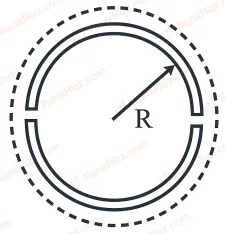
A wooden wheel of radius RR is made of two semicircular parts (see figure). The two parts are held together by a ring made of a metal strip of cross sectional area SS and length LL. LL is slightly less than 2πR2\pi R. To fit the ring on the wheel, it is heated so that its temperature rises by ΔT\Delta T and it just steps over the wheel. As it cools down to surrounding temperature, it presses the semicircular parts together. If the coefficient of linear expansion of the metal is α\alpha, and its Young's modulus is YY, the force that one part of the wheel applies on the other part is :

Figure for JEE Main 2012 Physics question on Thermal stress
  1. A

    2πSYαΔT2\pi SY\alpha\Delta T

  2. B

    SYαΔTSY\alpha\Delta T

  3. C

    πSYαΔT\pi SY\alpha\Delta T

  4. D

    2SYαΔT2SY\alpha\Delta T