RankRizzStart free

Wave Optics — JEE Main Previous Year Questions

Every Wave Optics question JEE Main has set, grouped by the idea it tests rather than the order of the syllabus. 198 questions across 6 distinct ideas. Free to read, answer key on every one.

Questions

198

Distinct ideas

6

Share of marks

4.8%

Difficulty

MEDIUM

The ideas inside Wave Optics

A chapter is not one subject — it is a handful of procedures the examiner reuses. These are the ones Wave Optics questions actually test.

01Wavefronts and Huygens' principleset 50×
02Young's double slit experiment: fringe width and intensityset 68×
03YDSE with slabs, white light and modified setupsset 1×
04Single slit diffractionset 29×
05Resolving power of microscopes and telescopesset 12×
06Polarisation: Malus's law and Brewster's lawset 38×

Every Wave Optics question

1–20 OF 198 · NEWEST FIRST

JEE MAIN 2026 · 22 JAN S2Wavefronts and Huygens' principleTRANSCRIBED

The wavelength of light, while it is passing through water is 540 nm. The refractive index of water is . The wavelength of the same light when it is passing through a transparent medium having refractive index of is ____________nm.

  1. A

    840

  2. B

    380

  3. C

    480

  4. D

    540

JEE MAIN 2026 · 24 JAN S2Wavefronts and Huygens' principleTRANSCRIBED

In the Young's double slit experiment the intensity produced by each one of the individual slits is The distance between two slits is 2 mm . The distance of screen from slits is 10 m. The wavelength of light is . The intensity of light on the screen in front of one of the slits is __________.

  1. A

  2. B

  3. C

  4. D

JEE MAIN 2026 · 21 JAN S2Wavefronts and Huygens' principleTRANSCRIBED

Given below are two statements :
Statement I : In a Young's double slit experiment, the angular separation of fringes will increase as the screen is moved away from the plane of the slits
Statement II: In a Young's double slit experiment, the angular separation of fringes will increase when monochromatic source is replaced by another monochromatic source of higher wavelength
In the light of the above statements, choose the correct answer from the options given below :

  1. A

    Both Statement I and Statement II are true

  2. B

    Statement I is false but Statement II is true

  3. C

    Both Statement I and Statement II are false

  4. D

    Statement I is true but Statement II is false

JEE MAIN 2026 · 21 JAN S1Young's double slit experiment: fringe width and intensityTRANSCRIBED

In a double slit experiment the distance between the slits is 0.1 cm and the screen is placed at 50 cm from the slits plane. When one slit is covered with a transparent sheet having thickness t and refractive index n(=1.5), the central fringe shifts by 0.2 cm. The value of t is____ cm

  1. A

  2. B

  3. C

  4. D

JEE MAIN 2026 · 24 JAN S1Polarisation: Malus's law and Brewster's lawTRANSCRIBED

Au unpolarised light is incident at an inteiface of two dielectric media having refractive indices of 2 (incident medium) and (medium) respectively. To satisfy the condition that reflected and refracted rays are perpendicular to each other, the angle of incidence is ___.

  1. A

  2. B

  3. C

  4. D

JEE MAIN 2026 · 04 APR S1Single slit diffractionTRANSCRIBED

A slit of width is illuminated by light of wavelength . The linear separation between 1st and 3rd minima in the diffraction pattern produced on a screen placed at a distance from the slit system is :

  1. A

  2. B

  3. C

  4. D

JEE MAIN 2026 · 06 APR S1Young's double slit experiment: fringe width and intensityTRANSCRIBED

In interference experiment the path difference between two interfering waves at a point on the screen is , where is the wavelength of these waves, and at another point the path difference is . The ratio of intensities at points and is _______.

  1. A

    3

  2. B

    4

  3. C

    1/3

  4. D

    1/4

JEE MAIN 2026 · 23 JAN S2Polarisation: Malus's law and Brewster's lawTRANSCRIBED

When an unpolarized light falls at a particular angle on a glass plate (placed in air), it is observed that the reflected beam is linearly polarized. The angle of refracted
beam with respect to the normal is ______ .

( (1.52) = , refractive indices of air and glass are 1.00 and 1.52, respectively.)

  1. A

  2. B

  3. C

  4. D

JEE MAIN 2026 · 05 APR S1Young's double slit experiment: fringe width and intensityTRANSCRIBED

In Young's double slit experiment, the fringe width of the interference pattern produced on the screen is 2.4 m. If the experiment is carried out in another medium having refractive index 1.2, the fringe width will be _______ m.

  1. A


  2. B


  3. C

  4. D

JEE MAIN 2026 · 04 APR S2Polarisation: Malus's law and Brewster's lawTRANSCRIBED

An unpolarized light of certain intensity passes through a combination of two polarizers whose transmission axes are at 30° and 90°, respectively, with respect to the horizontal axis. A third polarizer with its transmission axis at 60° with the horizontal axis is placed between the two existing polarizers. The ratio of the output intensities with and without the third polarizer is ______.

  1. A

  2. B

  3. C

  4. D

JEE MAIN 2026 · 05 APR S2Young's double slit experiment: fringe width and intensityTRANSCRIBED

The maximum intensity in a Young's double slit experiment is , distance between the slits (d) is  , where is the wavelength of light used. The intensity of the fringe, exactly opposite to one of the slits on the screen, placed at  is_________.

  1. A

  2. B

  3. C

  4. D

JEE MAIN 2026 · 04 APR S1Resolving power of microscopes and telescopesTRANSCRIBED

A telescope with objective diameter is used to observe a distant star emitting light of wavelength 500 nm, at a resolution of radian. The value of is _____ cm.

  1. A

  2. B

  3. C

  4. D

JEE MAIN 2026 · 22 JAN S2Single slit diffractionTRANSCRIBED

Which of the following are true for a single slit diffraction?
A. Width of central maxima increases with increase in wavelength keeping slit width constant.
B. Width of central maxima increases with decrease in wavelength keeping slit width constant.
C. Width of central maxima increases with decrease in slit width at constant wavelength.
D. Width of central maxima increases with increase in slit width at constant wavelength.
E. Brightness of central maxima increases for decrease in wavelength at constant slit width.

  1. A

    A, C, E only

  2. B

    A., D only

  3. C

    B, C only

  4. D

    B, D only

JEE MAIN 2026 · 28 JAN S1Wavefronts and Huygens' principleTRANSCRIBED

Given below are two statements:
Statement I: A plane wave after passing through prism remains as plane wave but passing through small pin hole may become spherical wave.
Statement II: The curvature of a spherical wave emerging from a slit will increase for increasing slit wridth
In the light of the above statements, choose the correct answer from the options given below

  1. A

    Both Statement I and Statement II are true

  2. B

    Statement I is false but Statement II is true

  3. C

    Statement I is true but Statement II is false

  4. D

    Both Statement I and Statement II are false

JEE MAIN 2026 · 04 APR S1Polarisation: Malus's law and Brewster's lawTRANSCRIBED

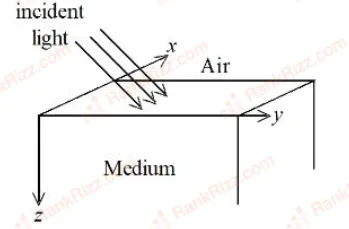
An unpolarized light is incident on the plane interface of air-dielectric medium shown in figure. If the incident angle is equal to Brewster angle, identify the expression representing reflected wave.

image
  1. A

  2. B

  3. C

  4. D

JEE MAIN 2026 · 06 APR S2Young's double slit experiment: fringe width and intensityTRANSCRIBED

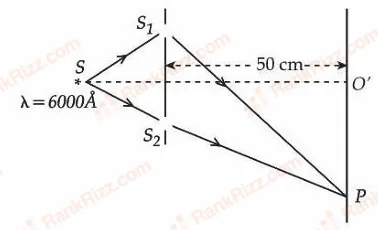
In a Young double slit experiment, the wavelength of incident light is 6000 Å. The separation between slits and is 5 cm and the distance between slits plane and screen is 50 cm, as shown in the figure below. If the resultant intensity at P is equal to the intensity due to individual slits, the path difference between interfering waves is __________ Å.

image
  1. A

    4000

  2. B

    3000

  3. C

    2000

  4. D

    1000

JEE MAIN 2026 · 02 APR S1Single slit diffractionTRANSCRIBED

In single slit diffraction pattern, the wavelength of light used is 628 nm and slit width is 0.2 mm, the angular width of central maximum is degrees. The value of is __________.

JEE MAIN 2026 · 06 APR S1Polarisation: Malus's law and Brewster's lawTRANSCRIBED

An unpolarized light of intensity passes through polarizer and then through a certain optically active solution and finally it goes to analyser. If the angle between analyser and polariser is 0 and intensity of light emerged from analyser is , the angle of rotation of the light by the solution with respect to analyser is _______ degrees.

JEE MAIN 2026 · 08 APR S2Resolving power of microscopes and telescopesTRANSCRIBED

Some distant star is to be observed by some telescope of diameter of objective lens , at an angular resolution of radian. If the wavelength of light from the star reaching the telescope is 500 nm, the minimum diameter of the objective lens of the telescope is __________ cm. (nearest integer)

JEE MAIN 2026 · 21 JAN S2Young's double slit experiment: fringe width and intensityTRANSCRIBED

In a Young's double slit experiment set up, the two slits are kept 0.4. mm apart and screen is placed at 1 m from slits. If a thin transparent sheet of thickness is introduced in front of one of the slits then center bright fringe shifts by 20 mm on the screen. The refractive index of transparent sheet is given by , where is __________.