RankRizz

Dual Nature of Radiation & Matter — JEE Main Previous Year Questions

Every Dual Nature of Radiation & Matter question JEE Main has set from 2004–2026, grouped by the idea it tests rather than the order of the syllabus. 216 questions across 4 distinct ideas. Free to read, answer key on every one.

Questions

216

Distinct ideas

4

Share of marks

3.4%

Difficulty

MEDIUM

The ideas inside Dual Nature of Radiation & Matter

A chapter is not one subject — it is a handful of procedures the examiner reuses. These are the ones Dual Nature of Radiation & Matter questions actually test.

Dual Nature of Radiation & Matter weightage, year by year

The share of each year’s Physics questions that came from Dual Nature of Radiation & Matter, counted from the 168 papers we hold for the last 10 years, and session by session inside a year.

Steady: 3.7% of Physics questions in 2024–2026 against 3.8% in 2017–2023, and between 2.5% and 4.6% in every year shown.

202616 / 4753.4%JAN 2.8%APR 4.0%
202521 / 4754.4%JAN 5.2%APR 3.6%
202421 / 6003.5%JAN 3.3%APR 3.7%
202327 / 7503.6%JAN 3.6%APR 3.6%
202222 / 6603.3%JUN 3.3%JUL 3.3%
202133 / 7204.6%FEB 6.0%MAR 3.3%JUL 5.2%AUG 3.8%
202018 / 4004.5%JAN 4.7%SEP 4.4%
201916 / 4803.3%JAN 3.8%APR 2.9%
20183 / 1202.5%4 PAPERS, ONE SESSION
20174 / 904.4%3 PAPERS, ONE SESSION

“QS” is Dual Nature of Radiation & Matter questions out of all Physics questions that year. A year with more sittings asks more questions, which is why the share, not the count, is the number to compare.

Dual Nature of Radiation & Matter: quick answers

How many Dual Nature of Radiation & Matter questions has JEE Main asked?

216 questions from 2004–2026. Over the last 20 papers, Dual Nature of Radiation & Matter carried about 3.4% of Physics marks.

Which Dual Nature of Radiation & Matter topics come up most?

Photoelectric effect and Einstein's equation (98 questions), de Broglie wavelength of matter waves (82 questions), Photons: energy, momentum and radiation pressure (29 questions). Start with these, they are what the examiner keeps coming back to.

Is Dual Nature of Radiation & Matter important for JEE Main?

Steady: 3.7% of Physics questions in 2024–2026 against 3.8% in 2017–2023, and between 2.5% and 4.6% in every year shown. It has carried about 3.4% of Physics marks in recent papers, rated medium on our difficulty scale. The year-by-year table above shows how that has moved.

Do these Dual Nature of Radiation & Matter PYQs have answers and solutions?

Yes. Every question shows its official answer key, and a worked solution opens on the question’s own page wherever we have one. Reading and checking answers is free, no sign-up needed.

What’s the fastest way to revise Dual Nature of Radiation & Matter?

Do one past question per idea first: Dual Nature of Radiation & Matter has 4 distinct ideas, listed above. Then practise the topics you get wrong, or build a timed test from this chapter.

Every Dual Nature of Radiation & Matter question

1–20 OF 216 · NEWEST FIRST

JEE MAIN 2026Photoelectric effect and Einstein's equationTRANSCRIBED

In the photoelectric experiment, if we use a monochromatic light, the I-VI\text{-}V curve is as shown. If the work function of the metal is 2 eV2\ \mathrm{eV}, estimate the power of light used.

(Assume efficiency of photo emission = 10−3%10^{-3}\%, i.e. the number of photoelectrons emitted are 10−3%10^{-3}\% of the number of photons incident on the metal.)
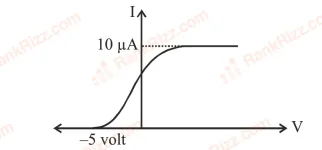
Physics
  1. A

    2 W2\ \mathrm{W}

  2. B

    7 W7\ \mathrm{W}

  3. C

    10 W10\ \mathrm{W}

  4. D

    5 W5\ \mathrm{W}

JEE MAIN 2026Photons: energy, momentum and radiation pressureTRANSCRIBED

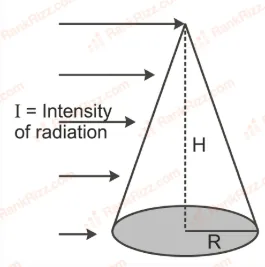
The radiation force experienced by body exposed to radiation of intensity II , assuming surface of body to be perfectly absorbing is :

Figure for JEE Main 2026 Physics question on Photons: energy, momentum and radiation pressure
  1. A

    πR2Ic\frac{\pi R^2I}{c}

  2. B

    πRHIc\frac{\pi RHI}{c}

  3. C

    IRH2c\frac{IRH}{2c}

  4. D

    IRHc\frac{IRH}{c}

JEE MAIN 2026 · 24 JAN S2Photoelectric effect and Einstein's equationTRANSCRIBED

When a light of a given wavelength falls on a metallic surface the stopping potential for photoelectrons is 3.2 V. If a second light having wavelength twice of first light is used, the stopping potential drops to 0. 7 V. The wavelength of first light is ___ m.
(h=6.63×10⁻³⁴J.s,e=1.6×10⁻¹⁹C,c=3×10⁸m/s)(h= 6.63\times10^{-34}J.s,e=1.6\times10^{-19}C,c=3\times10^{8}m/s)

  1. A

    2.2×10−82.2\times10^{-8}

  2. B

    2.5×10−72.5\times10^{-7}

  3. C

    2.9×10−82.9\times10^{-8}

  4. D

    3.1×10−73.1\times10^{-7}

JEE MAIN 2026 · 28 JAN S2Photons: energy, momentum and radiation pressureTRANSCRIBED

Number of photons of equal energy emitted per second by a 6 mW laser source operating at 663 nm is ____ . (Given: h=6.63×10⁻³⁴J.s and c=3×10⁸m/sh=6.63\times 10^{-34}J.s\text{ and }c=3\times 10^{8} m/s)

  1. A

    5×10155\times 10^{15}

  2. B

    10×101510\times 10^{15}

  3. C

    5×10165\times 10^{16}

  4. D

    2×10162\times 10^{16}

JEE MAIN 2026 · 22 JAN S2Photoelectric effect and Einstein's equationTRANSCRIBED

Light is incident on a metallic plate having work function 110×10−20J110 \times 10^{-20}J. If the produced photoelectrons have zero kinetic energy then the angular frequency of the incident light is ___ rad/s. (h = 6.63×10⁻³⁴J.s.6.63 \times 10^{-34}J.s.).

  1. A

    1.04×10161.04 \times 10^{16}

  2. B

    1.66×10151.66 \times 10^{15}

  3. C

    1.66×10161.66 \times 10^{16}

  4. D

    1.04×10131.04 \times 10^{13}

JEE MAIN 2026 · 23 JAN S1de Broglie wavelength of matter wavesTRANSCRIBED

The de Broglie wavelength of an oxygen molecule at 27∘C is x×10−12m27^{\circ}C\text{ is }x\times10^{-12}m. The value of x is (take Planck's constant =6.63×10⁻³⁴J.s=6.63\times10^{-34}J.s, Boltzmann constant =1.38×10⁻²³J/K=1.38\times10^{-23}J/K, mass of oxygen molecule =5.31×10⁻²⁶kg=5.31\times10^{-26}kg)

  1. A

    20

  2. B

    24

  3. C

    30

  4. D

    26

JEE MAIN 2026 · 04 APR S1Photoelectric effect and Einstein's equationTRANSCRIBED

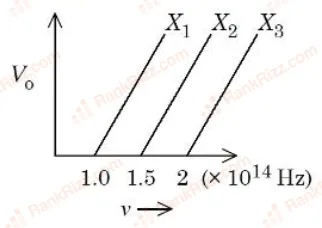
The graph shows variation of stopping potential V0V_0 with the frequency ν\nu of the incident radiation for three photosensitive metals X1X_1, X2X_2 and X3X_3. Which metal will give out electrons with greater kinetic energy, for the same wavelength of incident radiation?

Figure for JEE Main 2026 Physics question on Photoelectric effect and Einstein's equation
  1. A

    X1X_1

  2. B

    X2X_2

  3. C

    X3X_3

  4. D

    All same

JEE MAIN 2026 · 05 APR S1de Broglie wavelength of matter wavesTRANSCRIBED

An electron of mass mm is moving in an electric field E⃗=−2Eoi^\vec{E} = -2E_o \hat{i} (EoE_o = constant > 0), with an initial velocity V⃗=voi^\vec{V} = v_o \hat{i} (vov_o = constant > 0). If λo=h4mvo\lambda_o = \frac{h}{4mv_o}, its de Broglie wavelength at time tt is _______. (ee = charge of electron)

  1. A

    4λo[1−Eoe⋅t2m⋅vo]\frac{4\lambda_o}{\left[1 - \frac{E_o e \cdot t}{2m \cdot v_o}\right]}

  2. B

    4λo[1+Eoe⋅t2m⋅vo]\frac{4\lambda_o}{\left[1 + \frac{E_o e \cdot t}{2m \cdot v_o}\right]}

  3. C

    4λo[1+2Eoe⋅tm⋅vo]\frac{4\lambda_o}{\left[1 + \frac{2E_o e \cdot t}{m \cdot v_o}\right]}

  4. D

    4λo[1−2Eoe⋅tm⋅vo]\frac{4\lambda_o}{\left[1 - \frac{2E_o e \cdot t}{m \cdot v_o}\right]}

JEE MAIN 2026 · 08 APR S2Photons: energy, momentum and radiation pressureTRANSCRIBED

A monochromatic source of light operating at 15 kW emits 2.5×10222.5 \times 10^{22} photons/s. The region of an electromagnetic spectrum to which the emitted electromagnetic radiation belongs to __________. (Take h=6.6×10⁻³⁴h = 6.6 \times 10^{-34} J.s and c=3×10⁸c = 3 \times 10^8 m/s).

  1. A

    Microwave

  2. B

    Infrared

  3. C

    Visible

  4. D

    Ultraviolet

JEE MAIN 2026 · 21 JAN S1Photoelectric effect and Einstein's equationTRANSCRIBED

A light wave described by E=60[sin⁡(3×10¹⁵)t+sin⁡(12×1015)t]E=60[\sin(3\times10^{15})t+\sin(12\times10^{15})t] (in SI units) falls on a metal surface of work function 2.8 eV. The maximum kinetic energy of ejected photoelectron is (approximately) ___ eV. (h=6.6×10⁻³⁴J.s and e=1.6×10¹⁹C)(h=6.6\times10^{-34}J.s\text{ and }e=1.6\times10^{19}C)

  1. A

    7.8

  2. B

    6.0

  3. C

    3.8

  4. D

    5.1

JEE MAIN 2026 · 05 APR S1Photoelectric effect and Einstein's equationTRANSCRIBED

Light source having wavelength 331 nm is used to generate photo-electrons whose stopping potential is 0.2 V. The work function of the used metal in the experiment is α×10−19\alpha \times 10^{-19} J. The value of α\alpha is _______. (h = 6.62×10−346.62 \times 10^{-34} J s, e = 1.6×10−191.6 \times 10^{-19} C and c = 3×1083 \times 10^8 m/s)

  1. A

    3.683.68

  2. B

    4.684.68

  3. C

    5.685.68

  4. D

    2.682.68

JEE MAIN 2026 · 02 APR S1Photoelectric effect and Einstein's equationTRANSCRIBED

For a certain metal, when monochromatic light of wavelength λ\lambda is incident, the stopping potential for photoelectrons is 3V03V_0. When the same metal is illuminated by light of wavelength 2λ2\lambda, then the stopping potential becomes V0V_0. The threshold wavelength for photoelectric emission for the given metal is αλ\alpha \lambda. The value of α\alpha is __________.

  1. A

    11

  2. B

    44

  3. C

    22

  4. D

    33

JEE MAIN 2026 · 05 APR S2de Broglie wavelength of matter wavesTRANSCRIBED

An electron is travelling with a velocity vv in free space and when it enters a medium, its velocity is reduced by 20%. The de Broglie wavelength of electron in the medium is αλ0\alpha \lambda_0.where λ0\lambda_0 is its de Broglie wavelength in free space. The value of α\alpha is :

  1. A

    1.201.20

  2. B

    1.01.0

  3. C

    1.251.25

  4. D

    0.750.75

JEE MAIN 2026 · 08 APR S2Photoelectric effect and Einstein's equationTRANSCRIBED

K1K_1 and K2K_2 be the maximum kinetic energies of photoelectrons emitted from a surface of a given material for the light of wavelength λ1\lambda_1 and λ2\lambda_2, respectively. If λ1=2λ2\lambda_1 = 2\lambda_2 then the work function of material is given by :

  1. A

    K2+2K1K_2 + 2K_1

  2. B

    2K2−K12K_2 - K_1

  3. C

    K1−2K2K_1 - 2K_2

  4. D

    K2−2K1K_2 - 2K_1

JEE MAIN 2026 · 04 APR S2de Broglie wavelength of matter wavesTRANSCRIBED

The de Broglie wavelength associated with an electron accelerated through a potential difference V is λe\lambda_e and the de Broglie wavelength associated with a proton accelerated through the same potential difference is λp\lambda_p. If their corresponding masses are mem_e and mpm_p, respectively, then the ratio of their de Broglie wavelengths (λeλp)\left(\frac{\lambda_e}{\lambda_p}\right) is ______.

  1. A

    mpme\sqrt{\frac{m_p}{m_e}}

  2. B

    memp\sqrt{\frac{m_e}{m_p}}

  3. C

    mpme\frac{m_p}{m_e}

  4. D

    (mpme)2\left(\frac{m_p}{m_e}\right)^2

JEE MAIN 2026 · 28 JAN S1de Broglie wavelength of matter wavesTRANSCRIBED

The ratio of de Broglie wavelength of a deutron with kinetic energy E to that of an alpha particle with kinetic energy 2E, is n : 1. The value of n is __.
(Assume mass of proton= mass of neutron) :

JEE MAIN 2026 · 06 APR S2de Broglie wavelength of matter wavesTRANSCRIBED

The de Broglie wavelength for an electron accelerated through the potential difference of V1V_1 volt is λ1\lambda_1. When the potential difference is changed to V2V_2 volt, the associated de Broglie wavelength is increased by 50%. If (V1/V2)=(9/α)(V_1 / V_2) = (9 / \alpha), then the value of α\alpha is __________.

JEE MAIN 2026 · 21 JAN S2de Broglie wavelength of matter wavesTRANSCRIBED

A particle having electric charge 3×10−193\times 10^{-19} C and mass 6×10−276 \times 10^{-27} kg is accelerated by applying an electric Potential of 1.21 V. Wavelength of the matter wave
associated with the particle is α×10−12m\alpha \times 10^{-12}m. The value of α\alpha is __________. (Take Planck's constant = 6.6×10−346.6 \times 10^{-34} J.s. )

JEE MAIN 2025 · 04 APR S1Photons: energy, momentum and radiation pressureTRANSCRIBED

A small mirror of mass m is suspended by a massless thread of length ll. Then the small angle through which the thread will be deflected when a short pulse of laser of energy E falls normal on the mirror (c = speed of light in vacuum and g = acceleration due to gravity)

  1. A

    θ=3E4mcgl\theta = \dfrac{3E}{4mc\sqrt{gl}}

  2. B

    θ=Emcgl\theta = \dfrac{E}{mc\sqrt{gl}}

  3. C

    θ=E2mcgl\theta = \dfrac{E}{2mc\sqrt{gl}}

  4. D

    θ=2Emcgl\theta = \dfrac{2E}{mc\sqrt{gl}}

JEE MAIN 2025 · 03 APR S1Photons: energy, momentum and radiation pressureTRANSCRIBED

The radiation pressure exerted by a 450 W light source on a perfectly reflecting surface placed at 2m away from it, is :

  1. A

    1.5×10−81.5 \times 10^{-8} Pascals

  2. B

    00

  3. C

    6×10−86 \times 10^{-8} Pascals

  4. D

    3×10−83 \times 10^{-8} Pascals