JEE MAIN 2026 · 28 JAN S1Stress, strain, Hooke's law and Young's modulusTRANSCRIBED
Two wires A and B made of different materials of lengths 6.0 cm and 5.4 cm, respectively and area of cross sections 3.0×10⁻⁵m2 and 4.5×10⁻⁵m2, respectively are stretched by the same magnitude under a given load. The ratio of the Young's modulus of A to that of B is x : 3. The value of x is ___ .
- A
- B
- C
- D
JEE MAIN 2026 · 04 APR S1Bulk modulus and compressibilityTRANSCRIBED
The increase in the pressure required to decrease the volume (ΔV) of water is 6.3×10⁷ N/m². The percentage decrease in the volume is _____. (Bulk modulus of water = 2.1×10⁹ N/m².)
- A
- B
- C
- D
JEE MAIN 2026 · 06 APR S1Stress, strain, Hooke's law and Young's modulusTRANSCRIBED
A lift of mass 1600 kg is supported by thick iron wire. If the maximum stress which the wire can withstand is 4×10⁸ N/m2 and its radius is 4 mm, then maximum acceleration the lift can take is _______ m/s2.
(take g = 10 m/s2 and π = 3.14)
- A
- B
- C
- D
JEE MAIN 2026 · 04 APR S2Stress, strain, Hooke's law and Young's modulusTRANSCRIBED
A metal string A is suspended from a rigid support and its free end is attached to a block of mass M. Second block having mass 2M is suspended at the bottom of the first block using a string B. The area of cross sections of strings A and B are same. The ratio of lengths of strings of A to B is 2 and the ratio of their Young's moduli (YA/YB) is 0.5. The ratio of elongations in A to B is ______.
- A
- B
- C
- D
JEE MAIN 2026 · 05 APR S1Stress, strain, Hooke's law and Young's modulusTRANSCRIBED
The Young's modulus of steel wire of radius r and length L is Y. If the radius r and length L of the wire are doubled then the value of Y
- A
- B
- C
- D
JEE MAIN 2026 · 06 APR S2Stress, strain, Hooke's law and Young's modulusTRANSCRIBED
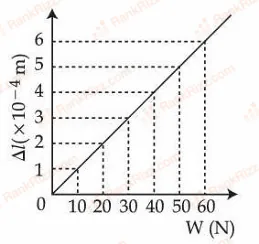
Figure represents the extension (Δl) of a wire of length 1 meter, suspended from the ceiling of the room at one end with a load W connected to the other end. If the cross-sectional area of the wire is 10−5 m2 then the Young's modulus of the wire is __________ N/m2.
- A
1.0×10¹¹
- B
2.0×10¹⁰
- C
1.0×10¹⁰
- D
2.0×10¹¹
JEE MAIN 2026 · 04 APR S1Stress, strain, Hooke's law and Young's modulusTRANSCRIBED
A string A of length 0.314 m and Young's modulus 2×10¹⁰ N/m² is connected to another string B of length and Young's modulus both twice of those of A. This series combination of strings is then suspended from a rigid support and its free end is fixed to a load of mass 0.8 kg. The net change in length of the combination is _____ mm.
(radius of both the strings is 0.2 mm and acceleration due to gravity = 10 m/s2)
(Mass of both strings is to be neglected as compared to the mass of load )
- A
- B
- C
- D
JEE MAIN 2026 · 06 APR S1Stress, strain, Hooke's law and Young's modulusTRANSCRIBED
The two wires A and B of equal cross-section but of different materials are joined together. The ratio of Young's modulus of wire A and wire B is 20/11. When the joined wire is kept under certain tension the elongations in the wires A and B are equal. If the length of wire A is 2.2 m, then the length of wire B is _______ m.
- A
- B
- C
- D
JEE MAIN 2026 · 24 JAN S1Thermal stressTRANSCRIBED
A brass wire of length 2 m and radius 1 mm at 27 °C is held taut between two rigid supports. Initially, it was cooled to a temperature of -43 °C, creating a tension T in the wire. The temperature to which the wire has to be cooled in order to increase the tension in it to 1.4T, is ____ °C.
- A
- B
- C
- D
JEE MAIN 2026 · 05 APR S1Stress, strain, Hooke's law and Young's modulusTRANSCRIBED
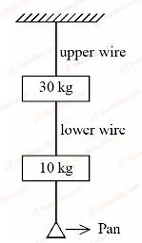
Two wires as shown in the figure below, made of steel and have breaking stress of 12×108 N/m2. Area of cross-section of upper wire is 0.008 cm2 and of lower wire is 0.004 cm2. The maximum mass that can be added to pan without breaking any wire is _______ kg. (take g=10 m/s2)
- A
- B
- C
- D
JEE MAIN 2026 · 23 JAN S1Stress-strain curve and elastic behaviourTRANSCRIBED
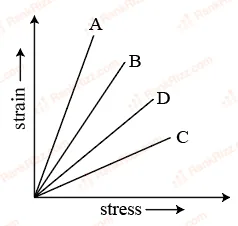
The strain-stress plot for materials A, B, C and D is shown in the figure. Which material has the largest Young's modulus?
- A
- B
- C
- D
JEE MAIN 2026 · 05 APR S2Elastic potential energy in stretched wiresTRANSCRIBED
A copper wire of length 3 m is stretched by 3 mm by applying an external force. The volume of the wire is 600×10−6 m³. The elastic potential energy stored in the wire in stretched condition would be _______ J :
(Given Young's modulus of copper =1.1×10¹¹ N/m²)
JEE MAIN 2026 · 05 APR S1Modulus of rigidity and Poisson's ratioTRANSCRIBED
A cube has side length 5 cm and modulus of rigidity 105 N/m2. The displacement produced by a force of 10 N in the upper face of cube is _______ mm.
JEE MAIN 2026 · 02 APR S1Stress, strain, Hooke's law and Young's modulusTRANSCRIBED
A uniform wire of length l of weight w is suspended from the roof with a weight of W at the other end. The stress in the wire at 3l distance from the top is (AW+γ2⋅Aw), where A is the cross sectional area of the wire. The value of γ is __________.
JEE MAIN 2026 · 06 APR S1Bulk modulus and compressibilityTRANSCRIBED
A certain gas is isothermally compressed to (31)rd of its initial volume (V0=3 litre) by applying required pressure. If the bulk modulus of the gas is 3×10⁵ N/m2, the magnitude of work done on the gas is _______ J.
JEE MAIN 2025 · 08 APR S2Stress, strain, Hooke's law and Young's modulusTRANSCRIBED
A 3 m long wire of radius 3 mm shows an extension of 0.1 mm when loaded vertically by a mass of 50 kg in an experiment to determine Young's modulus. The value of Young's modulus of the wire is P×1011 Nm−2, where P is : (Take g=3π m/s2)
- A
- B
- C
- D
JEE MAIN 2025 · 04 APR S2Modulus of rigidity and Poisson's ratioTRANSCRIBED
A cylindrical rod of length 1 m and radius 4 cm is mounted vertically. It is subjected to a shear force of 105 N at the top. Considering infinitesimally small displacement in the upper edge, the angular displacement θ of the rod axis from its original position would be : (shear moduli, G=1010 N/m2)
- A
160π1
- B
- C
- D
JEE MAIN 2025 · 29 JAN S1Bulk modulus and compressibilityTRANSCRIBED
The fractional compression (VΔV) of water at the depth of 2.5 km below the sea level is ______%.Given, the Bulk modulus of water =2×10⁹Nm−2, density of water =103kgm−3, acceleration due to gravity =g=10ms−2.
- A
- B
- C
- D
JEE MAIN 2025 · 07 APR S1Stress, strain, Hooke's law and Young's modulusTRANSCRIBED
Two wires A and B are made of same material having ratio of lengths LBLA=31 and their diameters ratio dBdA=2. If both the wires are stretched using same force, what would be the ratio of their respective elongations?
- A
- B
- C
- D
JEE MAIN 2025 · 02 APR S1Elastic potential energy in stretched wiresTRANSCRIBED
A steel wire of length 2 m and Young's modulus 2.0×10¹¹ Nm−2 is stretched by a force. If Poisson ratio and transverse strain for the wire are 0.2 and 10−3 respectively, then the elastic potential energy density of the wire is ______ ×105 (in SI units).