RankRizz

Kinetic Theory of Gases — JEE Main Previous Year Questions

Every Kinetic Theory of Gases question JEE Main has set from 2004–2026, grouped by the idea it tests rather than the order of the syllabus. 191 questions across 6 distinct ideas. Free to read, answer key on every one.

Questions

191

Distinct ideas

6

Share of marks

3%

Difficulty

EASY

The ideas inside Kinetic Theory of Gases

A chapter is not one subject — it is a handful of procedures the examiner reuses. These are the ones Kinetic Theory of Gases questions actually test.

Kinetic Theory of Gases weightage, year by year

The share of each year’s Physics questions that came from Kinetic Theory of Gases, counted from the 168 papers we hold for the last 10 years, and session by session inside a year.

Steady: 3.4% of Physics questions in 2024–2026 against 3.6% in 2017–2023, and between 1.7% and 4.5% in every year shown.

202615 / 4753.2%JAN 3.2%APR 3.1%
202513 / 4752.7%JAN 2.4%APR 3.1%
202424 / 6004.0%JAN 4.3%APR 3.7%
202324 / 7503.2%JAN 3.3%APR 3.1%
202224 / 6603.6%JUN 3.9%JUL 3.3%
202126 / 7203.6%FEB 3.3%MAR 4.0%JUL 3.8%AUG 3.3%
202018 / 4004.5%JAN 4.0%SEP 4.8%
201919 / 4804.0%JAN 2.9%APR 5.0%
20182 / 1201.7%4 PAPERS, ONE SESSION
20174 / 904.4%3 PAPERS, ONE SESSION

“QS” is Kinetic Theory of Gases questions out of all Physics questions that year. A year with more sittings asks more questions, which is why the share, not the count, is the number to compare.

Kinetic Theory of Gases: quick answers

How many Kinetic Theory of Gases questions has JEE Main asked?

191 questions from 2004–2026. Over the last 20 papers, Kinetic Theory of Gases carried about 3% of Physics marks.

Which Kinetic Theory of Gases topics come up most?

Molar specific heats of gases, Mayer's relation and gas mixtures (60 questions), Ideal gas equation and gas laws (38 questions), RMS, average and most probable speeds of gas molecules (29 questions). Start with these, they are what the examiner keeps coming back to.

Is Kinetic Theory of Gases important for JEE Main?

Steady: 3.4% of Physics questions in 2024–2026 against 3.6% in 2017–2023, and between 1.7% and 4.5% in every year shown. It has carried about 3% of Physics marks in recent papers, rated easy on our difficulty scale. The year-by-year table above shows how that has moved.

Do these Kinetic Theory of Gases PYQs have answers and solutions?

Yes. Every question shows its official answer key, and a worked solution opens on the question’s own page wherever we have one. Reading and checking answers is free, no sign-up needed.

What’s the fastest way to revise Kinetic Theory of Gases?

Do one past question per idea first: Kinetic Theory of Gases has 6 distinct ideas, listed above. Then practise the topics you get wrong, or build a timed test from this chapter.

Every Kinetic Theory of Gases question

1–20 OF 191 · NEWEST FIRST

JEE MAIN 2026 · 22 JAN S2Mean free pathTRANSCRIBED

Consider two boxes containing ideal gases A and B such that their temperatures, pressures and number densities are same. The molecular size of A is half of that of B and mass of molecule A is four times that of B. If the collision frequency in gas B is 32×1018/s32 \times 10^{18}/s then collision frequency in gas A is _____________/s.

  1. A

    32×10832 \times 10^{8}

  2. B

    2×1082 \times 10^{8}

  3. C

    8×1088 \times 10^{8}

  4. D

    4×1084 \times 10^{8}

JEE MAIN 2026 · 05 APR S1Molar specific heats of gases, Mayer's relation and gas mixturesTRANSCRIBED

Given below are two statements: one is labelled as Assertion A and the other is labelled as Reason R.
Statement I: Change in internal energy of a system containing nn mole of ideal gas can be written as ΔU=nCv(Tf−Ti)=nRγ−1(Tf−Ti)\Delta U = n C_v (T_f - T_i) = \frac{nR}{\gamma - 1}(T_f - T_i), where γ=CpCv\gamma = \frac{C_p}{C_v}, TiT_i = initial temperature, TfT_f = final temperature.
Statement II: Relation between degree of freedom ff and γ\gamma (= Cp/CvC_p/C_v) is (γ=1+2f)\left(\gamma = 1 + \frac{2}{f}\right).
Choose the correct answer from the options given below

  1. A

    Both A and R are true, and R is the correct explanation of A

  2. B

    Both A and R are true, but R is not the correct explanation of A

  3. C

    A is true but R is false

  4. D

    A is false but R is true

JEE MAIN 2026 · 02 APR S1Molar specific heats of gases, Mayer's relation and gas mixturesTRANSCRIBED

Heat is supplied to a diatomic gas at constant pressure. Then the ratio of ΔQ:ΔU:ΔW\Delta Q : \Delta U : \Delta W is __________.

  1. A

    2:3:52:3:5

  2. B

    5:3:25:3:2

  3. C

    2:5:72:5:7

  4. D

    7:5:27:5:2

JEE MAIN 2026 · 04 APR S2Kinetic interpretation of pressure and temperatureTRANSCRIBED

Given below are two statements: one is labelled as Assertion A and the other is labelled as Reason R

Assertion A: If the average kinetic energy of H2_2 and O2_2 molecules, kept in two different sized containers are same, then their temperatures will be same.

Reason R: The r.m.s. speed of H2_2 and O2_2 molecules are same at same temperature.
Choose the correct answer from the options given below : 

  1. A

    Both A and R are true, and R is the correct explanation of A

  2. B

    Both A and R are true, but R is NOT the correct explanation of A

  3. C

    A is true but R is false

  4. D

    A is false but R is true

JEE MAIN 2026 · 21 JAN S2RMS, average and most probable speeds of gas moleculesTRANSCRIBED

The r.m.s. speed of oxygen molecules at 47∘47^\circ is equal to that of the hydrogen molecules kept at ________ C∘C^\circ. (Mass of oxygen molecule/mass of hydrogen molecule = 32/2)

  1. A

    -235

  2. B

    -20

  3. C

    -253

  4. D

    -100

JEE MAIN 2026 · 04 APR S1Ideal gas equation and gas lawsTRANSCRIBED

One gas of n1n_1 mole of molecules at temperature T1T_1, volume V1V_1, and pressure P1P_1, and another gas of n2n_2 mole of molecules at temperature T2T_2, volume V2V_2, and pressure P2P_2, are mixed resulting in pressure PP and volume VV of the mixture. The temperature of the mixture is :

  1. A

    T1+T22\frac{T_1+T_2}{2}

  2. B

    T1T2PVT2P1V1+T1P2V2\frac{T_1 T_2 PV}{T_2 P_1 V_1 + T_1 P_2 V_2}

  3. C

    T2P1V1+T1P2V2T1T2PV\frac{T_2 P_1 V_1 + T_1 P_2 V_2}{T_1 T_2 PV}

  4. D

    ∣T1−T2∣2\frac{|T_1-T_2|}{2}

JEE MAIN 2026 · 06 APR S2Degrees of freedom, equipartition of energy and internal energyTRANSCRIBED

If 2 mole of an ideal monoatomic gas at temperature TT, is mixed with 6 mole of another ideal monoatomic gas at temperature 2T2T then the temperature of mixture is :

  1. A

    52T\dfrac{5}{2}T

  2. B

    54T\dfrac{5}{4}T

  3. C

    72T\dfrac{7}{2}T

  4. D

    74T\dfrac{7}{4}T

JEE MAIN 2026 · 06 APR S1Ideal gas equation and gas lawsTRANSCRIBED

Two closed vessels of same volume are joined through a narrow tube and both vessels are filled with air of pressure 90 kPa and temperature 400 K. Keeping the temperature of one vessel constant at 400 K the second vessel temperature is raised to 500 K. The final pressure in the vessels is _______ kPa.

  1. A

    100

  2. B

    120

  3. C

    90

  4. D

    105

JEE MAIN 2026 · 02 APR S2Ideal gas equation and gas lawsTRANSCRIBED

A mixture of carbon dioxide and oxygen has volume 8310 cm3^3, temperature 300 K, pressure 100 kPa and mass 13.2 g. The number of moles of carbon dioxide and oxygen gases in the mixture respectively are _____.
(Assume both gases behave like ideal gases) [R=8.31R = 8.31 J/mol.K]

  1. A

    0.150.15 and 0.180.18

  2. B

    0.250.25 and 0.080.08

  3. C

    0.210.21 and 0.120.12

  4. D

    0.130.13 and 0.200.20

JEE MAIN 2026 · 28 JAN S2Mean free pathTRANSCRIBED

The mean free path of a molecule of diameter 5×10⁻¹⁰m5\times 10^{-10}m at the temperature 41 °C and pressure 1.38×10⁵Pa1.38\times 10^{5} Pa, is given as ___ m (Given kB=1.38×10⁻²³J/Kk_{B}=1.38\times 10^{-23}J/K.)

  1. A

    22×10−102\sqrt{2}\times 10^{-10}

  2. B

    102×10−810\sqrt{2}\times 10^{-8}

  3. C

    22×10−82\sqrt{2}\times 10^{-8}

  4. D

    2×10−82\times 10^{-8}

JEE MAIN 2026 · 24 JAN S2Molar specific heats of gases, Mayer's relation and gas mixturesTRANSCRIBED

When 300 J of heat given to an ideal gas with Cp=72RC_{p}= \frac{7}{2}R its temperature raises from 20∘C20^{\circ}C to 50∘C50^{\circ}C keeping its volume constant. The millimoles of the gas is (approximately) __ . (R = 8.314 J/mol.K)

JEE MAIN 2026 · 21 JAN S2Molar specific heats of gases, Mayer's relation and gas mixturesTRANSCRIBED

A diatomic gas ( y= 1.4) does 100 J of work when it is expanded isobarically. Then the heat given to the gas ____ J.

JEE MAIN 2026 · 21 JAN S1Molar specific heats of gases, Mayer's relation and gas mixturesTRANSCRIBED

10 mole of oxygen is heated at constant volume from 30∘C to 40∘C30^{\circ}C  \text{to}  40^{\circ}C. The change in the internal energy of the gas is ____ cal (the molecular specific heat of oxygen at constant pressure, Cp=7cal/mol.∘CandR=2cal./mol.∘C).C_{p}= 7 \text{cal}/\text{mol}.^{\circ}C \text{and} R = 2 \text{cal}./\text{mol}.^{\circ}C).

JEE MAIN 2026 · 22 JAN S2Ideal gas equation and gas lawsTRANSCRIBED

An insulated cylinder of volume 60cm360cm^{3} is filled with a gas at 27∘C27 ^{\circ}C and 2 atmospheric pressure. Then the gas is compressed making the final volume as 20cm320cm^{3} while allowing the temperature to rise to 77∘C77 ^{\circ}C. The final pressure is ___________ atmospheric pressure.

JEE MAIN 2026 · 24 JAN S1Ideal gas equation and gas lawsTRANSCRIBED

A gas of certain mass filled in a closed cylinder at a pressure of 3.23 kPa has temperature 50 °C. The gas is now heated to double its temperature. The modified pressure is __ Pa.

JEE MAIN 2025 · 04 APR S1Mean free pathTRANSCRIBED

The mean free path and the average speed of oxygen molecules at 300 K and 1 atm are 3×10−73 \times 10^{-7} m and 600 m/s, respectively. Find the frequency of its collisions.

  1. A

    2×10102 \times 10^{10}/s

  2. B

    9×1059 \times 10^{5}/s

  3. C

    2×1092 \times 10^{9}/s

  4. D

    5×1085 \times 10^{8}/s

JEE MAIN 2025 · 07 APR S2Kinetic interpretation of pressure and temperatureTRANSCRIBED

The helium and argon are put in the flask at the same room temperature (300 K). The ratio of average kinetic energies (per molecule) of helium and argon is : (Molar mass of helium = 4 g/mol, Molar mass of argon = 40 g/mol)

  1. A

    1 : 10

  2. B

    10 : 1

  3. C

    1:101 : \sqrt{10}

  4. D

    1 : 1

JEE MAIN 2025 · 04 APR S2Ideal gas equation and gas lawsTRANSCRIBED

There are two vessels filled with an ideal gas where volume of one is double the volume of other. The large vessel contains the gas at 8 kPa at 1000 K while the smaller vessel contains the gas at 7 kPa at 500 K. If the vessels are connected to each other by a thin tube allowing the gas to flow and the temperature of both vessels is maintained at 600 K, at steady state the pressure in the vessels will be (in kPa).

  1. A

    4.4

  2. B

    6

  3. C

    24

  4. D

    18

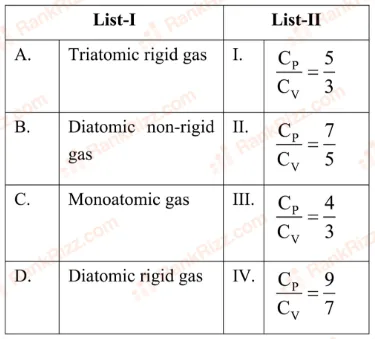
JEE MAIN 2025 · 07 APR S1Molar specific heats of gases, Mayer's relation and gas mixturesTRANSCRIBED

Match the List-I with List-II.

Figure for JEE Main 2025 Physics question on Molar specific heats of gases, Mayer's relation and gas mixtures

Choose the correct answer from the options given below : 

  1. A

    A-III, B-IV, C-I, D-II

  2. B

    A-III, B-II, C-IV, D-I

  3. C

    A-II, B-IV, C-I, D-II

  4. D

    A-IV, B-II, C-III, D-I

JEE MAIN 2025 · 28 JAN S2Kinetic interpretation of pressure and temperatureTRANSCRIBED

The kinetic energy of translation of the molecules in 50 g of CO2CO_{2} gas at 17∘C17^{\circ}C is

  1. A

    4205.5 J

  2. B

    4102.8 J

  3. C

    3582.7 J

  4. D

    3986.3 J