RankRizz

Thermal Properties of Matter — JEE Main Previous Year Questions

Every Thermal Properties of Matter question JEE Main has set from 2004–2026, grouped by the idea it tests rather than the order of the syllabus. 116 questions across 6 distinct ideas. Free to read, answer key on every one.

Questions

116

Distinct ideas

6

Share of marks

1.6%

Difficulty

MEDIUM

The ideas inside Thermal Properties of Matter

A chapter is not one subject — it is a handful of procedures the examiner reuses. These are the ones Thermal Properties of Matter questions actually test.

Thermal Properties of Matter weightage, year by year

The share of each year’s Physics questions that came from Thermal Properties of Matter, counted from the 168 papers we hold for the last 10 years, and session by session inside a year.

Falling: 1.5% of Physics questions in 2024–2026, down from 2.1% in 2017–2023. Its heaviest year was 2019, at 3.1%.

20267 / 4751.5%JAN 2.0%APR 0.9%
202513 / 4752.7%JAN 3.2%APR 2.2%
20243 / 6000.5%JAN 0.3%APR 0.7%
202312 / 7501.6%JAN 2.1%APR 1.1%
202215 / 6602.3%JUN 2.8%JUL 1.7%
202110 / 7201.4%FEB 0.7%MAR 1.3%JUL 1.4%AUG 1.9%
202011 / 4002.8%JAN 2.0%SEP 3.2%
201915 / 4803.1%JAN 3.8%APR 2.5%
20183 / 1202.5%4 PAPERS, ONE SESSION
20172 / 902.2%3 PAPERS, ONE SESSION

“QS” is Thermal Properties of Matter questions out of all Physics questions that year. A year with more sittings asks more questions, which is why the share, not the count, is the number to compare.

Thermal Properties of Matter: quick answers

How many Thermal Properties of Matter questions has JEE Main asked?

116 questions from 2004–2026. Over the last 20 papers, Thermal Properties of Matter carried about 1.6% of Physics marks.

Which Thermal Properties of Matter topics come up most?

Temperature scales and thermal expansion (26 questions), Calorimetry and specific heat capacity (23 questions), Heat conduction and thermal resistance (23 questions). Start with these, they are what the examiner keeps coming back to.

Is Thermal Properties of Matter important for JEE Main?

Falling: 1.5% of Physics questions in 2024–2026, down from 2.1% in 2017–2023. Its heaviest year was 2019, at 3.1%. It has carried about 1.6% of Physics marks in recent papers, rated medium on our difficulty scale. The year-by-year table above shows how that has moved.

Do these Thermal Properties of Matter PYQs have answers and solutions?

Yes. Every question shows its official answer key, and a worked solution opens on the question’s own page wherever we have one. Reading and checking answers is free, no sign-up needed.

What’s the fastest way to revise Thermal Properties of Matter?

Do one past question per idea first: Thermal Properties of Matter has 6 distinct ideas, listed above. Then practise the topics you get wrong, or build a timed test from this chapter.

Every Thermal Properties of Matter question

1–20 OF 116 · NEWEST FIRST

JEE MAIN 2026 · 21 JAN S1Calorimetry and specific heat capacityTRANSCRIBED

A gas based geyser heats water flowing at the rate of 5.0 litres per minute from 27°C to 87°C. The rate of consumption of the gas is ___ g/s. (take heat of combustion of gas=5.0×10⁴J/ggas=5.0\times10^{4}J/g) specific heat capacity of water =4200 J/ kg.°C

  1. A

    0.42

  2. B

    0.21

  3. C

    2.1

  4. D

    4.2

JEE MAIN 2026 · 28 JAN S1Change of state and latent heatTRANSCRIBED

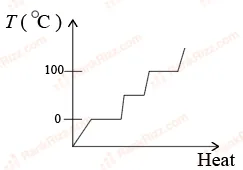
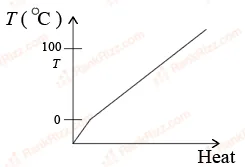
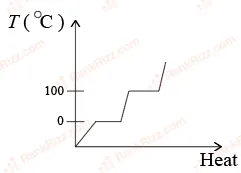
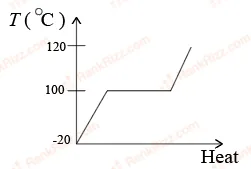
Which of the following best represents the temperature versus heat supplied graph for water, in the range of - 20 °C to 120 °C ?

  1. A
    31(1)
  2. B
    31(2)
  3. C
    31(3)
  4. D
    31(4)
JEE MAIN 2026 · 04 APR S2Temperature scales and thermal expansionTRANSCRIBED

The temperature of a metal strip having coefficient of linear expansion α\alpha is increased from T1T_1 to T2T_2 resulting in increase of its length by ΔL1\Delta L_1. The temperature is further increased from T2T_2 to T3T_3 such that the increase in its length is ΔL2\Delta L_2. Given T3+T1=2T2T_3 + T_1 = 2T_2 and T2−T1=ΔTT_2 - T_1 = \Delta T, the value of ΔL2\Delta L_2 is ______.

  1. A

    ΔL1[1+2α2(ΔT)2]\Delta L_1[1 + 2\alpha^2(\Delta T)^2]

  2. B

    ΔL1[1+α2(ΔT)2]\Delta L_1[1 + \alpha^2(\Delta T)^2]

  3. C

    ΔL1[1+2αΔT]\Delta L_1[1 + 2\alpha\Delta T]

  4. D

    ΔL1[1+αΔT]\Delta L_1[1 + \alpha\Delta T]

JEE MAIN 2026 · 21 JAN S1Temperature scales and thermal expansionTRANSCRIBED

An aluminium and steel rods having same lengths and cross-sections are joined to make total length of 120 cm at 30°C. The coefficient of linear expansion of aluminium and steel are 24×10−6/∘C and 1.2×10⁻⁵/∘C24\times10^{-6}/^{\circ}C\text{ and }1.2\times10^{-5}/^{\circ}C, respectively. The length of this composite rod when its temperature is raised to 100∘100^\circ C, is ___ cm.

  1. A

    120.06

  2. B

    120.20

  3. C

    120.15

  4. D

    120.03

JEE MAIN 2026 · 28 JAN S1Change of state and latent heatTRANSCRIBED

10 kg of ice at -10°C is added to 100 kg of water to lower its temperature from 25°C. Consider no heat exchange to surroundings. The decrement to the temperature of water is _____ °C.
(specific heat of ice= 2100 J/Kg.°C, specific heat of water= 4200 J/Kg.°C, latent heat of fusion of ice =3.36× 105J/Kg=3.36\times\ 10^5J/Kg)

  1. A

    11.6

  2. B

    10

  3. C

    6.67

  4. D

    15

JEE MAIN 2026 · 22 JAN S1Heat conduction and thermal resistanceTRANSCRIBED

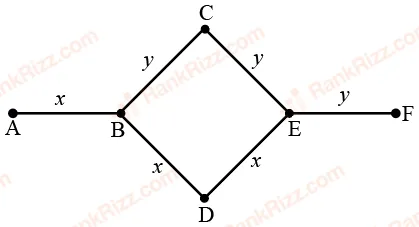
Rods xx and yy of equal dimensions but of different materials are joined as shown in figure. Temperatures of end points AA and FF are maintained at 100oC100 ^{o}C and 40oC40 ^{o}C respectively. Given the thermal conductivity of rod xx is three times of that of rod yy, the temperature at junction points BB and EE are (close to):

Screenshot_41
  1. A

    60oC60 ^{o}C and 45oC45 ^{o}C respectively

  2. B

    80oC80 ^{o}C and 60oC60 ^{o}C respectively

  3. C

    89oC89 ^{o}C and 73oC73 ^{o}C respectively

  4. D

    80oC80 ^{o}C and 70oC70 ^{o}C respectively

JEE MAIN 2026 · 05 APR S2Change of state and latent heatTRANSCRIBED

The heat extracted out of x gram of water initialy at  50°50°C to  cool it down to 0°0°C is sufficient to evaporate  (1000−x)(1000 - x) gram  of water also initialy at 50°50°C. The value of xx (closest integer) is_______.  (Take Latent heat of water  L=2256L = 2256 kJ/kg K, specific heat capacity of water c=4200c = 4200 J/kg·K)

JEE MAIN 2025 · 24 JAN S2Temperature scales and thermal expansionTRANSCRIBED

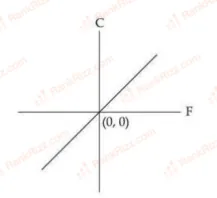
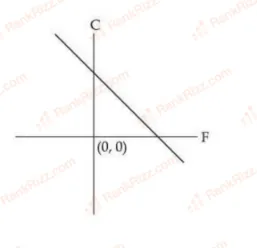
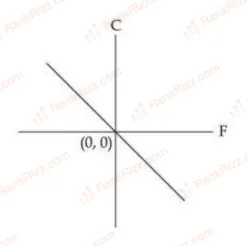
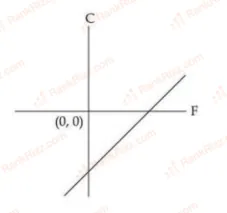
Which of the following figure represents the relation between Celsius and Fahrenheit temperatures?

  1. A
    Figure for JEE Main 2025 Physics question on Temperature scales and thermal expansion
  2. B
    Figure for JEE Main 2025 Physics question on Temperature scales and thermal expansion
  3. C
    Figure for JEE Main 2025 Physics question on Temperature scales and thermal expansion
  4. D
    Figure for JEE Main 2025 Physics question on Temperature scales and thermal expansion
JEE MAIN 2025 · 04 APR S2Temperature scales and thermal expansionTRANSCRIBED

Consider a rectangular sheet of solid material of length l=9l = 9 cm and width d=4d = 4 cm. The coefficient of linear expansion is α=3.1×10⁻⁵\alpha = 3.1 \times 10^{-5} K−1^{-1} at room temperature and one atmospheric pressure. The mass of sheet m=0.1m = 0.1 kg and the specific heat capacity Cv=900C_v = 900 J kg−1^{-1}K−1^{-1}. If the amount of heat supplied to the material is 8.1×1028.1 \times 10^2 J then change in area of the rectangular sheet is :

  1. A

    2.0×10−62.0 \times 10^{-6} m2^2

  2. B

    3.0×10−73.0 \times 10^{-7} m2^2

  3. C

    6.0×10−76.0 \times 10^{-7} m2^2

  4. D

    4.0×10−74.0 \times 10^{-7} m2^2

JEE MAIN 2025 · 22 JAN S1Change of state and latent heatTRANSCRIBED

An amount of ice of mass 10−3kg and temperature −10oC10^{-3}kg \text{ and temperature } -10^{o}C is transformed to vapour of temperature 110oC110^{o}C by applying heat. The total amount of work required for this conversion is, (Take, specific heat of ice =2100Jkg−1K−1,= 2100Jkg^{-1}K^{-1}, specific heat of water 4180Jkg−1K−1,4180Jkg^{-1}K^{-1},  specific heat of steam  =1920Jkg−1K−1,=1920Jkg^{-1}K^{-1},  Latent heat of ice =3.35×10⁵Jkg−1=3.35\times10^{5}Jkg^{-1} and Latent heat of steam =2.25×10⁶Jkg−1)= 2.25\times10^{6}Jkg^{-1})

  1. A

    3043 J

  2. B

    3024 J

  3. C

    3003 J

  4. D

    3022 J

JEE MAIN 2025 · 08 APR S2Calorimetry and specific heat capacityTRANSCRIBED

Water falls from a height of 200 m into a pool. Calculate the rise in temperature of the water assuming no heat dissipation from the water in the pool. (Take g=10g = 10 m/s2^2, specific heat of water = 4200 J/(kg K))

  1. A

    0.23 K

  2. B

    0.36 K

  3. C

    0.14 K

  4. D

    0.48 K

JEE MAIN 2025 · 29 JAN S2Heat conduction and thermal resistanceTRANSCRIBED

The difference of temperature in a material can convert heat energy into electrical energy. To harvest the heat energy, the material should have

  1. A

    high thermal conductivity and high electrical conductivity

  2. B

    low thermal conductivity and low electrical conductivity

  3. C

    high thermal conductivity and low electrical conductivity

  4. D

    low thermal conductivity and high electrical conductivity

JEE MAIN 2025 · 23 JAN S1Change of state and latent heatTRANSCRIBED

A gun fires a lead bullet of temperature 300 K into a wooden block. The bullet having melting temperature of 600 K penetrates into the block and melts down. If the total heat required for the process is 625 J , then the mass of the bullet is grams. (Latent heat of fusion of lead =2.5×10⁴JKg−1=2.5\times10^{4}JKg^{-1} and specific heat capacity =125JKg−1K−1=125JKg^{-1}K^{-1} of lead

  1. A

    10

  2. B

    20

  3. C

    5

  4. D

    15

JEE MAIN 2025 · 29 JAN S2Newton's law of coolingTRANSCRIBED

A cup of coffee cools from 90∘90^{\circ} to 80∘80^{\circ} in t minutes when the room temperature is 20∘20^{\circ}. The time taken by the similar cup of coffee to cool from 80∘80^{\circ} to 60∘60^{\circ} at the same room temperature is :

  1. A

    1310t\frac{13}{10}t

  2. B

    1013t\frac{10}{13}t

  3. C

    513t\frac{5}{13}t

  4. D

    135t\frac{13}{5}t

JEE MAIN 2025 · 22 JAN S1Thermal radiation: Stefan's law, Wien's law and Kirchhoff's lawTRANSCRIBED

Two spherical bodies of same materials having radii 0.2 m and 0.8 m are placed in same atmosphere. The temperature of the smaller body is 800 K and temperature of the bigger body is 400 K . If the energy radiated from the smaller body is E, the energy radiated from the bigger body is (assume, effect of the surrounding temperature to be negligible),

  1. A

    16 E

  2. B

    E

  3. C

    64 E

  4. D

    256 E

JEE MAIN 2025 · 24 JAN S2Newton's law of coolingTRANSCRIBED

The temperature of a body in air falls from 40oC40^{o}C to 24oC24^{o}C in 4 minutes. The temperature of the air is 16oC16^{o}C. The temperature of the body in the next 4 minutes will be:

  1. A

    143oC\frac{14}{3} ^{o}C

  2. B

    423oC\frac{42}{3} ^{o}C

  3. C

    283oC\frac{28}{3} ^{o}C

  4. D

    563oC\frac{56}{3} ^{o}C

JEE MAIN 2025 · 02 APR S2Calorimetry and specific heat capacityTRANSCRIBED

Match List-I with List-II.

List-I
(A) Heat capacity of body
(B) Specific heat capacity of body
(C) Latent heat
(D) Thermal conductivity

List-II
(I) J kg−1^{-1}
(II) J K−1^{-1}
(III) J kg−1^{-1} K−1^{-1}
(IV) J m−1^{-1} K−1^{-1} s−1^{-1}

Choose the correct answer from the options given below :

  1. A

    (A)-(III), (B)-(I), (C)-(II), (D)-(IV)

  2. B

    (A)-(IV), (B)-(III), (C)-(II), (D)-(I)

  3. C

    (A)-(III), (B)-(IV), (C)-(I), (D)-(II)

  4. D

    (A)-(II), (B)-(III), (C)-(I), (D)-(IV)

JEE MAIN 2025 · 07 APR S2Heat conduction and thermal resistanceTRANSCRIBED

Two cylindrical rods A and B made of different materials, are joined in a straight line. The ratio of lengths, radii and thermal conductivities are: LALB=12\frac{L_A}{L_B} = \frac{1}{2}, rArB=2\frac{r_A}{r_B} = 2 and KAKB=12\frac{K_A}{K_B} = \frac{1}{2}. The free ends of rods A and B are maintained at 400 K, 200 K respectively. The temperature of rods interface is _____ K,when equilibrium is established.

JEE MAIN 2025 · 22 JAN S1Heat conduction and thermal resistanceTRANSCRIBED

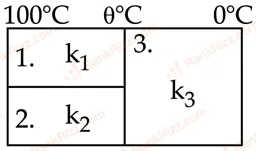
Three conductors of same length having thermal conductivity k1,k2 and K3k_1, k_2 \text{ and } K_3 are connected as shown in figure.

Figure for JEE Main 2025 Physics question on Heat conduction and thermal resistance

Area of cross sections of 1st and 2nd1^{st} \text{ and }2^{nd} conductor are same and for 3rd3^{rd} conductor it is double of the 1st1^{st} conductor. The temperatures are given in the figure. In steady state condition, the value of 0 is _______ oC^oC.
(Given :k1=60Js−1m−1K−1,k2=120Js−1m−1K−1,k3=135Js−1m−1K−1)(\text{Given }:k_1=60Js^{-1}m^{-1}K^{-1},k_2= 120Js^{-1}m^{-1}K^{-1}, k_3= 135Js^{-1}m^{-1}K^{-1})

JEE MAIN 2025 · 07 APR S1Thermal radiation: Stefan's law, Wien's law and Kirchhoff's lawTRANSCRIBED

A wire of length 10 cm and diameter 0.5 mm is used in a bulb. The temperature of the wire is 1727 degrees C and power radiated by the wire is 94.2 W. Its emissivity is x8\frac{x}{8} where x = ______.
(Given σ=6.0×10⁻⁸\sigma = 6.0 \times 10^{-8} W m−2^{-2} K−4^{-4}, π=3.14\pi = 3.14 and assume that the emissivity of wire material is same at all wavelength. )