RankRizz

Mechanical Properties of Fluids — JEE Main Previous Year Questions

Every Mechanical Properties of Fluids question JEE Main has set from 2004–2026, grouped by the idea it tests rather than the order of the syllabus. 193 questions across 9 distinct ideas. Free to read, answer key on every one.

Questions

193

Distinct ideas

9

Share of marks

4.2%

Difficulty

MEDIUM

The ideas inside Mechanical Properties of Fluids

A chapter is not one subject — it is a handful of procedures the examiner reuses. These are the ones Mechanical Properties of Fluids questions actually test.

Mechanical Properties of Fluids weightage, year by year

The share of each year’s Physics questions that came from Mechanical Properties of Fluids, counted from the 168 papers we hold for the last 10 years, and session by session inside a year.

Rising: 4.3% of Physics questions in 2024–2026, up from 2.7% in 2017–2023. Its heaviest year was 2025, at 4.4%.

202620 / 4754.2%JAN 4.0%APR 4.4%
202521 / 4754.4%JAN 4.8%APR 4.0%
202426 / 6004.3%JAN 3.3%APR 5.3%
202322 / 7502.9%JAN 2.3%APR 3.6%
202221 / 6603.2%JUN 3.1%JUL 3.3%
202113 / 7201.8%FEB 0.7%MAR 2.7%JUL 2.4%AUG 1.4%
202015 / 4003.8%JAN 4.0%SEP 3.6%
201913 / 4802.7%JAN 2.1%APR 3.3%
20183 / 1202.5%4 PAPERS, ONE SESSION
20171 / 901.1%3 PAPERS, ONE SESSION

“QS” is Mechanical Properties of Fluids questions out of all Physics questions that year. A year with more sittings asks more questions, which is why the share, not the count, is the number to compare.

Mechanical Properties of Fluids: quick answers

How many Mechanical Properties of Fluids questions has JEE Main asked?

193 questions from 2004–2026. Over the last 20 papers, Mechanical Properties of Fluids carried about 4.2% of Physics marks.

Which Mechanical Properties of Fluids topics come up most?

Stokes' law and terminal velocity (34 questions), Surface tension and surface energy (28 questions), Fluid pressure, Pascal's law and accelerated/rotating liquids (24 questions). Start with these, they are what the examiner keeps coming back to.

Is Mechanical Properties of Fluids important for JEE Main?

Rising: 4.3% of Physics questions in 2024–2026, up from 2.7% in 2017–2023. Its heaviest year was 2025, at 4.4%. It has carried about 4.2% of Physics marks in recent papers, rated medium on our difficulty scale. The year-by-year table above shows how that has moved.

Do these Mechanical Properties of Fluids PYQs have answers and solutions?

Yes. Every question shows its official answer key, and a worked solution opens on the question’s own page wherever we have one. Reading and checking answers is free, no sign-up needed.

What’s the fastest way to revise Mechanical Properties of Fluids?

Do one past question per idea first: Mechanical Properties of Fluids has 9 distinct ideas, listed above. Then practise the topics you get wrong, or build a timed test from this chapter.

Every Mechanical Properties of Fluids question

1–20 OF 193 · NEWEST FIRST

JEE MAIN 2026Archimedes' principle and floatationTRANSCRIBED

A wooden block is floating in a liquid, 40\ \%\ of its volume is inside the liquid when the vessel is stationary. Percentage of volume immersed when the vessel moves upwards with an acceleration a=5 m.s−2a=5\ m.s^{-2} is

  1. A

    60\ \%\

  2. B

    40\ \%\

  3. C

    20\ \%\

  4. D

    33.33\%\

JEE MAIN 2026 · 23 JAN S2Stokes' law and terminal velocityTRANSCRIBED

A small metallic sphere of diameter 2 mm and density 10.5g/cm310.5 g/cm ^{3} is dropped in glycerine having viscosity 10 Poise and density 1.5g/cm31.5 g/cm^{3} respectively. The terminal velocity attained by the sphere is __ cm/scm/s.
(π=227 and g=10m/s2)(\pi=\frac{22}{7} \text { and } g=10m/s^{2})

  1. A

    1.5

  2. B

    2.0

  3. C

    1.0

  4. D

    3.0

JEE MAIN 2026 · 24 JAN S2Archimedes' principle and floatationTRANSCRIBED

A cubical block of density ρb=600kg/m3\rho_{b}= 600kg/m^{3} floats in a liquid of density ρe=900kg/m3\rho_{e}= 900kg/m^{3}. If the height of block is H = 8.0 cm then height of the submerged part is ________ cm.

  1. A

    6.3

  2. B

    4.3

  3. C

    7.3

  4. D

    5.3

JEE MAIN 2026 · 22 JAN S2Angle of contact and capillary riseTRANSCRIBED

When a part of a straight capillary tube is placed vertically in a liquid, the liquid raises up to certain height h. If the inner radius of the capillary tube, density of the liquid and surface tension of the liquid decrease by 1 % each, then the height of the liquid in the tube will change by __ %.

  1. A

    +3

  2. B

    -3

  3. C

    +1

  4. D

    -1

JEE MAIN 2026 · 04 APR S2Equation of continuity and Bernoulli's theoremTRANSCRIBED

A water spray gun is attached to a hose of cross sectional area 30 cm2^2. The gun comprises of 10 perforations each of cross sectional area of 15 mm2^2. If the water flows in the hose with the speed of 50 cm/s, calculate the speed at which the water flows out from each perforation. (Neglect any edge effects)

  1. A

    100100 m/s

  2. B

    1010 m/s

  3. C

    10001000 m/s

  4. D

    15×10215 \times 10^2 m/s

JEE MAIN 2026 · 05 APR S2Surface tension and surface energyTRANSCRIBED

Eight mercury drops, each of radius rr coalesce to form a bigger  drop. The surface energy released in this process is_________ .
( S is the surface tension of mercury).

  1. A

    8πr2S8\pi r^2 S

  2. B

    16πr2S16\pi r^2 S

  3. C

    64πr2S64\pi r^2 S

  4. D

    4πr2S4\pi r^2 S

JEE MAIN 2026 · 08 APR S2Equation of continuity and Bernoulli's theoremTRANSCRIBED

A liquid of density 600 kg/m3^3 flowing steadily in a tube of varying cross-section. The cross-section at a point AA is 1.0 cm2^2 and that at BB is 20 mm2^2. Both the points AA and BB are in same horizontal plane, the speed of the liquid at AA is 10 cm/s. The difference in pressures at AA and BB points is __________ Pa.

  1. A

    18

  2. B

    144

  3. C

    36

  4. D

    72

JEE MAIN 2026 · 06 APR S2Speed of efflux and applications of Bernoulli's theoremTRANSCRIBED

A cylindrical vessel of 40 cm radius is completely filled with water and its capacity is 528 dm3^3 (dm : decimeter). The vessel is placed on a solid block of exactly same height as vessel. If a small hole is made at 70 cm below the top of water level, then horizontal range of water falling on the ground in the beginning is __________ cm.

  1. A

    1202120\sqrt{2}

  2. B

    1402140\sqrt{2}

  3. C

    1403140\sqrt{3}

  4. D

    1203120\sqrt{3}

JEE MAIN 2026 · 08 APR S2Stokes' law and terminal velocityTRANSCRIBED

A spherical liquid drop of radius RR acquires the terminal velocity v1v_1 when falls through a gas of viscosity η\eta. Now the drop is broken into 64 identical droplets and each droplet acquires terminal velocity v2v_2 falling through the same gas. The ratio of terminal velocities v1/v2v_1/v_2 is __________.

  1. A

    4

  2. B

    0.25

  3. C

    32

  4. D

    16

JEE MAIN 2026 · 02 APR S2Surface tension and surface energyTRANSCRIBED

The surface tension of a soap bubble is 0.03 N/m. The work done in increasing the diameter of bubble from 2 cm to 6 cm is απ×10−4\alpha\pi \times 10^{-4} J. The value of α\alpha is : (Take π=3.14\pi = 3.14)

  1. A

    0.860.86

  2. B

    0.640.64

  3. C

    1.921.92

  4. D

    7.687.68

JEE MAIN 2026 · 21 JAN S2Angle of contact and capillary riseTRANSCRIBED

Surface tension of two liquids (having same densities), T1T_{1} and T2T_{2}, are measured using capillary rise method utilizing two tubes with inner radii of r1r_{1} and r2r_{2}
where r1>r2r_{1} > r_{2}. The measured liquid heights in these tubes are h1h_{1} and h2h_{2} respectively. [Ignore the weight of the liquid about the lowest point of miniscus]. The heights h1h_{1} and h2h_{2} and surfaces tensions T1T_{1} and T2T_{2} satisfy the relation :

  1. A

    h1=h2h_{1} = h_{2} and T1=T2T_{1} = T_{2}

  2. B

    h1>h2h_{1} > h_{2} and T1<T2T_{1} < T_{2}

  3. C

    h1<h2h_{1} < h_{2} and T1=T2T_{1} = T_{2}

  4. D

    h1>h2h_{1} > h_{2} and T1=T2T_{1} = T_{2}

JEE MAIN 2026 · 23 JAN S2Fluid pressure, Pascal's law and accelerated/rotating liquidsTRANSCRIBED

An air bubble of volume 2.9 cm3cm^{3} rises from the bottom of a swimming pool of 5 m deep. At the bottom of the pool water temperature is 17o17^{o}C. The volume of the bubble when it reaches the surface, where the water temperature is 27o27^{o}C, is ______cm3cm^{3}.
(g=10m/s2g = 10 m/s^{2}, density of water = 103kg/m310^{3} kg/m^{3}, and 1 atm pressure is 10510^{5} Pa)

  1. A

    3.0

  2. B

    2.0

  3. C

    4.5

  4. D

    4.2

JEE MAIN 2026 · 21 JAN S1Speed of efflux and applications of Bernoulli's theoremTRANSCRIBED

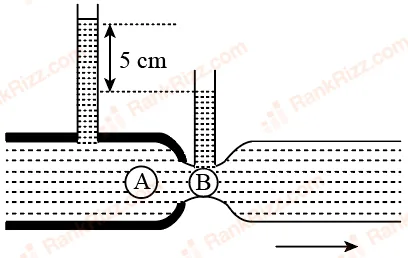
Water flows through a horizontal tube as shown in the figure. The difference in height between the water colunms in vertical tubes is 5 cm and the area of cross-sections at A and B are 6cm26cm^{2} and 3cm23cm^{2} respectively. The rate of flow will be ____ cm3/scm^{3/s}. (takeg=10m/s2)(take g=10m/s^{2})

Screenshot_5
  1. A

    2003200\sqrt{3}

  2. B

    1003100\sqrt{3}

  3. C

    2003\frac{200}{\sqrt{3}}

  4. D

    2006200\sqrt{6}

JEE MAIN 2026 · 02 APR S2Stokes' law and terminal velocityTRANSCRIBED

If an air bubble of diameter 2 mm rises steadily through a liquid of density 2000 kg/m3^3 at a rate of 0.5 cm/s, then the coefficient of viscosity of liquid is _________ Poise. (Take g=10g = 10 m/s2^2)

  1. A

    0.880.88

  2. B

    8.88.8

  3. C

    88.888.8

  4. D

    0.0880.088

JEE MAIN 2026 · 22 JAN S1Fluid pressure, Pascal's law and accelerated/rotating liquidsTRANSCRIBED

Given below are two statements:

Statement I : Pressure of a fluid is exerted only on a solid surface in contact as the fluid-pressure does not exist everywhere in a still fluid.
Statement II: Excess potential energy of the molecules on the surface of a liquid, when compared to interior, results in surface tension.

In the light of the above statements, choose the correct answer from the options given below

  1. A

    Both Statement I and Statement II are true

  2. B

    Statement I is true but Statement II is false

  3. C

    Both Statement I and Statement II are false

  4. D

    Statement I is false but Statement II is true

JEE MAIN 2026 · 02 APR S1Surface tension and surface energyTRANSCRIBED

A liquid drop of diameter 2 mm breaks into 512 droplets. The change in surface energy is α×10−6\alpha \times 10^{-6} J. The value of α\alpha is __________. (Take surface tension of liquid = 0.08 N/m)

  1. A

    1010

  2. B

    77

  3. C

    88

  4. D

    1111

JEE MAIN 2026 · 04 APR S1Surface tension and surface energyTRANSCRIBED

The surface tension of a soap solution is 3.5×10−23.5 \times 10^{-2} N/m. The work required to increase the radius of a soap bubble from 1 cm to 2 cm is α×10−6\alpha \times 10^{-6} J. The value of α\alpha is _____. (π=22/7)(\pi = 22/7)

JEE MAIN 2026 · 24 JAN S2Surface tension and surface energyTRANSCRIBED

A soap bubble of surface tension 0.04 N/m is blown to a diameter of 7 cm. If (15000 - x) μJ\mu J of work is done in blowing it further to make its diameterl4 cm, then the value of x is_____.
(π=22/7)\left(\pi=22/7\right)

JEE MAIN 2026 · 24 JAN S1Stokes' law and terminal velocityTRANSCRIBED

Sixty four rain drops of radius 1 mm each falling down w-ith a terminal velocity of 10 cm/s coalesce to fonn a bigger drop. The terminal velocity of bigger drop is_____cm/s

JEE MAIN 2026 · 21 JAN S2Stokes' law and terminal velocityTRANSCRIBED

The terminal velocity of a metallic ball of radius 6 mm in a viscous fluid is 20 cm/s. The terminal velocity of another ball of same material and having radius 3 mm in the same fluid will be ________ cm/ s.