JEE ADVANCED 2011 · PAPER 2HARDTRANSCRIBED
JEE Advanced 2011 Physics question — Angular momentum of particles and rigid bodies
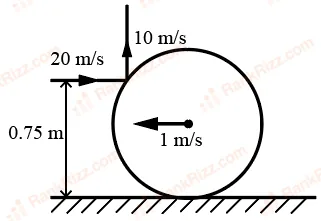
A thin ring of mass 2 kg and radius 0.5 m is rolling without slipping on a horizontal plane with velocity 1 m/s. A small ball of mass 0.1 kg, moving with velocity 20 m/s in the opposite direction, hits the ring at a height of 0.75 m and goes vertically up with velocity 10 m/s. Immediately after the collision
SOLUTION
Key idea: During the short collision, use the impulse–momentum theorem for the ring's linear momentum and the angular impulse about its centre. Ignore the small friction impulse.
- Ball's horizontal momentum: N s before, after (it moves vertically). So the ring receives a horizontal impulse N s in the ball's original direction (to the right).
- Ring's linear momentum: before, N s to the left. After, . The CM of the ring is at rest.
- Rotation: the ring rolls left at 1 m/s, so rad/s (anticlockwise). The impulse acts m above the centre, giving a clockwise angular impulse of N m s. With kg m²:
- So the ring spins about its stationary CM: (A) is correct and (B) is wrong.
- The lowest point moves with speed m/s to the right (anticlockwise spin, CM at rest). It slides right on the ground, so kinetic friction acts to the left. (C) is correct and (D) is wrong.
Answer: (A), (C)
Tagged Angular momentum of particles and rigid bodies. Machine-assigned, so read it as a strong shortlist rather than a verdict.