JEE ADVANCED 2012 · PAPER 2+3 / −1MEDIUMTRANSCRIBED
JEE Advanced 2012 Physics question — Rolling with friction, slipping and impulsive forces
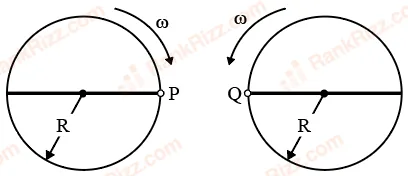
Two identical discs of same radius R are rotating about their axes in opposite directions with the same constant angular speed . The disc are in the same horizontal plane. At time t = 0 , the points P and Q are facing each other as shown in the figure. The relative speed between the two points P and Q is . as function of times best represented by
SOLUTION
Key idea: Write both velocity vectors as functions of time and subtract them.
- Take the left disc rotating clockwise with P starting at its rightmost point, and the right disc rotating anticlockwise with Q starting at its leftmost point.
- Velocities ():
- The vertical components cancel:
- is zero at , rises to a maximum, returns to zero at , and repeats. That gives two equal humps per period , starting from zero, which is graph (A).
Answer: (A)
Tagged Rolling with friction, slipping and impulsive forces. Machine-assigned, so read it as a strong shortlist rather than a verdict.