JEE Advanced 2012 Physics question — Rolling with friction, slipping and impulsive forces
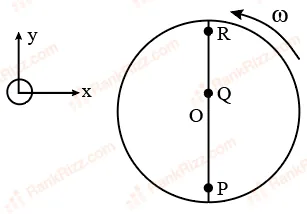
Consider a disc rotating in the horizontal plane with a constant angular speed about its centre O. The disc has a shaded region on one side of the diameter and an unshaded region on the other side as shown in the figure. When the disc is in the orientation as shown, two pebbles P and Q are simultaneously projected at an angle towards R. The velocity of projection is in the y-z plane and is same for both pebbles with respect to the disc. Assume that (i) they land back on the disc before the disc completed rotation. (ii) their range is less than half disc radius, and (iii) remains constant throughout . Then
SOLUTION
Take as origin with , as in the figure; the disc turns anticlockwise () and the unshaded half is . In the flight time the disc turns through , and a point is on the unshaded side of the turned diameter when its component along is positive. Each pebble has horizontal velocity along relative to the disc, and range .
Q is at just above and also carries the disc's velocity along , so it lands at :
since . So Q lands in the unshaded region.
P is at the rim, , and carries the disc's velocity along , so it lands at with component .
Landing on the disc needs , so (because ). Then and the component is positive, so P also lands in the unshaded region.
Hence, the correct option is (C).
Tagged Rolling with friction, slipping and impulsive forces. Machine-assigned, so read it as a strong shortlist rather than a verdict.