JEE ADVANCED 2012 · PAPER 1+3 / −1MEDIUMTRANSCRIBED
JEE Advanced 2012 Physics question — Angular momentum of particles and rigid bodies
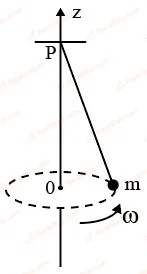
A small mass m is attached to a massless string whose other end is fixed at P as shown in the figure. The mass is undergoing circular motion in the x-y plane with centre at O and constant angular speed If the angular momentum of the system, calculated about O and P are denoted by and respectively, then
SOLUTION
Key idea: . It is constant only if both its magnitude and its direction stay the same.
- About O (centre of the circle): lies in the x-y plane and is perpendicular to . So , which is constant in magnitude and always along z.
- About P (above the plane): from P to the mass points down and outward along the string. is perpendicular to the string and tilted away from the z-axis, and this tilted vector turns around the z-axis as the mass revolves. Its magnitude is constant but its direction changes.
- So is constant and varies with time.
Answer: (C)
Tagged Angular momentum of particles and rigid bodies. Machine-assigned, so read it as a strong shortlist rather than a verdict.