JEE Advanced 2011 Physics question — Equilibrium of rigid bodies and toppling
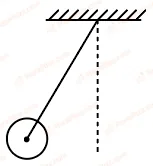
A metal rod of length 'L' and mass 'm' is pivoted at one end. A thin disk of mass 'M' and radius 'R' (< L) is attached at its centre to the free end of the rod. Consider two ways the disc is attached :(case A) The disc is not free to rotate about its center and (case B) the disc is free to rotate about its center. The rod-disc system performs SHM in vertical plane after being released from the same displaced position. Which of the following statement(s) is (are) true ?
SOLUTION
In both cases the restoring torque about the pivot comes from the weights of the rod and the disc acting at the same points, so for an angular displacement
is the same in both cases: (A) is true and (B) is false.
Case A: the disc is fixed to the rod, so it turns with the rod and its rotation about its own centre adds :
Case B: the disc is free to turn about its centre. Its weight and the force from the rod both act through its centre, so they exert no torque about the centre; released without spin, the disc keeps its orientation and only translates with the end of the rod:
For small oscillations . The numerator is the same and , so : (D) is true and (C) is false.
Hence, the correct options are (A) and (D).
Tagged Equilibrium of rigid bodies and toppling. Machine-assigned, so read it as a strong shortlist rather than a verdict.