JEE Advanced 2023 Physics question — Angle of contact and capillary rise
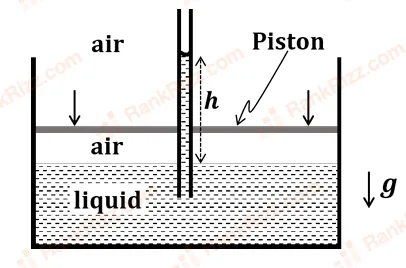
An incompressible liquid is kept in a container having a weightless piston with a hole. A capillary tube of inner radius 0.1 mm is dipped vertically into the liquid through the airtight piston hole, as shown in the figure. The air in the container is isothermally compressed from its original volume to with the movable piston. Considering air as an ideal gas, the height () of the liquid column in the capillary above the liquid level in cm is ____.
[Given: Surface tension of the liquid is 0.075 Nm, atmospheric pressure is N m, acceleration due to gravity (g) is 10 m s, density of the liquid is kg m and contact angle of capillary surface with the liquid is zero]
SOLUTION
Initially the air above the liquid is at atmospheric pressure and has volume . When the air isothermally compressed to , the ideal-gas relation gives
Hence the air pressure inside the container becomes
The top of the capillary tube is open to the atmosphere, so the air pressure above the meniscus is still . Let be the height of the liquid column that rises in the capillary, and the inner radius of the tube.
Across a concave meniscus (contact angle ), the Laplace pressure difference is .
Pressure just below the meniscus inside the liquid: (pressure is lower in the liquid for a concave surface)
Pressure at the base of the capillary (same level as the reservoir surface):
This pressure must equal the air pressure on the free surface inside the container, . Therefore,
Solving for :
Substituting the given data and we obtain
Converting to centimetres,
Hence, the height of the liquid column in the capillary is 25 cm.
Tagged Angle of contact and capillary rise. Machine-assigned, so read it as a strong shortlist rather than a verdict.