RankRizz

Mechanical Properties of Fluids — JEE Advanced Previous Year Questions

Every Mechanical Properties of Fluids question JEE Advanced has set from 2007–2026, grouped by the idea it tests rather than the order of the syllabus. 33 questions across 5 distinct ideas. Free to read, answer key on every one.

Questions

33

Distinct ideas

5

Share of marks

4.3%

Difficulty

MEDIUM

The ideas inside Mechanical Properties of Fluids

A chapter is not one subject — it is a handful of procedures the examiner reuses. These are the ones Mechanical Properties of Fluids questions actually test.

01Fluid pressure, Pascal's law and accelerated/rotating liquidsset 8×
02Archimedes' principle and floatationset 1×
03Equation of continuity and Bernoulli's theoremset 12×
04Speed of efflux and applications of Bernoulli's theoremNot set in Advanced
05Viscosity, Poiseuille's equation and Reynolds numberNot set in Advanced
06Stokes' law and terminal velocityNot set in Advanced
07Surface tension and surface energyset 10×
08Excess pressure in drops and bubblesNot set in Advanced
09Angle of contact and capillary riseset 2×

Every Mechanical Properties of Fluids question

21–33 OF 33 · NEWEST FIRST

JEE ADVANCED 2014 · PAPER 2Equation of continuity and Bernoulli's theoremTRANSCRIBED

If the density of air is ρa\rho_a and that of the liquid ρl\rho_l, then for a given piston speed the rate (volume per unit time) at which the liquid is sprayed will be proportional to

  1. A

    ρaρl\sqrt{\frac{\rho_a}{\rho_l}}

  2. B

    ρaρl\sqrt{{\rho_a}{\rho_l}}

  3. C

    ρlρa\sqrt{\frac{\rho_l}{\rho_a}}

  4. D

    ρl\rho_l

JEE ADVANCED 2014 · PAPER 2Fluid pressure, Pascal's law and accelerated/rotating liquidsTRANSCRIBED

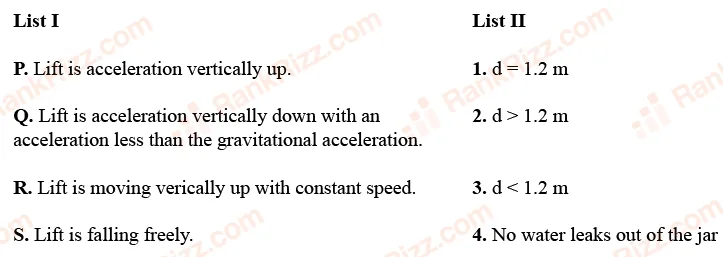
A person in a lift is holding a water jar, which has a small hole at the lower end of its side. When the lift is at rest, the water jet coming out of the hole hits the floor of the lift at a distance of 1.2 m from the person. In the following, state of the lift’s motion is given in List I and the distance where the water jet hits the floor of the lift is given in List II. Match the statements from List I with those in List II and select the correct answer using the code given below the list.

Figure for JEE Advanced 2014 Physics question on Fluid pressure, Pascal's law and accelerated/rotating liquids
  1. A

    P-2, Q-3, R-2, S-4

  2. B

    P-2, Q-3, R-1, S-4

  3. C

    P-1, Q-1, R-1, S-4

  4. D

    P-2, Q-3, R-1, S-1

JEE ADVANCED 2013 · PAPER 1Fluid pressure, Pascal's law and accelerated/rotating liquidsTRANSCRIBED

A solid sphere of radius R and density ρ\rho is attached to one end of a mass-less spring of force constant k. The other end of the spring is connected to another solid sphere of radius R and density 3ρ3 \rho. The complete arrangement is placed in a liquid of density 2ρ2 \rho and is allowed to reach equilibrium. The correct statement(s) is (are)

  1. A

    the net elongation of the spring is 4πR3ρg3k\frac{4 \pi R^3 \rho g}{3k}

  2. B

    the net elongation of the spring is 8πR3ρg3k\frac{8 \pi R^3 \rho g}{3k}

  3. C

    the light sphere is partially submerged.

  4. D

    the light sphere is completely submerged.

JEE ADVANCED 2012 · PAPER 2Fluid pressure, Pascal's law and accelerated/rotating liquidsTRANSCRIBED

A thin uniform cylindrical shell, closed at both ends, is partially filled with water. It is floating vertically in water in half-submerged state. If ρc\rho_c is the relative density of the material of the shell with respect to water, then the correct statement is that the shell is

  1. A

    more than half filled if ρc\rho_c is less than 0.5

  2. B

    more than half filled if ρc\rho_c is less than 1.0

  3. C

    half filled if ρc\rho_c is less than 0.5

  4. D

    less than half filled if ρc\rho_c is less than 0.5

JEE ADVANCED 2011 · PAPER 2Fluid pressure, Pascal's law and accelerated/rotating liquidsTRANSCRIBED

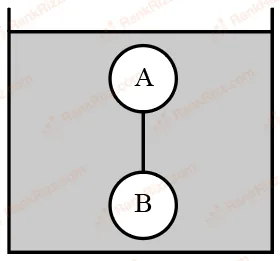
Two solid spheres A and B of equal volumes but of different densities dAd_A and dBd_B are connected by a string. They are fully immersed in a fluid of density dFd_F. They get arranged into an equilibrium state as shown in the figure with a tension in the string. The arrangement is possible only if

Figure for JEE Advanced 2011 Physics question on Fluid pressure, Pascal's law and accelerated/rotating liquids
  1. A

    dA<dFd_A < d_F

  2. B

    dB>dFd_B > d_F

  3. C

    dA>dFd_A > d_F

  4. D

    dA+dB=2dFd_A + d_B = 2 d_F

JEE ADVANCED 2010 · PAPER 2Surface tension and surface energyTRANSCRIBED

If r=5×10⁻⁴m,p=103kgm−3,g=10ms−2,T=0.11Nm−1r = 5 \times 10^{-4} m, p = 10^3 kgm^{-3}, g = 10 ms^{-2}, T = 0.11 Nm^{-1}, the radius of the drop when it detaches from the dropper is approximately

  1. A

    1.4×10−31.4 \times 10^{-3} m

  2. B

    3.3×10−33.3 \times 10^{-3} m

  3. C

    2.0×10−32.0 \times 10^{-3} m

  4. D

    4.1×10−34.1 \times 10^{-3} m

JEE ADVANCED 2009 · PAPER 2Equation of continuity and Bernoulli's theoremTRANSCRIBED

A cylindrical vessel of height 500 mm has an orifice (small hole) at its bottom. The orifice is initially closed and wateris filled in it up to height H. Now the top is completely sealed with a cap and theorifice at the bottom is opened. Some water comes out from the orifice and the water level in the vessel becomes steady with height of water column being 200 mm. Find the fall in height (in mm) of water level due to opening ofthe orifice.
[Take atmospheric pressure =1.0×10⁵N/m2= 1.0 \times 10^5 N/m^2, density of water =1000kg/m3= 1000 kg/m^3 and g=10m/s2g = 10 m/s^2. Neglect any affect of surface tension.]

JEE ADVANCED 2009 · PAPER 2Surface tension and surface energyTRANSCRIBED

Two soap bubbles A and B are kept in a closed chamber where the air is maintained at pressure 8 N/m2^2. The radii of bubbles A and B are 2 cm and 4 cm, respectively. Surface tension of the soap-water used to make bubbles is 0.04 N/m. Find the ratio nBnA\frac{n_B}{n_A}. Where nAn_A and nBn_B are the number of moles of air in bubbles A and B, respectively. [Neglect the effect of gravity.]

JEE ADVANCED 2008 · PAPER 2Surface tension and surface energyTRANSCRIBED

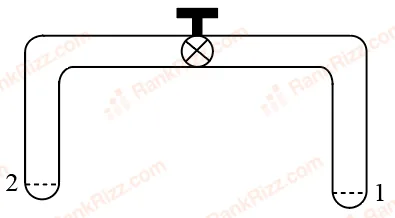
A glass tube of uniform internal radius (r) has a valve separating the two identical ends. Initially, the valve is in a tightly closed position. End 1 has a hemispherical soap bubble of radius r. End 2 has sub-hemispherical soap bubble as shown in figure. Just after opening the valve,

Figure for JEE Advanced 2008 Physics question on Surface tension and surface energy
  1. A

    air from end 1 flows towards end 2. No change in the volumeof the soap bubbles

  2. B

    air from end 1 flows towards end 2. Volumeof the soap bubble at end 1 decreases

  3. C

    no change occurs

  4. D

    air from end 2 flows towards end 1. Volume of the soap bubble at end 1 increases

JEE ADVANCED 2008 · PAPER 1Equation of continuity and Bernoulli's theoremTRANSCRIBED

STATEMENT-1
The stream of water flowing at high speed from a garden hose pipe tends to spread like a fountain when held vertically up, but tends to narrow down when held vertically down.
and
STATEMENT-2
In any steady flow of an incompressible fluid, the volume flow rate of the fluid remains constant.

  1. A

    STATEMENT-1 is True, STATEMENT-2 is True; STATEMENT-2 is a correct explanation for STATEMENT-1

  2. B

    STATEMENT-1 is True, STATEMENT-2 is True; STATEMENT-2 is NOT a correct explanation for STATEMENT-1

  3. C

    STATEMENT-1 is True, STATEMENT-2 is False

  4. D

    STATEMENT-1 is False, STATEMENT-2 is True

JEE ADVANCED 2008 · PAPER 1Surface tension and surface energyTRANSCRIBED

As the bubble moves upwards, besides the buoyancy force the following forces are acting on it

  1. A

    Only the force of gravity

  2. B

    The force due to gravity and the force due to the pressure of the liquid

  3. C

    The force due to gravity, the force due to the pressure of the liquid and the force due to viscosity of the liquid

  4. D

    The force due to gravity and the force due to viscosity of the liquid

JEE ADVANCED 2008 · PAPER 1Equation of continuity and Bernoulli's theoremTRANSCRIBED

The buoyancy force acting on the gas bubble is (Assume R is the universal gas constant)

  1. A

    ρlnRgT0(P0+ρlgH)25(P0+ρlgy)75\rho_lnRgT_0\frac{(P_0 + \rho_lgH)^{\frac{2}{5}}}{(P_0 + \rho_lgy)^{\frac{7}{5}}}

  2. B

    ρlnRgT0(P0+ρlgH)25[P0+ρlg(H−y)]35\frac{\rho_lnRgT_0}{(P_0 + \rho_lgH)^{\frac{2}{5}}[P_0 + \rho_lg(H - y)]^{\frac{3}{5}}}

  3. C

    ρlnRgT0(P0+ρlgH)35(P0+ρlgy)85\rho_lnRgT_0\frac{(P_0 + \rho_lgH)^{\frac{3}{5}}}{(P_0 + \rho_lgy)^{\frac{8}{5}}}

  4. D

    ρlnRgT0(P0+ρlgH)35[P0+ρlg(H−y)]25\frac{\rho_lnRgT_0}{(P_0 + \rho_lgH)^{\frac{3}{5}}[P_0 + \rho_lg(H - y)]^{\frac{2}{5}}}

JEE ADVANCED 2007 · PAPER 2Surface tension and surface energyTRANSCRIBED

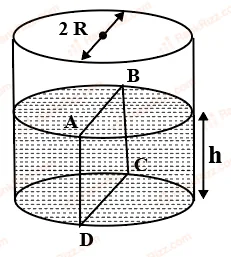
Water is filled up to a height h in a beaker of radius R as shown in the figure. The density of water is ρ\rho, the surface tension of water is T and the atmospheric pressure is P0P_0. Consider a vertical section ABCD of the water column through a diameter of the beaker. The force on water on one side of this section by water on the other side of this section has magnitude.

Figure for JEE Advanced 2007 Physics question on Surface tension and surface energy
  1. A

    ∣2P0Rh+πR2ρgh−2RT∣\mid 2P_0Rh + \pi R^2 \rho gh - 2RT \mid

  2. B

    ∣2P0Rh+Rρgh2−2RT∣\mid 2P_0Rh + R \rho gh^2 - 2RT \mid

  3. C

    ∣P0πR2+Rρgh2−2RT∣\mid P_0 \pi R^2 + R \rho gh^2 - 2RT \mid

  4. D

    ∣P0πR2+Rρgh2+2RT∣\mid P_0 \pi R^2 + R \rho gh^2 + 2RT \mid